Finding the right CNC milling machine hinges on rigidity, precision, and scalable capabilities for metal, wood, and composite materials. The following five machines are among the most capable options currently available on the market, spanning compact desktop models to larger, all-metal builds designed for industrial use. Each entry highlights core features, applications, and the practical benefits they offer for workshop workflows and production tasks.
The table below provides a quick reference to the chosen products, including their key attributes and typical strengths.
| Product | Brand | Key Strengths | Applications |
|---|---|---|---|
| AnoleX CNC Router Machine 4030-Evo Ultra 2 | AnoleX | All-metal XYZ, dual steel linear rails, 800W router | Metal, aluminum, wood, PCB prototyping |
| WolfPawn 4040 PRO CNC Router Machine | WolfPawn | All-metal frame, 500W spindle, stable linear guides | Wood, acrylic, lightweight metal work |
| ACMER Ascarva 4S CNC Milling Machine | ACMER | Spindle upgrade path, fast carving speeds | Wood, plastic, epoxy, signage |
| Carvera Air Desktop CNC Machine | MAKERA CARVERA | Compact enclosed design, quick tool changer | Arts, crafts, intricate small parts |
| SainSmart Genmitsu PROVerXL 4×4 CNC Machine | SainSmart | Large work area, dual Z-axis, closed-loop | Wood, metal, batch production |
AnoleX CNC Router Machine 4030-Evo Ultra 2

The AnoleX 4030-Evo Ultra 2 features an all-metal XYZ axis with dual HGH-15 steel linear rails and 1204 ball screws. This setup increases rigidity, improves cutting accuracy, and expands load capacity for metals, aluminum, brass, and wood. An upgraded Φ65mm trim router with 800W power enables robust material removal, while a 6-speed range (8000–24000 RPM) provides tuning for different materials. The GRBL_ESP32-based control board supports advanced functions like a 4th axis (rotary), coolant control, and closed-loop motors, with laser engraving options and a 3-pin touch probe for precise workholding. This machine aims at serious hobbyists and small shops that require metal-capable performance in a compact footprint.
WolfPawn 4040 PRO CNC Router Machine

The WolfPawn 4040 PRO is built on a sturdy all-metal frame with a 400 x 400 x 75 mm work area, designed for stable operation across woodworking and light metal tasks. It uses a 500W spindle with X and Y axes driven by 2GT belts and V-wheels, plus robust Z-axis guidance via TR8-2T screws. Advanced motion stability comes from the linear guideways and pre-assembled components, making setup efficient. Compatibility with GRBL 1.1F and software like UGS, Candle, and Fusion 360 broadens its software ecosystem, appealing to hobbyists and semi-professional shops seeking quick deployment and reliable results.
ACMER Ascarva 4S CNC Milling Machine

The ACMER Ascarva 4S offers a 70W spindle with potential for future upgrades to higher power spindles (up to 500W), providing a path from entry-level to more demanding carving. It delivers high-speed performance with a fast maximum carving speed and flexible acceleration. The machine emphasizes upgraded X- and Y-axis durability through reinforced steel wheels, dust protection on the Z-axis, and a solid construction designed for extended operation. It supports 5W/10W laser modules, enabling combined milling and laser engraving for versatile DIY and prototype workflows.
Carvera Air Desktop CNC Machine
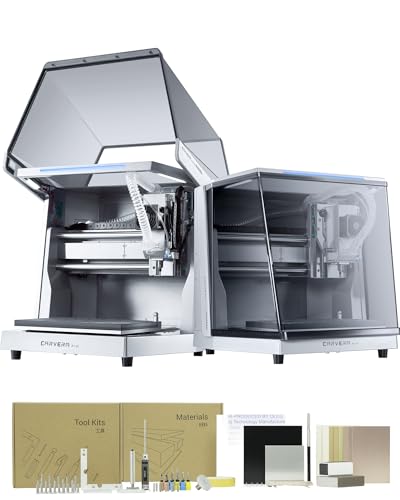
The Carvera Air from MAKERA CARVERA emphasizes safety and compact design with a fully enclosed chassis. It supports a quick tool changer and an optional 4th axis and laser, suitable for precision carving and engraving on small parts. The closed-loop stepper system enhances accuracy, while the enclosure helps maintain a clean work area and reduce noise. Its 11.8″ x 7.9″ x 5.1″ work area suits intricate detail work in arts, crafts, and design prototyping, making it a strong choice for makers seeking desktop-level capability with safety features.
SainSmart Genmitsu PROVerXL 4×4 CNC Machine

The Genmitsu PROVerXL 4×4 delivers a generous 1300 mm x 1300 mm work area, an open-front design suitable for large sheets, and industrial-grade Φ20 mm ball screws with dual X-axis linear rails plus Y-axis ball screws. Four NEMA 23 closed-loop stepper motors provide precise feedback to prevent lost steps at high speeds, with a maximum feed rate approaching 5000 mm/min. The machine is designed for large-scale wood, metal, and composite projects, making it a strong option for small production runs or batch fabrication in a workshop setting.
Buying Guide: key purchase considerations
- Work area and footprint: Match the machine’s physical size with your workspace and project scale. Larger work areas enable batch processing and sheet material handling, but require more room and power.
- Frame rigidity: All-metal builds with robust linear rails and high-precision ball screws provide better cutting accuracy and longer tool life, especially for metals and dense materials.
- Spindle power and range: Higher-wattage spindles enable faster material removal in metals and denser plastics. Assess whether upgrade paths (e.g., from 70W to 500W) align with long-term needs.
- Control electronics and firmware: Open-source ecosystems (GRBL, UGS, Fusion 360 compatibility) offer flexibility, software updates, and community support. Closed-loop motors reduce missed steps at speed.
- Dust and chip management: Dust protection for rails and chassis helps sustain precision, reduce wear, and improve safety in long jobs.
- Software compatibility: Check if the machine ships with compatible CAM software or requires third-party tools. Ensure it supports the file formats you routinely use.
- Safety features: Enclosures, emergency stops, and auto-probing features can improve safety and precision, especially in a shared or educational environment.
- Upgrade paths: Consider future enhancements such as an additional axis, laser modules, or multi-tool changers to extend functionality without a full replacement.
- Budget and maintenance: Balance upfront cost with expected maintenance, including spindle replacements, belt tensioning, and alignment checks.
Across these options, users should align machine capabilities with project requirements—whether tackling metal fabrication, large-scale woodworking, or detailed prototyping. Industrial-grade builds provide stability and repeatable results, while compact desktop models prioritize versatility and ease of use for smaller studios or hobbyists.
Add a Comment