Answering the buyer’s search for robust, industrial-grade cable stripping solutions, these machines offer heavy-duty construction, high stripping speeds, and broad wire compatibility. They’re best suited for professional recyclers, scrap yards, and workshop technicians who need reliable, continuous operation. Below is a concise buyer’s guide to five top options, each with clear benefits and practical trade-offs.
| Product | Key Benefit | Ideal For |
|---|---|---|
| VEVOR Wire Stripping Machine (0.06-1.5 in) | Wide size range; high-speed motorized stripping | Medium to large-scale recycling shops |
| VEVOR Electric Wire Stripping Machine (0.06″-1.5″) | Automatic stripping with transparent guard | Lightweight, portable operations needing speed |
| CREWORKS 11 Channel (0.06-1.6 in) | Multiple feed channels for many wires at once | Busy workshops handling diverse copper sizes |
| CREWORKS 8 Channel (0.06-0.67 in) | Compact with versatile adjustment and all-copper motor | Small to mid-sized jobs, tight spaces |
| STRIPMEISTER E1000 | Industrial-grade power with precise cuts | Professional recyclers and electricians needing force |
VEVOR Wire Stripping Machine 0.06-1.5 Inch

This heavy-duty, aluminum-alloy machine is built for rugged environments. It uses high-hardness blades to maintain stability under continuous use. Best for salvage yards and service shops that require durable, long-lasting performance.
- Best for: Professional recyclers who process mixed wire batches.
- Why selected: Broad compatibility with diameters from 0.06 to 1.5 inches and solid, reusable construction.
- Caution: Metal debris and frequent use may require blade maintenance to sustain speed.
VEVOR Electric Wire Stripping Machine, 370W

Automatic stripping with a 370W motor drives 0.06-1.5 inch wires at up to 75 feet per minute. The transparent acrylic plate offers visibility, and the lightweight aluminum base supports easy transport and setup.
- Best for: Shops needing fast, automated stripping with easy monitoring.
- Why selected: Automatic operation reduces labor and increases throughput.
- Caution: The machine is powered by an induction motor; ensure a stable electrical supply for peak performance.
CREWORKS 11 Channel Automatic Wire Stripper

This CREWORKS model covers wires from 0.06 to 1.6 inches with 11 feed channels and a 550W motor. It’s suitable for workshop environments that need simultaneous stripping of multiple wires and clean, precise cuts through adjustable rollers.
- Best for: High-throughput environments handling a variety of copper wires.
- Why selected: The 11 channels streamline operations and reduce manual repositioning.
- Caution: Wider channels mean larger space requirements; ensure adequate bench area.
CREWORKS Automatic Wire Stripper Machine (8 Channel)
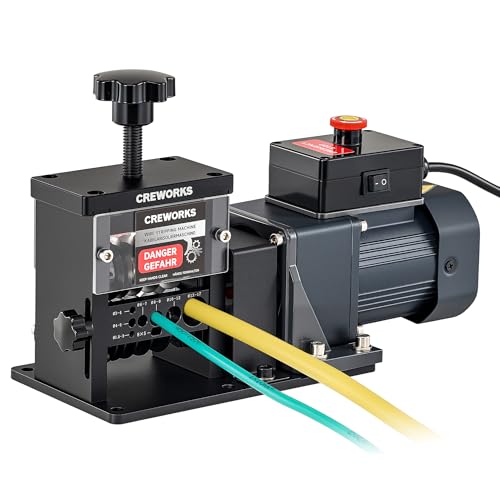
An 8-channel system with a 40W all-copper motor and five blades. It supports 0.06 to 0.67 inch wires and offers horizontal and vertical adjustments for precise cuts. It’s well-suited for busy workshops that need reliable, space-efficient equipment.
- Best for: Smaller spaces requiring versatile, adjustable stripping.
- Why selected: All-copper motor emphasizes efficiency and durability for regular use.
- Caution: Lower maximum gauge limit means you may need larger units for very thick cables.
Automatic Wire Stripping Machine – StripMeister E1000

Industrial-grade with over 50 lbs of stripping force, the StripMeister E1000 targets copper and aluminum cables up to 1-3/4 inches. It features a hardened CNC blade, dual wire guides, and an ultra-grip feeder for consistent results, even on kinked wires.
- Best for: Professional recyclers needing top-tier stripping power.
- Why selected: High stripping force and precision engineering support demanding jobs.
- Caution: Higher overall size and weight may reduce portability compared with lighter models.
Buying Guide
What should you look for in an industrial wire stripper?
- Wire size range: Ensure the machine covers the gauges you encounter most often (e.g., 0.06–1.5 inches or similar).
- Motor power and speed: Higher wattage and faster stripping speeds boost throughput but may add cost and noise.
- Channel count: More channels allow stripping multiple wires in parallel; balance with space and budget.
- Construction materials: Aluminum alloy frames provide durability and lightness; steel components offer long-term rigidity.
- Adjustability: Vertical and horizontal adjustments help achieve clean cuts on varied insulation and wire types.
- Portability vs. footprint: Weigh the need for mobility against workplace space and storage.
- Safety features: Guarding, emergency stops, and CSA/TUV/CE-style certifications improve operator protection.
Which machine matches which buyer?
- Best for ongoing, high-volume scrapyards: StripMeister E2000x or E1000 deliver more force and range.
- Better for mixed, frequent-use workshops: CREWORKS 11 Channel or 8 Channel models offer multiple feed options.
- Choose this if you need clear visibility and fast automation: VEVOR electric machines with transparent guards.
- Avoid this if you lack space for larger industrial units: Some models require substantial bench or floor space.
Maintenance and setup tips
- Regularly inspect blades and rollers for wear; replace as needed to preserve cutting quality.
- Keep the drive system clean from metal shavings and debris to prevent jams.
- Calibrate feeder guides when handling significantly different wire sizes.
FAQ
- What wire sizes do these machines handle? Most models support approximately 0.06 to 1.5 inches, with some models extending up to 1.6 or 3-1/4 inches.
- Are these machines suitable for aluminum wires? Yes, several models strip both copper and aluminum; check the model’s specifications for your needs.
- Do these units come with safety covers? Some models include guards or acrylic observation panels; verify product details.
- Can I remove the blades for maintenance? Many units feature replaceable blades designed for quick swap-outs.
- What is the advantage of multiple channels? They enable stripping multiple wires in parallel, improving throughput on busy jobs.
- Is professional certification important? For many industrial settings, CSA, TUV, or CE compliance supports safety expectations.
Add a Comment