Choosing the right bag filter housing is essential for efficient solid-liquid separation in industrial settings. This article highlights five robust options, covering stainless steel and reinforced polypropylene designs, pressure ratings up to 150 psi, and a range of bag sizes. Each product is evaluated for build quality, filtration area, real-time pressure monitoring, ease of bag changes, and overall operational cost. Use the buying guide below to compare features and match a housing to your process needs.
Summary of Selected Products
| Product | Material | Bag Size (approx.) | Max Pressure | Notable Feature |
|---|---|---|---|---|
| PreAsion #4 Bag Filter Housing | 304 Stainless Steel | 1″ Fnpt In/Out | 120 psi | Real-time pressure gauge, reusable filter bag |
| 2″ NPT Stainless Steel Bag Filter w/Mesh | Stainless Steel | 180×810 mm bag | 150 psi | Heavy-duty, quick opening |
| Pentair Pentek PBH Big Blue #20 | Polypropylene | 20-Inch Bag | 150 psi | Low-flow efficiency, corrosion resistant |
| PreAsion #3 Bag Filter Housing | 304 Stainless Steel | 1″ Fnpt In/Out | 120 psi | 0.6 sq ft area, pressure monitoring |
| Pazcii 2″ NPT Bag Filter Housing | 304 Stainless Steel | 7.1×31.9 inch bag | 150 psi | High filtration area, turbulence-aware flow |
PreAsion #4 Bag Filter Housing

The PreAsion #4 bag filter housing uses 304 stainless steel to form a rugged solid-liquid separation tool. It supports liquid flow from the filter bag to the outside, trapping particulates inside the bag for purification, separation, and recovery across industries such as water treatment, printing ink, and beverage manufacturing. A built-in pressure gauge enables real-time monitoring, ensuring timely pressure relief to protect the system. The design emphasizes low pressure loss and quick filter bag changes for energy efficiency and reduced operating costs.
2″ NPT Stainless Steel Bag Filter w/Mesh
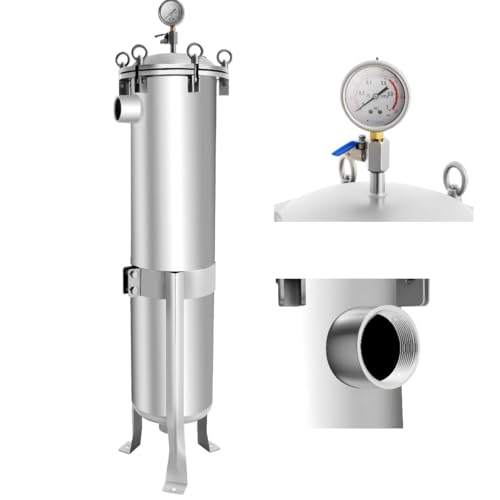
This heavy-duty housing features a stainless steel bag filter with a 2″ NPT connection. Key specs include a large filtration area of 0.46 m², a compact, protected design with a quick-opening mechanism, and reinforced mesh for the filter bag. The unit’s robust construction and sealing reduce leakage and support stable, high-flow operation. It is designed for multi-purpose filtration, capable of handling challenging liquids in industrial settings while maintaining manageable operating costs.
Pentair Pentek PBH Big Blue Bag Filter Housing
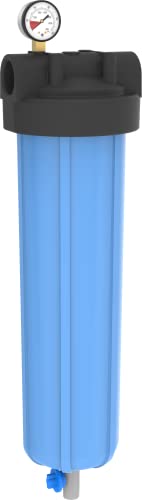
Pentair’s PBH Big Blue housing is molded from reinforced polypropylene offering strong chemical compatibility for low-flow applications. The lightweight yet durable design reduces system weight while maintaining resistance to chemical attack. Features include compatibility with standard big-blue 20-inch bags, a simple sealing system, and a design intended to minimize bag change time, helping keep process downtime short and predictable.
PreAsion #3 Bag Filter Housing

The #3 model from PreAsion provides 304 stainless steel construction with a 0.6 square foot filtration area and includes a 20 µm #3 filter bag and EDPM O-rings. It features a pressure gauge for real-time monitoring, enabling operators to manage process pressure and protect the filtration system. The compact design is suited for remediation and industrial filtration tasks that require reliable, durable filtration media and fast maintenance.
Pazcii 2″ NPT Bag Filter Housing

Pazcii’s 2″ NPT bag filter housing is built with 304 stainless steel and a high-capacity filter bag (7.1 by 31.9 inches, around 4.95 ft² area). The design emphasizes smooth side inlet flow to minimize turbulence and maximize filtration efficiency. It uses a reinforcement mesh basket to hold the filter bag in place, delivering effective filtration, purification, and recovery across liquid streams in various industries while maintaining resistance to corrosion and wear.
2″ NPT Bag Filter Housing, TBVECHI

This TBVECHI unit offers a 2″ NPT inlet/outlet with a 304 stainless steel body and a 150 psi maximum rating. It highlights movable foot design for adjustable height and easy cleaning due to sandblasted, polished surfaces. The design reduces side leakage risk and supports quick bag changes to lower operation costs, making it suitable for high-demand filtration workflows where reliability and ease of maintenance matter.
Buying Guide: Key Purchase Considerations
- Material and corrosion resistance: Stainless steel housings excel in aggressive environments, while reinforced polypropylene is lighter and chemical-compatible for certain fluids.
- Maximum operating pressure and flow rate: Match the system’s pressure and desired throughput to avoid bottlenecks or failures.
- Filtration area and bag size: Larger surface areas enable longer run times between changes and reduce downtime, especially for high-solid-content liquids.
- Real-time monitoring features: Pressure gauges help prevent over-pressurization and enable proactive maintenance.
- Ease of bag change and maintenance: Quick-opening mechanisms and accessible seals reduce maintenance time and labor costs.
- Seal integrity and O-rings: EDPM or compatible elastomers ensure long-lasting seals in varied chemical conditions.
- Footprint and installation: Consider height, base stability, and mounting options to fit existing equipment racks or piping layouts.
- Compatibility with filter bags: Some housings ship with standard bag sizes (e.g., 20 µm, 0.6 sq ft area); ensure your chosen bag type is readily available.
- Maintenance economics: Reusable bag options and energy-saving designs help reduce life-cycle costs.
- Service and support: Availability of replacement parts, customer support, and warranty terms can influence long-term reliability.
In selecting a bag filter housing, balance material durability, pressure handling, filtration area, and maintenance needs with your specific process liquids. For regulated environments or heavy-duty filtration, stainless steel housings with real-time gauges offer robust performance. For lighter, chemical-tolerant applications, reinforced polypropylene may suffice and reduce weight and cost. Evaluate your bag size requirements, anticipated throughputs, and ease of service to choose a housing that minimizes downtime while maximizing filtration efficiency.
Add a Comment