Looking for an industrial automatic tape dispenser that can speed up packaging, reduce waste, and improve consistency? This guide highlights five well-suited options for different workflows, from light-duty office packaging to heavy-duty industrial use. Each product is explained with who it’s best for, why it stands out, and practical limits to consider. The top picks cover dual-tape capability, programmable lengths, and robust build quality to support ongoing packaging needs in warehouses, shipping departments, and production lines.
Buyer-friendly summary table
| Product | Best For | ||
|---|---|---|---|
| NSA Zcut-9 Automatic Tape Dispenser Upgraded | Small to medium packaging batches | Twin-roll capability with digital shot counter | Up to 39 inch length, compact design |
| BriSunshine Automatic Tape Cutting Machine | General packaging tasks, versatile widths | Infrared sensor, automatic/manual modes | Requires setup for long runs |
| BEMPUS Ribbon Cutting Machine | Retail shipping and light manufacturing | Two-tape design, quick cut, portable | Limited to 6–60 mm width tapes |
| ZCUT-9GR Automatic Tape Dispenser | Two-roll operations, programmable lengths | Six programmed lengths, dual sensing | Preset lengths depend on programming |
| START International ZCM1000 | Mid to high production environments | Heavy-duty steel frame, wide tape width range | Higher price point, larger footprint |
NSA Zcut-9 Automatic Tape Dispenser Upgraded

The NSA Zcut-9 is designed for compact spaces while delivering consistent strip lengths. It fits up to two rolls at once and uses a digital counter to preset the number of shoots, helping standardize packaging cycles. This model suits small to mid-volume users who need reliable automation without a large footprint. The dual-roll capability supports quick material changes without manual unwinding, which is beneficial for busy shippers who handle multiple tape widths or brands.
Best for: Teams seeking a compact, two-roll dispenser for routine wrapping tasks or small e-commerce packing stations. Why: It offers digital presets and dual-roll support, reducing manual intervention and increasing throughput.
Caution: If you require very long single cuts beyond its typical cycle, ensure the machine’s preset range aligns with your standard package sizes to avoid frequent reprogramming.
Electric Tape Cutting Machine – BriSunshine

The BriSunshine unit is a versatile automatic tape cutter with an infrared sensor and fuse-protected safety features. It offers automatic and manual modes, making it suitable for both individual packaging tasks and higher-volume needs. The adjustable cutting length ranges from 20 to 999 mm and supports tapes between 8 and 50 mm wide, allowing users to adapt to a broad range of packaging materials. This is a strong pick for shops that juggle multiple tape types or frequently switch between small and mid-size bundles.
Best for: Packaging operators who need a flexible, user-friendly automatic cutter with a clear safety setup and a wide length range. Why: The dual-mode operation and programmable length simplify daily workflow and reduce setup time between jobs.
Caution: In high-output environments, verify that the power supply and motor duty cycle suit your daily run length to minimize downtime for maintenance.
BEMPUS Ribbon Cutting Machine

The BEMPUS model focuses on lightweight portability combined with fast cutting. It supports two tapes at once and is optimized for quick, clean cuts through automatic sensing and manual control modes. Its dual-tape capability makes it ideal for facilities handling two different tape types or widths in parallel. The unit is best for shipping departments in schools, offices, or small manufacturing settings where mobility matters as much as speed.
Best for: Small to mid-sized operations needing compact dual-tape handling and fast cut cycles. Why: It blends portability with automatic and manual control modes to accommodate varying tasks.
Caution: While portable, plan for adequate counter space and consider a model with a larger max tape width if your packing materials frequently exceed 60 mm.
ZCUT-9GR Automatic Tape Dispenser

The ZCUT-9GR offers dual-roll processing with a programmable six-length memory and a looping counter. The device enables precise, repeatable cuts for order consistency, making it a strong choice for operations that require standardized wrap lengths across batches. The dual photo sensor helps ensure accurate cuts even as tape positions shift between rolls, which is beneficial for environments with frequent roll changes.
Best for: Medium-to-high volume packaging lines needing multiple preset lengths and reliable repeatability. Why: Six programmable lengths plus dual-roll capacity support diverse packaging formats while maintaining accuracy.
Caution: Programming errors can lead to unexpected cut lengths; take care to verify each stored length before running a production shift.
START International ZCM1000 Electric Tape Dispenser
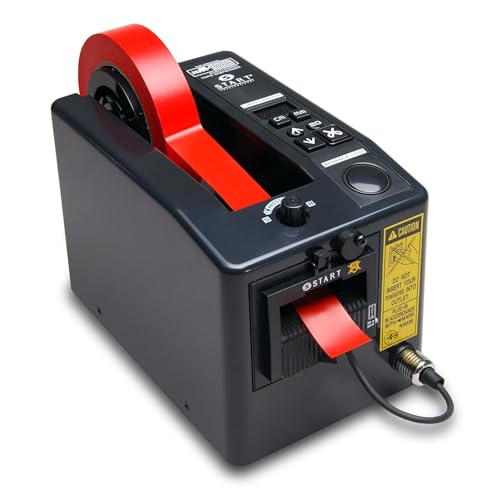
The START International ZCM1000 is a robust machine designed for medium to high production needs, with adjustable feed rollers and a durable steel frame. It supports a wide range of tape widths from 0.28″ to 2″ and cut lengths from 0.79″ to 39″ (20 mm to 999 mm). The device is well-suited for repeated, consistent taping in industrial settings and can tolerate heavier usage typical of fulfillment centers and manufacturing lines.
Best for: Industrial environments requiring long-term durability and broad tape compatibility. Why: A steel frame and wide range of cut lengths enable heavy-duty, repetitive packaging tasks with consistent results.
Caution: Higher up-front investment may be a consideration; ensure floor space and service access align with facility layout to maximize utilization.
Buying Guide
What to consider when choosing an industrial auto tape dispenser
- Production pace and volume: Match the machine’s speed and duty cycle to your daily packing volume to avoid bottlenecks.
- Tape width and types: Confirm compatible tape widths and materials (gummed, masking, packaging, etc.) for your typical shipments.
- Cut length range and presets: Ensure the device can handle the standard package sizes you use, and whether you need programmable memory for repeat orders.
- Number of rolls: Dual-roll dispensers minimize downtime during roll changes; consider whether you often handle multiple tape types.
- Footprint and mobility: Larger industrial models offer durability but require floor space; portable options help in multi-station workflows.
- Safety and maintenance: Look for safety interlocks, fuse protections, and easy blade access for maintenance and blade life longevity.
- Control interface: Digital counters, memory presets, and user-friendly controls reduce operator training time and errors.
How to compare options quickly
- Best for dual-tape environments: Look for dual-roll capability and quick-change mechanisms.
- Best for standards and repeatability: Choose machines with multiple preset lengths and looping counters.
- Best for versatility: Prioritize models with automatic and manual modes and a wide cutting-length range.
FAQ
- What is the typical tape width range for these machines?
Most options support a broad range, commonly from about 6 mm to 60 mm, with some models handling narrower or wider tapes. - Can these dispensers handle gummed and film tapes?
Many models are designed to work with packaging tapes and similar materials; verify specific compatibility for your tape stock. - Are programmable lengths essential for shipping operations?
They help standardize package sizes and reduce misfeeds, especially on high-volume lines. - Is dual-roll operation worth it for small warehouses?
Yes, if you frequently switch between two tape types or widths; it minimizes downtime for roll changes. - What maintenance should be expected?
Regular blade inspection, sensor alignment checks, and occasional motor or belt servicing help maintain accuracy.
Add a Comment