Hydrogen sulfide (H2S) detectors are essential for workplaces, labs, and homes where gas leaks could pose serious risk. This article highlights five reliable options catering to industrial safety, portable monitoring, and quick-response needs. Each product is chosen for clear alarms, straightforward use, and practical sensor performance. Read on to discover who each detector is best for and why.
Summary table of selected products
| Product | Best For | Key Strength |
|---|---|---|
| ZYKYCX Hydrogen Gas Detector | Industrial labs and hydrogen work areas | Fast 0.5s response, 0-1000 ppm range, triple alarms |
| TopTes Guard-101 | Work sites needing multi-gas awareness | 4 gases, long battery, rugged construction |
| TopTes Guard-863Pro | Heavy-use environments with data needs | 5-year O2 sensor, TFT display, USB export |
| Forensics USA NIST 4-Gas Monitor | Calibrated field monitoring | NIST calibration, USB data, multiple alarms |
| Forensics Hydrogen Gas Analyzer | Laboratories and compliance settings | NIST traceable, fast detection, color display |
ZYKYCX Hydrogen Gas Detector 0-1000 PPM

The ZYKYCX detector uses an electrochemical sensor to monitor hydrogen gas from 0 to 1000 ppm with 0.1 ppm resolution. It provides real-time readings alongside temperature and humidity data. A 0.5-second response time helps teams detect leaks quickly. This model supports three alert modes—visual, audible, and vibration—with customizable thresholds. It is well suited for hydrogen fuel cell rooms, laboratories, and industrial safety workflows where rapid notification is critical.
Best for: environments needing rapid, precise H2 detection and environmental monitoring in one handheld unit. Use this if you require fast alerts in noisy areas and want temperature/humidity context to support risk assessment.
Caution: Only rely on the configured thresholds; confirm that the device is properly calibrated for your specific gas concentration range.
TopTes Guard-101 Gas Detector
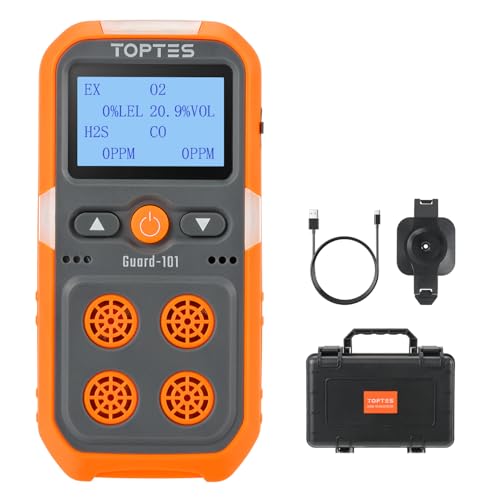
The Guard-101 is designed for rapid detection of four gases (H2S, CO, LEL, and O2) with a battery life up to 14 hours. Built for rugged work sites, its waterproof and explosion-proof construction includes a back clip for easy carrying. It offers LED, vibration, and sound alarms, with a data storage feature for reviewing monitoring records. Initial password protection helps prevent unauthorized changes. This model is best for industrial settings requiring multi-gas awareness and durable portability.
Best for: job sites needing multi-gas coverage in a single handheld device with simple carry and robust alarms. Choose this if you want long battery life and easy data access.
Caution: Password protection is a security feature; ensure staff memorize or securely store the default access if you rely on it for operation control.
TopTes Guard-863Pro 4 Gas Monitor

The Guard-863Pro covers H2S, CO, LEL, and O2 with a fast 0.5-second response and a vivid TFT color display. It includes an upgraded O2 sensor with a claimed five-year lifespan and USB data export for alarm records, fault logs, and operation history. The triple alarm system—sound, light, and vibration—ensures alerts persist until gas levels return to safe limits. It is ideal for demanding work environments where long-term data visibility and reliability matter.
Best for: professionals who need detailed data visualization and long-lasting oxygen sensing in tough environments. Choose this if you require easy data export for compliance and trend analysis.
Caution: Data export features depend on compatible software; verify your data workflow before purchasing.
Hydrogen Gas Analyzer by Forensics

This analyzer provides 0-1000 ppm measurement with 1 ppm resolution and includes a built-in pump for fast sampling. It carries USA NIST traceable calibration and a color display for easy data logging and interpretation. Alarms include adjustable audio, visual, and vibration alerts. It suits laboratory safety checks and precision monitoring tasks where traceability and rapid response are essential.
Best for: users who need NIST-traceable calibration and a pumped sampling system for high-accuracy H2 detection. Choose this for compliance-focused environments requiring traceable results.
Caution: Factory calibration claims may require periodic recalibration to maintain accuracy in field conditions.
Buying Guide: Key Purchase Considerations
- Gas range and resolution: Match detector range (0-1000 ppm) and resolution (0.1–1 ppm) to expected leak severity.
- Response time: A faster response (0.5 seconds or better) helps catch leaks early in critical spaces.
- Alarm types: Look for multi-modal alerts (visual, audible, vibration) and customizable thresholds for noisy environments.
- Sensor type and durability: Electrochemical sensors offer specificity; rugged housings and IP ratings suit harsh sites.
- Multi-gas capability: If you monitor several gases, a 4-gas or 4-channel detector can simplify safety management.
- Data logging and export: USB or software export supports traceability and compliance reporting.
- Calibration and maintenance: Confirm calibration intervals, whether factory calibration is included, and ease of field recalibration.
FAQ
- What is the typical use case for a 0-1000 ppm hydrogen detector?
– It is suitable for spaces where hydrogen leaks are possible, such as fuel cell rooms, labs, and industrial plants. - Why choose a 4-gas detector over a single-gas model?
– It provides simultaneous monitoring of multiple hazards (H2S, CO, LEL, O2), saving time and reducing equipment. - What does NIST calibration mean for a detector?
– It indicates traceable calibration to the U.S. National Institute of Standards and Technology, supporting measurement accuracy and compliance. - How important is data export?
– Data export helps track gas exposure over time, supports audits, and enables easy reporting and analysis. - Are pumped detectors better than diffusion-only models?
– Pumps can accelerate sample delivery in thin air or distant sampling points, improving response times in some layouts.
Add a Comment