Answer: For reliable lifting and rigging, choose slings and trolleys that suit your load, distance, and environment. This guide highlights five top options, from heavy‑duty wire rope slings to flat‑eye lifting straps and manual trolleys, each chosen for specific use cases. Best for contractors needing versatile slings, fleet operators seeking durable straps, and workshop teams requiring compact, portable equipment.
Summary of selected products:
| Product | Best For | Working Load | Length / Size |
|---|---|---|---|
| Four Leg Bridle Wire Rope Sling (HSI) 3′ Long | Heavy lifts, towing, general rigging | 5 Tons | 3′ length, 3/8″ diameter |
| Sumpluct 4″ x 12′ 2-Ply Lifting Strap | Vertical lifts, offshore, flatbed setups | 11,200 lbs vertical | 4″ x 12′ |
| Sumpluct 4″ x 8′ 2-Ply Lifting Strap | Compact lifts, storage in toolbox | 11,200 lbs vertical | 4″ x 8′ |
| Kodiak Straps 2-Ply Lifting Straps, 2″ x 8′ | Engine hoist, towing, light machinery | 6,200 lbs vertical | 2″ x 8′ |
| HONYTA Manual Trolley, 6600 lbs | Hand-pushed load transfer on I-beams | 3 Tons (6600 lbs) | Fits flange 3.9–7 inches |
Four Leg Bridle Wire Rope Sling | 5 Ton Vertical Rated

The Four Leg Bridle Wire Rope Sling is a 3′ length, 3/8″ diameter sling rated for 5 tons vertical. It features an integrated eye hook with a safety latch for added load security and a helical spliced swaged eye termination to support larger loads. Two safety tags identify the working load limit and critical sling data for OSHA compliance. Best for heavy lifts where a compact, multi-leg sling provides stability and load distribution. Caution: ensure hook clearance and load balance to avoid knotting or twisting under tension.
Sumpluct 4″ x12FT 2-Ply Lifting Sling

The Sumpluct 4″ x 12′ 2-Ply Lifting Sling offers 11,200 lbs vertical, 9,000 lbs choker, and 22,200 lbs basket capacities. The flat-eye design resists paint marking, and the strap folds compactly for toolbox storage. Suitable for crane or boom truck operations, trailer work, and heavy equipment moves. Choose this if you need a versatile, high‑capacity strap that transitions from lift to trailer tie‑down. Caution: avoid over‑tightening to prevent strap edge wear on sharp corners.
Sumpluct 4″x8′ 2-Ply Lifting Sling

This 4″ x 8′ Sumpluct sling mirrors the 12′ variant with identical 11,200 lbs vertical capacity and 4″ width. It features soft eyes to prevent surface damage and is designed for engine hoists, cranes, and flatbed transportation. Best for mid‑length lifts where a compact, sturdy sling is needed. Better for quicker setups and easier handling in limited spaces. Caution: lower capacity in basket hitch compared to the vertical rating; verify hitch configuration before use.
Kodiak Straps 2-Ply Lifting Straps, 2″ x 8′

Kodaki Straps 2-Ply Lifting Straps, 2″ x 8′, offer 6,200 lbs vertical, 4,900 lbs chockey, and 12,400 lbs basket capacities. Polyester webbing provides lower stretch than nylon, reducing chain sling weight and corrosion risk. Ideal for engine cranes, heavy equipment moves, and towing tasks. Best for lighter-to-midweight lifting with quick pairing to hoists and beaming clamps. Limitation: not designed for extremely high heat or sharp, jagged edges without protective padding.
HONYTA Manual Trolley
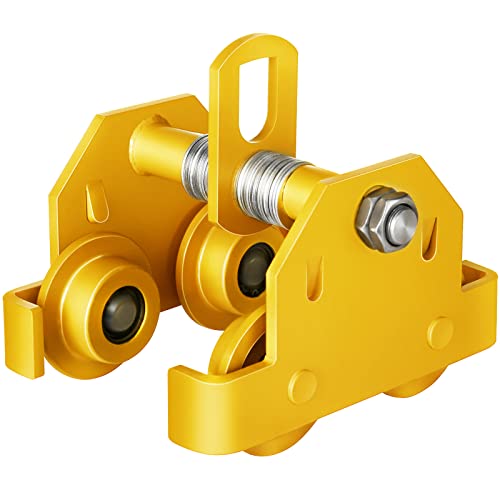
The HONYTA Manual Trolley supports 3 tons (6600 lbs) capacity and is designed to run on straight or curved I‑beams. It features durable manganese steel with anti‑collision properties and rust resistance. Best for shop floors or outdoor yards where manual load transfer along a beam is needed. Choose this if you require smooth, controllable movement across a beam. Caution: ensure flange width compatibility before purchase.
Buying Guide: Key Considerations For Hoisting And Lifting Equipment
- Load type and orientation: vertical, basket, or choker lifts affect sling choice. Use vertical slings for single‑direction lifts; baskets require higher capacities.
- Capacity vs. working load limit: always select equipment with a WLL above the actual load. Do not exceed rated capabilities especially in dynamic lifts.
- Material and flexibility: wire rope slings offer high strength for heavy, industrial lifts; polyester straps are lighter, flexible, and resistant to environmental factors like UV and chemicals.
- End fittings and safety features: safety latches, forged sleeves, and protective thimbles extend sling life and improve security during lifts.
- Environment and exposure: diesel, solvents, and heat can degrade certain materials. Choose straps with chemical resistance if used in harsh environments.
- Storage and transport: longer slings are less convenient to store. Foldable or flat‑eye designs save space in toolboxes or vans.
- Compatibility with hoists and beaming: verify hook types, clamp compatibility, and beam flange widths before selecting a trolley or sling.
FAQ
- What is the difference between a vertical sling and a choker sling?
- Vertical slings carry weight straight down; choker slings wrap under the load, increasing grip but reducing lifting stability. Choose based on load geometry and balance.
- Can I use a lifting sling for towing?
- Some slings are designed for towing in addition to lifting, but verify rated loads and equipment compatibility. Do not substitute towing gear for lifting gear unless explicitly rated for both tasks.
- What safety features should I look for?
- Integrated safety latches, forged sleeves, protective thimbles, and clear WLL tags help ensure correct, compliant use.
- How do I protect slings from wear and tear?
- Avoid sharp edges, use edge protectors or padding, and inspect for fraying, corrosion, or kinks before each lift.
- Which sling is best for a compact toolbox setup?
- Shorter slings, such as 3′ lengths with flat eyes, are easier to store and transport without compromising capacity.
- What should I verify before buying a manual trolley?
- Beam flange width compatibility, load capacity, and wheel durability for the expected travel path.
Add a Comment