Answering the need for powerful, high-flow dust collection, this guide compares five top-rated options. Each pick is best for serious hobbyists, small shops, or professional setups that require real suction, versatile mounting, and straightforward maintenance. The top products cover mobile models, wall-mount flexibility, and pre-separator designs to protect vacuums and improve filtration. Use this comparison to choose based on airflow (CFM), motor size, and compatibility with your tools. A quick buying table follows to summarize core specs and ideal buyers.
Buying summary table
| Product | Best For | Airflow (CFM) | Mounting | |
|---|---|---|---|---|
| WEN DC3474 | Medium to large shop, mobile | up to 600 CFM | Mobile base, optional wall mount | Strong 7.4-amp motor |
| WEN DC3401 | Compact spaces, wall-friendly | up to 660 CFM | Mobile base, optional wall mount | Good balance of size and flow |
| WEN DC1300 | High flow, multi-tool | 1,300 CFM | Mobile base, dual inlets | Highest airflow on list |
| Dustopper PRO | Pre-separator for vacuums | Not a standalone CFM spec | Stationary with standard hoses | Excellent separation and filter savings |
| DEWALT DXVCS003 | Vacuum-integrated systems | Noted for efficiency | Portable with casters | High-efficiency pre-separator |
WEN DC3474 Woodworking Dust Collector

The WEN DC3474 is a 7.4-amp induction-motor dust collector with a 15-gallon bag. It’s designed for mobility and convenience, featuring a 9-inch impeller and a 4-inch dust port for tool connections. Best for: shop owners who need a strong, mobile unit with optional wall mounting for quick access between stations.
Why chosen: It combines solid air movement (up to 600 CFM) with a compact footprint, making it a practical upgrade for mid-sized workshops. The optional wall-mount option helps save floor space in smaller shops.
Caution: The 15-gallon bag may require more frequent emptying in dust-heavy setups; ensure adequate access for bag removal and disposal.
WEN DC3401 Woodworking Dust Collector
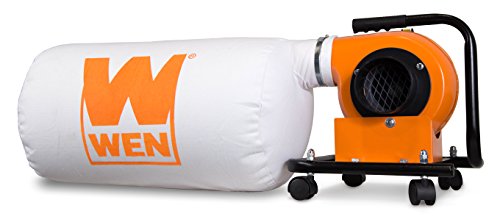
The DC3401 uses a 5.7-amp motor with a 6-inch impeller, moving up to 660 CFM. It includes a 12-gallon bag and offers wall-mount compatibility alongside a mobile base. Best for: smaller shops that still need robust airflow and the flexibility to move or wall-mount as space requires.
Why chosen: It provides a compact yet capable airflow solution, with built-in portability and an onboard carrying handle for easy relocation. This model suits users who want a balance between performance and footprint.
Caution: While compact, the 12-gallon bag may need more frequent changes with fine dust; plan bag replacements accordingly to avoid suction loss.
WEN DC1300 1,300 CFM Dust Collector

The DC1300 delivers high airflow with 1,300 CFM capacity, a 50-gallon vertical collection bag, and dual 4-inch inlets for multi-tool connections. Best for: shops needing strong, scalable suction capable of handling several tools simultaneously.
Why chosen: Its high airflow makes it well-suited for larger tools or dense dust loads, helping maintain suction across multiple connected machines. It’s also designed for easier expansion with two tool connections.
Caution: The larger bag and wider footprint require a bit more floor space and clearance for bag changes and maintenance.
Dustopper PRO Dust Separator

The Dustopper PRO is a high-efficiency, low-profile dust separator designed to attach to shop vacuums or dust extractors. Best for: users seeking maximum dust separation before it reaches the vacuum, reducing filter and bag changes.
Why chosen: Its patented design prioritizes dust separation efficiency and minimizes suction loss from clogged filters. It’s a cost-saving add-on for any vacuum-based dust system.
Caution: This is a separator, not a primary standalone dust collector; airflow depends on your vacuum or blower’s capacity and setup.
DEWALT DXVCS003 Dust Separator

The DEWALT 10-gallon stainless steel separator captures most debris before it reaches the vacuum, delivering 99.5% efficiency in particle separation. Best for: workshop setups using vacuum systems where maximizing filter life matters and where mobility is important.
Why chosen: Its robust stainless design and high-efficiency separation can substantially reduce clogging and maintenance. The 10-gallon capacity provides a practical balance between emptying frequency and space use.
Caution: Like other separators, it relies on a compatible vacuum and hoses; verify hose sizes and base stability for best results.
Bucktool 1HP Wall-Mount Dust Collector

The Bucktool DC30A-1 offers a 1HP induction motor with 550 CFM airflow and a wall-mount design with portable wheels and brakes. Best for: dedicated wall-space workshops needing strong, space-saving dust collection with occasional mobility.
Why chosen: It combines solid airflow with a wall-mount option and wheels for mobility, making it versatile for mixed layouts and tighter rooms.
Caution: While space-saving, the unit’s airflow may be lower than larger floor-stand models in heavy-duty, multi-tool setups; plan tool connections accordingly.
Buying Guide: Key Considerations For High-Flow Dust Collectors
Airflow needs (CFM) should align with your tool load. Higher CFM helps maintain suction when multiple tools run at once but may require more space and power.
Mounting and mobility: Decide between wall-mount, mobile bases, or a stationary setup. Wall-mounts save floor space but may limit repositioning; mobile units offer flexibility across a shop.
Dust separation vs. primary collection: Pre-separators like Dustopper and DEWALT DXVCS models reduce filter maintenance by capturing most debris before the vacuum or main bag, extending service intervals.
Filtration and bags: Check bag capacity and filter type. Larger bags increase interval between changes but need more storage space. Some units use reusable filters; others rely on disposable bags.
Tool compatibility: Confirm dust port sizes (commonly 4 inches) and whether multiple inlets can service more than one tool concurrently. Dual inlets support simultaneous connections for larger setups.
Space and power: Ensure adequate floor space and electrical supply for the chosen motor size. Induction motors tend to run quieter and with longer life in workshop environments.
FAQ
- What CFM do I need for a home shop? Start with 600–1,000 CFM for a typical hobbyist shop and scale up if you run multiple large tools at once.
- Is a dust separator necessary? A separator reduces filter fouling and bag changes, improving overall system efficiency, especially when using a shop vacuum for dust collection.
- Should I choose wall-mount or mobile? Wall-mounts save floor space and keep plugs accessible; mobiles offer flexibility to move between stations.
- How often should bags be replaced? Replacement frequency depends on dust volume and bag capacity; monitor suction loss as a practical indicator.
- Can I run two tools on one system? Yes, models with dual inlets or larger capacity are designed for multi-tool use, but ensure the system’s airflow remains sufficient when both tools are active.
- Are metal tanks more durable than plastic? Metal tanks, like the DEWALT models, tend to offer greater durability in demanding environments, though they may be heavier to move.
Add a Comment