When you need a robust, high-performance 3D printer capable of large builds, fast speeds, and reliable multi-material printing, these heavy-duty options stand out. This guide highlights five top choices, explaining who each is best for and why. It also includes a practical buying guide and a concise FAQ to help you choose confidently for professional use.
| Product | Build Volume | Best For |
|---|---|---|
| QIDI Max4 Combo | 390×390×340 mm | Large industrial parts, multi-material projects |
| Creality K2 Pro Combo | 300×300×300 mm | High-speed multi-color printing |
| Creality K2 Combo | 260×260×260 mm | Multi-color prototypes with auto leveling |
| FLASHFORGE Adventurer 5M Pro | 220×220×220 mm | Fast, automatic leveling with multiple nozzle options |
| FLASHFORGE AD5X | 220×220×220 mm | High-speed multi-color printing in a compact form |
Buyer’s note: This selection emphasizes printers that excel in speed, large or flexible build-area options, reliable auto-leveling features, and solid multi-material capabilities. Each option serves different production scales—from full-assembly prototyping to fast batch runs—so you can prioritize speed, size, or color versatility depending on your workflow.
QIDI Max4 Combo 3D Printer
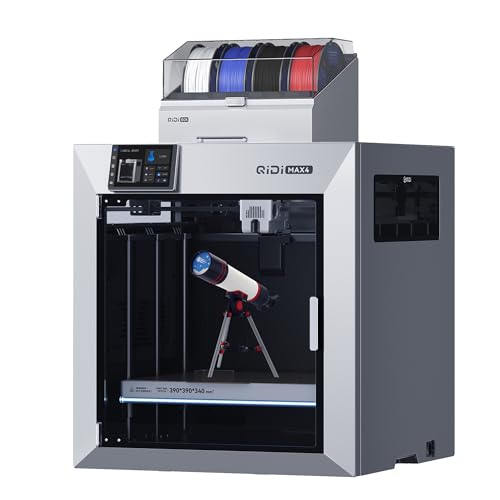
The Max4 Combo stands out for a true ultra-large build area at 390×390×340 mm, which is 55% larger than its MAX3 predecessor. It is designed for printing large industrial parts, complex molds, and big prototypes in a single piece, reducing the need for assembly or splitting. A full-surface silicone heated bed supports even temperature distribution and strong first-layer adhesion, helping to prevent warping in high-hotend scenarios. The printer’s closed-loop motors on the X/Y axes, a 2 mm lead screw, and an anti-backlash Z-axis system contribute to high precision and stable operation, even at elevated speeds. A 65℃ active heated chamber and a Polar Cooler system support high-temp materials like ABS-CF, PC, and PPS-CF, expanding material options beyond standard PLA/ABS.
Best for: professional shops and engineers who need large, reliable prints and the capability to work with hardened materials. It’s especially suited for manufacturing, prototyping, and mold creation where a single-piece build saves time and handling.
Limitation: The device targets high-end usage and may require more setup and calibration compared with smaller consumer models. Expect a learning curve with material workflows at higher temperatures.
Creality K2 Combo (A)

The K2 Combo offers multicolor printing via CFS modules, supporting up to 16 colors when used with four CFS units. It provides a 260×260×260 mm build volume, which fits mid-sized prototyping needs. The printer emphasizes an out-of-the-box experience with pre-assembly and screen installation, helping teams bring concepts to prints quickly. A notable feature is its auto leveling and auto filament handling, designed to streamline repeated production tasks. The K2’s direct-drive extruder supports a range of materials, while a quiet operation profile helps maintain a productive office or studio environment.
Best for: teams needing quick-start multicolor capability without extensive assembly, and for projects that fit within a medium build volume but require diverse color/material combos.
Caution: While powerful for multi-color printing, the 260 mm cube build area is smaller than large-format workflows; plan parts accordingly.
FLASHFORGE AD5X Multi-Color Printer

The AD5X emphasizes ultra-fast printing with speeds up to 600 mm/s and 20,000 mm/s² acceleration. It supports up to four colors concurrently and includes 1-Click Auto Leveling for simplified setup. The 220×220×220 mm build volume is compact, making it ideal for rapid prototyping, product iterations, and small-batch production where speed and color variation matter. The combination of a core XY framework and direct-drive capability supports stable high-speed performance with consistent quality across color transitions.
Best for: teams focused on rapid iteration with quick color variation, small-to-medium parts, and a need for a streamlined workflow with minimal calibration steps.
Caution: The smaller build volume may limit large component printing; pair with a larger-format option for bigger parts if needed.
Creality K2 Plus Combo

The K2 Plus Combo expands multicolor printing using the CFS system to a 16-color capability with four CFS units, enabling vibrant color transitions for multi-material projects. It offers a larger 350×350×350 mm build volume compared to the standard K2 models, which accommodates bigger prototypes or batch printing. The 600 mm/s high-speed performance is driven by FOC step-servo motors and a 20,000 mm/s² acceleration, delivering fast prints without sacrificing stability. An intelligent RFID-based filament handling system supports reliable material management, while auto-leveling and a robust aluminum frame provide structural reliability.
Best for: users needing larger builds and robust multi-color capabilities in a compact-to-mid-sized footprint, suitable for rapid prototyping and multi-material experiments.
Caution: As with all high-speed systems, optimal results depend on well-tuned material profiles and stable ambient conditions to avoid quality fluctuations at extreme speeds.
Buying Guide: Key Purchase Considerations
- Build volume vs. workspace: If you print large parts, favor printers with bigger build volumes like the QIDI Max4 Combo. For bench-top prototyping, compact models with strong color options are ideal.
- Speed vs. accuracy: High-speed capabilities (600–800 mm/s) are valuable for rapid iterations, but ensure the machine maintains surface quality at speed through a rigid frame and good extrusion control.
- Multi-color and multi-material workflow: Look for CFS or similar multi-color ecosystems (up to 16 colors with four units) for complex parts without post-processing painting.
- Auto leveling and bed calibration: Automatic leveling saves time and reduces failed first layers; consider models with multi-point bed sensing for consistency across large beds.
- Chamber heating and material compatibility: A heated chamber (65℃) enables high-temperature materials, lowering warping risk. Verify supported materials align with your needs (PLA, ABS, PETG, CF-filled variants, etc.).
- Ease of setup and maintenance: Pre-assembled or plug-and-play units shorten onboarding. Check for reliable filament handling and easy nozzle swaps if you plan to experiment with different materials.
- Support ecosystem and accessories: Consider the availability of spare parts, CFS modules, and community resources to maximize uptime and material choices.
Frequently Asked Questions
- What is the advantage of a heated chamber in heavy-duty 3D printers?
A heated chamber stabilizes ambient temperature around high-temperature materials, reducing warping and improving layer adhesion for ABS, PC, and CF-filled materials. - Is auto leveling essential for multi-color printing?
Auto leveling simplifies first-layer reliability, which is especially helpful when swapping filaments or changing colors across multiple nozzles or modules. - Can I print with multiple colors at once?
Yes. Printers with multi-color modules (CFS or similar) enable up to 16 colors by linking multiple extruders or color systems, useful for prototypes and detailed finishes. - Which printer is best for large prototypes?
The QIDI Max4 Combo offers the largest native build volume among the listed options, suitable for big industrial parts in a single print. - Do I need professional calibration for high-speed printing?
High-speed printing benefits from a rigid frame, stable rails, and properly tuned profiles; some setup and ongoing fine-tuning are common for optimal results. - What should I consider about material compatibility?
Check supported materials and any required upgrade options (nozzle types, hardened steel for CF composites) to ensure compatibility with your project lineup.
Add a Comment