Answering the need for energy-efficient, maintenance-friendly moisture control in compressed air systems, this guide highlights top heatless desiccant dryers. Ideal buyers include facilities managers, automotive shops, electronics labs, and manufacturers looking to achieve clean, dry air without heat-based regeneration. The selected options balance reliability, efficiency, and ease of integration. The quick comparison below helps you choose:
| Product | Best For | Why It Stands Out |
|---|---|---|
| Yokoma Heatless Adsorption Dryer | Electronics and chemical industries | Long service life with corrosion-resistant cylinder and intelligent control |
| HayWHNKN 10FW Heatless Adsorption Dryer | Mid to large compressors (7.5–11 kW) | Low purge consumption and wide pressure range |
| Ingersoll Rand DA5IM Modular Dryer | Critical applications with tight dew point needs | ISO Class 2 dew point, compact 3/8 in NPT |
| Ingersoll Rand DA15IM Modular Dryer | Medium-flow systems | Balanced flow and dew point for general process air |
| Ingersoll Rand DA25IM Modular Dryer | Higher-flow requirements | Higher CFM with reliable 3/8 in NPT fit |
Note: This article focuses on heatless, adsorption-based air dryers that use desiccant regeneration without external heating. For refrigerant-based options, consider the VEVOR unit noted in this guide, but it does not fall under heatless technology.
Yokoma Heatless Adsorption Dryer
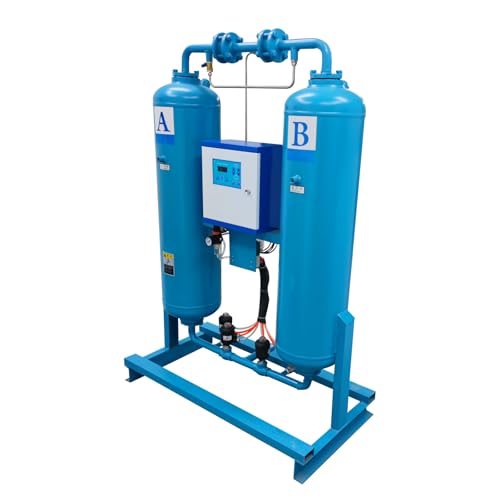
Product: Yokoma Heatless Adsorption Dryer
Brand: Yokoma
Key features: Long service life with thickened, pressure-resistant adsorption cylinder; corrosion resistance from sandblasting; high-efficiency filter with added alumina for dry gas; intelligent microcomputer control for automatic air-drying management.
Best for: Electronics and chemical industry environments needing reliable, unattended operation and durable components. Choose this if you prioritize a long service life and intelligent control.
Caution: Data indicates strong corrosion resistance, but installation should ensure compatible piping and electrical supply for the intelligent controller.
HayWHNKN 10FW Heatless Adsorption Dryer

Product: HayWHNKN 10FW Heatless Adsorption Dryer
Brand: HayWHNKN
Key features: Achieves dew point as low as -40°F with 53 CFM treated air; low purge consumption (~12% with 100W draw); 1″ NPT connections; compatible with 58–145 PSI and minimal system pressure drop.
Best for: Medium-to-large compressor setups where energy efficiency and robust dew-point performance matter. Choose this if you need strong moisture removal with modest purge losses.
Caution: Designed for specific compressor ranges; ensure your system aligns with the 58–145 PSI working window and purge profile.
Ingersoll Rand DA5IM Modular Heatless Desiccant Dryer

Product: Ingersoll Rand DA5IM Modular Heatless Desiccant Air Dryer
Brand: Ingersoll Rand
Key features: Suitable for critical applications such as paint spraying, control air, electronics; ISO Class 2 dew point with pre-filter and after-filter protection; 3/8 in NPT; 3 CFM, 200 psi max, 3 psi pressure drop.
Best for: Facilities requiring precise dew-point control in low to moderate air flows, with clean, controlled downstream air. Choose this for critical process air in constrained spaces.
Caution: Capacity is modest; verify system CFM requirements to avoid undersizing.
Ingersoll Rand DA15IM Modular Heatless Desiccant Dryer

Product: Ingersoll Rand DA15IM Modular Heatless Desiccant Dryer
Brand: Ingersoll Rand
Key features: Designed for critical applications; ISO Class 2 dew point; 3/8 in NPT; 9 CFM flow; 200 psi max; 3 psi pressure drop.
Best for: Medium-flow process lines needing reliable, clean dry air for sensitive operations. Choose this if you need a step-up from DA5IM with higher throughput.
Caution: Ensure downstream filters are maintained to preserve desiccant performance over time.
Ingersoll Rand DA25IM Modular Heatless Desiccant Dryer
Product: Ingersoll Rand DA25IM Modular Heatless Desiccant Dryer
Brand: Ingersoll Rand
Key features: Critical applications focus; ISO Class 2 dew point; 3/8 in NPT; 15 CFM; 200 psi max; 3 psi pressure drop.
Best for: Higher-flow needs within a heatless network where clean air is essential, such as paint booths or electronics manufacturing. Choose this if your line demands more air without increasing energy use.
Caution: Higher CFM options exist—confirm your exact demand to avoid oversizing and unnecessary capital expenditure.
Buying Guide
What to consider when choosing a heatless dryer:
- Air flow (CFM) and system pressure: Match the dryer’s capacity to your compressor output and piping. Oversizing wastes energy, while undersizing reduces dew-point performance.
- Target dew point: Critical processes (electronics, painting, labs) require ISO Class 2 or better; confirm the dryer’s dew-point specs.
- Desiccant type and regeneration: Heatless systems rely on desiccants with purge cycles; evaluate purge percentage and energy implications (where low purge and stable drying matter).
- Footprint and connections: Check NPT sizing (commonly 3/8 in) and overall dimensions to fit your plant layout.
- Maintenance and filters: Integrated pre-filters and after-filters extend desiccant life; plan for filter replacement intervals.
- Electrical and control features: Intelligent controls or simple timers impact ease of use and automation potential.
FAQ
- What is a heatless air dryer?
It uses desiccant to remove moisture from compressed air without external heating during the regeneration cycle. - When should I choose a heatless dryer over a refrigerated one?
When you want lower operating costs, simpler maintenance, and reliable dew-point control without the energy draw of heaters. - What dew point is typical for heatless systems?
Many provide dew points around -40°F to ISO Class 2, depending on design and application. - How do I size a heatless dryer?
Base sizing on required CFM, operating pressure, and target dew point; always check worst-case air demand. - Are there any common downsides to heatless dryers?
Higher purge air consumption and potential desiccant replacement frequency; plan energy use and maintenance accordingly.
Add a Comment