Water-to-water heat exchangers are designed to transfer heat between two water loops with no direct contact. They’re ideal for radiant floor heating, snow-melt systems, and other hydronic setups where clean separation of fluids is important. This guide highlights five top options, explaining who each product is best for, and why they’re recommended. Whether you’re upgrading an existing system or installing a new one, these choices balance performance, durability, and cost-efficiency for American homes and small commercial projects.
Summary table of selected products:
| Product | Best For | Main Advantage | Limitations |
|---|---|---|---|
| VEVOR Brazed Plate Heat Exchanger | Mid-to-large residential and light commercial systems | High heat transfer with robust 316L stainless steel construction | Higher upfront cost |
| ALECOIL 5″x12″ 50 Plates | Heavier-duty residential or small-commercial heating | Strong turbulence design for efficiency | Requires adequate space for 5″x12″ plates |
| ALECOIL 5″x12″-100 Plates | Large residence or small business installations | Very high capacity and transfer area | Bulkier and heavier |
| AB Plate Heat Exchanger 4″x12″ 30 Plates | Budget-friendly projects with solid performance | Reliable copper edges with 316L stainless steel | Moderate capacity |
| INTBUYING 100 Plate Heat Exchanger | Medium-to-large heating installations | 304 stainless steel with vacuum welding and filtration | Data variability on performance specs |
VEVOR Brazed Plate Heat Exchanger, EATB28-80
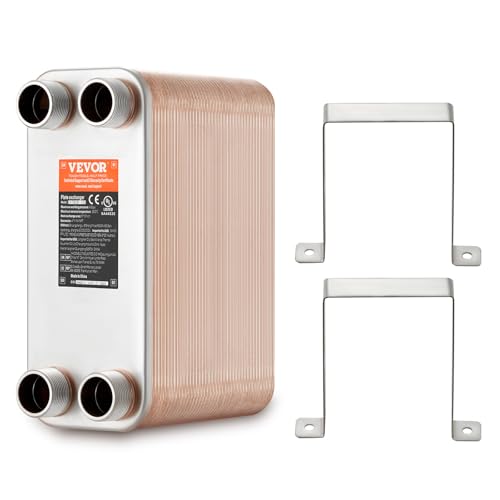
The VEVOR unit uses 316L stainless steel with copper brazing at critical joints for strong leak resistance and durability under high pressure and temperature. It features a high-conductivity plate design with an asymmetrical herringbone pattern that creates turbulence for efficient heat exchange. This model can deliver up to 780-1080K BTU per hour, supporting higher flow rates and more stable temperatures. Best for mid-to-large residential setups or light commercial projects where robust performance matters.
Best for: Homeowners upgrading radiant floors, snow-melt, or pool heating where high reliability and efficiency are priorities. Caution: The unit’s size and 80-plate configuration require adequate space and proper mounting.
ALECOIL 3″x8″ 16 Plates Heat Exchanger

This ALECOIL model employs 316L stainless steel with copper brazing and an asymmetric fish-bone plate design. The design promotes strong turbulence and opposite-direction flow to boost heat transfer rates while reducing secondary-side pressure drop. With a capacity around 121,000 BTU/h and a 2.25 sq ft transfer area, it’s well suited for smaller- to mid-sized systems or as a secondary exchanger in larger networks. Best for: smaller homes or retrofit projects needing compact but efficient performance. Caution: Lower overall capacity means it’s not ideal for very large applications.
AB Plate Heat Exchanger, 4″x12″ 30 Plates

The AB plate exchanger combines high-quality 316L stainless steel with 99.9% copper brazing at the edges to resist leakage under higher pressures and temperatures. It has a 30-plate configuration measuring 4″x12″ and a 1″ MPT port, offering 250,000 to 330,000 BTU/h capacity depending on system conditions. Best for: mid-range heating or cooling tasks in homes with radiant floors or snow-melt needs on a budget. Limitation: modest heat transfer area compared to larger plate counts.
ALECOIL 5″x12″ 50 Plates Heat Exchanger

This ALECOIL unit uses a fish-bone plate design to create strong turbulence and counterflow, promoting efficient heat transfer while lowering secondary-side pressure drop. It has 748,000 BTU/h capacity and 15.68 sq ft heat transfer area across 50 plates with a 5″x12″ footprint. Best for: medium-to-large residential or light commercial heating installations where space allows a larger exchanger. Caution: Higher capacity comes with greater size and cost considerations.
ALECOIL 5″x12″-100 Plates Heat Exchanger

With 1-1/4″ MPT ports and 1,452,000 BTU/h capacity across 100 plates, this unit delivers substantial heat transfer area and flow capability for demanding water-to-water applications. The asymmetric plate design continues to provide turbulence and high heat transfer efficiency while reducing pump energy requirements. Best for: large residences or small commercial systems requiring robust performance. Limitation: significant footprint and installation considerations.
INTBUYING 100 Plate Heat Exchanger
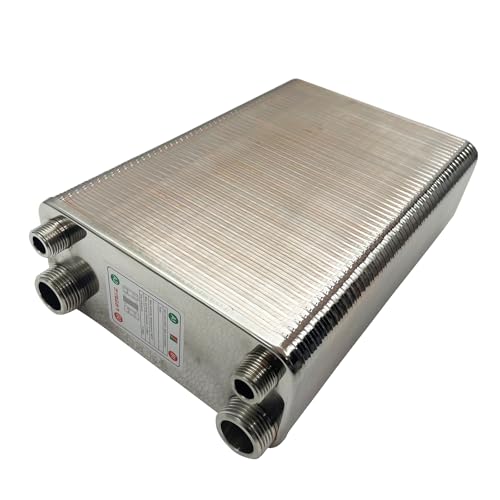
INTBUYING’s unit uses SUS304 stainless steel with copper-filtered edges and vacuum-welding to enhance pressure strength and reduce resistance. It offers a 100-plate configuration designed for larger water-to-water transfers in heating or floor systems. Best for: mid-to-large hydronic networks that demand durability and reliable flow. Caution: Data on exact BTU/h can vary by installation and temperature conditions, so dimensioning is essential.
Buying Guide
What to consider when choosing a water-to-water heat exchanger:
- Capacity and area: Larger plates mean more heat transfer; match to your heating load and space constraints.
- Material and brazing: 316L stainless steel with copper brazing offers leak resistance and durability in high-temperature applications.
- Port size and connections: Ensure MPT or flange connections fit your piping and pumps without excessive adapters.
- Plate design: Fish-bone or asymmetric plates enhance turbulence and efficiency but may affect pressure drops and pump requirements.
- System compatibility: Check whether your application is radiant floor, snow-melt, or general hydronic heating to pick a model with appropriate BTU/h ratings.
- Installation footprint: Larger plate counts provide capacity but require more space and careful mounting.
Key questions to ask when comparing options:
- Is the capacity sufficient for peak heating demands in winter?
- Do the materials and brazing meet required chemical compatibility and pressure ratings?
- Can the unit be integrated with existing pumps and control systems without extensive retrofitting?
- What is the total cost of ownership including operating efficiency and electricity use?
Frequently Asked Questions
- What is a water-to-water heat exchanger used for? It transfers heat between two water loops without mixing fluids, commonly used in radiant floors and snow-melting systems.
- What materials are typical in these exchangers? Stainless steel plates (often 316L) brazed with copper provide durability and leak resistance.
- What should I consider for installation space? Heavier, higher-capacity units need solid mounting and room for piping and service access.
- How does plate design affect performance? Design influences turbulence, heat transfer rate, and pressure drop; choose based on system needs.
- Do these units require special maintenance? Regular inspection of seals and joints is recommended; debris filtration can help prevent blockages.
- Can I mix brands in a system? While possible, ensure compatible materials, connections, and flow characteristics to avoid inefficiencies.
Add a Comment