Answering buyers who want portable, high-speed welding with minimal heat distortion: handheld fiber laser welding machines offer rapid welds, integrated rust removal, and versatile cutting. This guide highlights five top options and explains who benefits most from each. Ideal for small shops, DIY enthusiasts, automotive hobbyists, and maintenance pros seeking fast, precise metal fabrication without bulky equipment.
Summary of selected products
| Product | Key Benefit | Best For | Representative Thickness |
|---|---|---|---|
| GWEIKE M 800W 6-in-1 | Fast welding with integrated rust removal | Small to mid-sized fabrication | 0.2–5 mm (cutting) |
| GWEIKE M 1200W 6-in-1 | Higher power for thicker materials | Professional repairs | 0.2–5 mm (cutting) |
| X1pro 700W (XLASERLAB) | Six-in-one with external wire feeder | Underwater capable, CNC retrofit | 0.2–4 mm (cutting) |
| xTool MetalFab 1200W | 8x faster than TIG with 3-in-1 welding, cutting, cleaning | Shop floor with automation | up to 5 mm (cutting) |
| Oabduz 1500W-3000W (US Stock) | 4-in-1 versatility for many metals | Maintenance and repair shops | varies by setting |
GWEIKE M 800W 6-in-1 Handheld Fiber Laser Welder
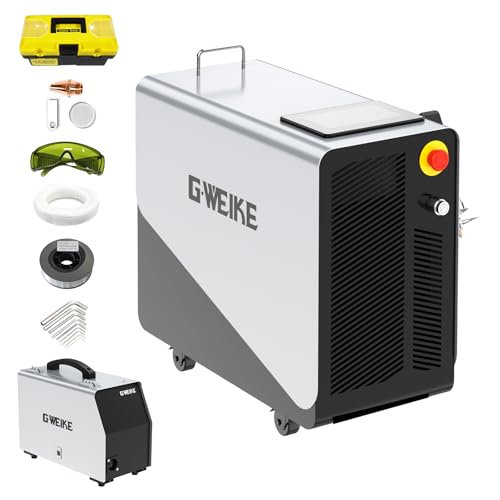
Best for compact, versatile setups. This 800W model delivers high-speed welding at 200–300 cm/min, reportedly up to 5× faster than MIG for many metals. It includes integrated rust removal and surface cleaning with 20 mm width per pass, plus handheld cutting for thicknesses 0.2–5 mm. Choose this if you need a ready-to-use package for small fabrication tasks, rust removal, and on-site repairs where space is limited.
Limitations: cutting and cleaning performance may be tempered by material condition and thickness; plan for thinner sections first to maximize clean welds.
GWEIKE M 1200W 6-in-1 Handheld Fiber Laser Welder
Better for higher demand work. The 1200W variant emphasizes speed and capability similar to the 800W, with more robust welding and cutting for broader applications. Best for professional repairs, automotive components, and thicker joints within the 0.2–5 mm range. It shares the rust-removal and cleaning features and supports 5× faster welds versus traditional methods, aiding productivity in small to mid-sized shops.
Caution: higher power may require upgraded ventilation and PPE considerations for extended sessions.
X1pro 700W Laser Welder (XLASERLAB)
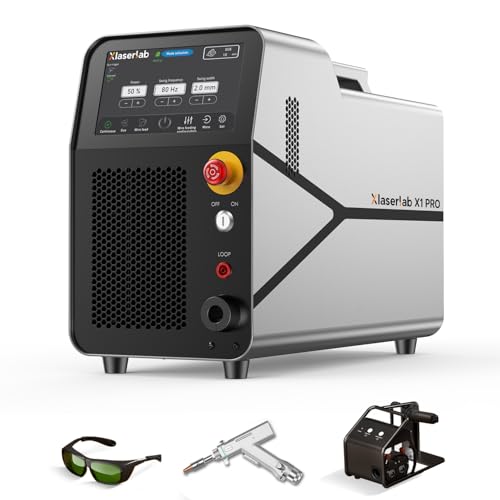
Ideal for multi-function versatility. The X1 Pro combines six functions—CNC retrofit, underwater welding, laser welding, cutting, rust removal, and seam cleaning—with an external wire feeder for steadier welds. Its waterproof design supports underwater welding, and a thermal management system claims longer laser life. Best for workshops needing a compact, all-in-one solution with underwater capability and robust performance in varied environments.
Limitation: while versatile, its complex feature set may require a learning period for optimum parameter selection.
xTool MetalFab 1200W 3-in-1 Laser Welder

Best for an integrated shop solution. The MetalFab 1200W blends welding, cutting, and cleaning with 108+ presets and an 8″ touchscreen. It supports automated wire feeding for longer, more reliable welds and claims 4–8× faster results versus TIG/MIG with a minimal heat-affected zone. Choose this if you want ready-to-operate parameters and a path to automation for consistent, shop-ready welds.
Limitation: as a 3-in-1 system, it may require more setup time to tailor parameters to unusual alloys or coatings.
Oabduz US Stock Laser Welder Machine 1500W/2000W/3000W

Best for larger repair tasks and industrial use. The 4-in-1 design replaces multiple machines and supports a range of metals, including steel, stainless steel, copper, and aluminum. It features automatic wire feeding, a water cooling system, and a robust laser source configuration (1.5–3 kW classes mentioned in product scope). Best for shops seeking a powerful, all-in-one solution for welding, rust removal, cleaning, and cutting in one workflow.
Limitation: higher power and integrated features can mean a larger footprint and greater initial investment; ensure adequate space and electrical capacity.
Buying Guide: How to Choose a Handheld Fiber Laser Welder
What to Consider When Buying
Power level and through-thickness capability determine the range of metals you can weld and cut. Higher wattage supports thicker joints but may require stronger cooling and ventilation. Consider whether you need underwater welding or automated wire feeding for continuous tasks.
What Functions Do You Need?
Six-in-one and four-in-one machines offer cutting, cleaning, rust removal, and welding in one unit. If you frequently perform surface prep or work with painted or rusty parts, integrated rust removal can save time. For shop automation, look for a model with external wire feeding and preset material parameters.
Portability vs. Capacity
Handheld devices trade some power for mobility. If your worksite is tight or you travel to sites, a lighter, compact unit may be preferable. For fixed shop floors with ample power, higher-wattage machines deliver deeper welds and faster cycles.
Environment and Maintenance
Water cooling and thermal management extend laser life and ensure stable performance. Verify that the system can operate under your ambient conditions and that maintenance access is straightforward.
Safety and Accessories
Consider included safety features such as protective shielding, helmet compatibility, and fume management. Accessories like reliable external wire feeders and protective PPE should influence your decision.
FAQ
- Q: What does “handheld” imply for laser welding? A: It indicates mobility and flexibility to weld in tight spaces, but may come with trade-offs in maximum penetrating power compared with fixed systems.
- Q: Can these machines weld aluminum and steel with the same settings? A: Often not; aluminum typically requires different parameters than steel. Look for presets or adjustable programs for each metal type.
- Q: Is underwater welding safe with these devices? A: Some models offer underwater capability; comply with manufacturer guidelines and ensure proper safety protocols for submersion work.
- Q: Do I need professional training to use these machines? A: Basic operation is straightforward, but optimizing parameters for each material typically requires familiarization and practice.
- Q: What maintenance is essential for longer life? A: Regular cooling system checks, lens and nozzle cleaning, and wire feeder maintenance help sustain performance.
- Q: Which model is best for a beginner? A: A compact, 800–1000W 6-in-1 unit with clear presets and straightforward interface is usually most approachable.
Add a Comment