For researchers and technicians needing reliable pre-filtration or sample cleanup, glass fiber syringe filters offer high flow, strong particle retention, and compatibility with a wide range of solvents. This guide highlights five top options, explains who benefits most, and helps you choose based on pore size, diameter, and housing material. Ideal buyers include molecular biologists, environmental testers, and quality-control labs seeking dependable filtration for both hydrophilic and hydrophobic solutions.
| Product | Diameter | Pore Size | ||
|---|---|---|---|---|
| ALLPURE Glass Fiber 25mm 1.2μm | 25 mm | 1.2 μm | PP | General pre-filtration with high flow and dirty-holding capacity |
| ALLPURE Glass Fiber 25mm 1.0μm | 25 mm | 1.0 μm | PP | Cleaner pre-filtration with better removal of fine particles |
| Deschem 13mm 0.45μm | 13 mm | 0.45 μm | PP | Smaller-volume samples or inline filtration with good fine-particle capture |
| Deschem 25mm 0.45μm | 25 mm | 0.45 μm | PP | Balanced filtration for larger volumes with finer retention |
| Omicron 25mm 1.0μm | 25 mm | 1.0 μm | Unknown | Standard glass fiber filtration with dependable performance |
ALLPURE Glass Fiber 25mm 1.2μm Filters

Product overview: Glass Fiber (GF) membrane, 1.2μm pore size, 25mm diameter in a PP housing. Designed to filter 10–100 mL samples with a 3.9 cm² filtration area. Features include high flow rate, large throughput, and substantial dirty-holding capacity. Suitable for both hydrophilic and hydrophobic solutions and capable of gas/air filtration.
Best for: Labs requiring robust pre-filtration with high sample throughput and tolerance to dirty samples. Best for general-purpose filtration where larger particulates need rapid removal.
Limitations: PP housings can be sensitive to certain aggressive solvents; verify compatibility for your solvent system before use.
ALLPURE Glass Fiber 25mm 1.0μm Filters

Product overview: Glass Fiber (GF) membrane, 1.0μm pore size, 25mm diameter in PP housing. Designed to filter 10–100 mL with a high flow rate and large throughput. Emphasizes high dirty-holding capacity and broad chemical resistance.
Best for: Situations where finer filtration is desired than 1.2 μm, while maintaining a high flow; suitable for more particulate-laden samples.
Limitations: Like other GF filters, check solvent compatibility for aggressive organics to avoid membrane damage.
Deschem 13mm 0.45μm GF Syringe Filter

Product overview: Glass Fiber (GF) syringe filter with 0.45 μm pore size, 13mm diameter. Suitable for small-volume samples and fine particulate removal. Emphasizes standard flow with moderate dirty-holding capacity.
Best for: Small-volume applications where finer filtration is needed in a compact format. Choose this if space is limited and you need a smaller footprint.
Limitations: Smaller diameter means lower total throughput; may require more units for larger samples.
Deschem 25mm 0.45μm GF Syringe Filter

Product overview: Glass Fiber (GF) syringe filter, 25mm diameter, 0.45 μm pore size. Balances filtration efficiency with sample volume capacity. Suitable for filtering 10–100 mL samples and provides good particle capture.
Best for: Laboratories that require a finer baseline filtration while processing moderate volumes. Better for achieving cleaner filtrates before downstream analyses.
Limitations: 0.45 μm is finer than many general-use GF filters; check if your workflow benefits from a coarser limit to maximize flow.
Omicron SFGF225B GF Syringe Filter
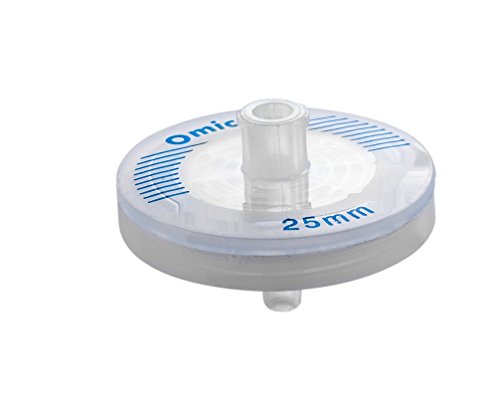
Product overview: Glass Fiber syringe filter, 25 mm diameter, 1.0 μm pore size. Non-sterile and supplied in a pack of 100. Emphasizes standard filtration performance with reliable flow and particle retention.
Best for: General lab filtration where 1.0 μm is an appropriate compromise between throughput and filtration fine-ness. Suitable for routine sample prep and pre-filtration steps.
Limitations: Non-sterile designation implies no sterility assurance; avoid sterile-use scenarios unless indicated by supplier.
Deschem 13mm 0.22μm GF Syringe Filter

Product overview: Glass Fiber (GF) syringe filter, 13mm diameter, 0.22 μm pore size. Tailored for finer filtration tasks in compact formats. Highlights include consistent flow and good particle capture at small volumes.
Best for: Applications needing very fine filtration with minimal sample volume. Better for analyses requiring tight particulate control before instrumentation.
Limitations: 0.22 μm filters can have reduced throughput; plan for multiple units if processing large sample sets.
Buying Guide: How To Choose The Right Glass Fiber Syringe Filter
- Diameter and sample volume: Smaller diameters (13 mm) suit low-volume samples; 25 mm filters handle larger volumes (10–100 mL) with higher throughput.
- Pore size and filtration goal: Use finer pore sizes (0.22–0.45 μm) for clearer filtrates and particulate control; coarser sizes (0.7–1.2 μm) for faster filtration when particulate load is moderate.
- Housing material: Polypropylene (PP) housings offer broad chemical resistance; verify compatibility with solvents in your workflow.
- Hydrophilic vs. hydrophobic compatibility: Glass fiber membranes generally tolerate a wide range of solvents but confirm compatibility with your sample matrix to prevent membrane swelling or degradation.
- Throughput vs. dirty-holding capacity: High through-put and dirty-holding capacity reduce clogging during filtration of dirty samples; this is advantageous for environmental and industrial samples.
- Sterility and handling: If sterility is required, select filters explicitly labeled as sterile or designed for sterile workflows.
FAQ
What is the main benefit of glass fiber syringe filters?
They combine high flow rates with strong particle retention, suitable for pre-filtration and handling challenging samples.
Which pore size is best for pre-filtration?
Common choices are 0.45 μm and 1.0 μm for balancing filtration efficiency and throughput, depending on sample clarity needs.
Are all glass fiber filters compatible with organic solvents?
Most are compatible with many aqueous solutions and common organic solvents, but always verify solvent compatibility with the specific membrane and housing material.
When should I choose a 13 mm filter instead of 25 mm?
Choose 13 mm for small-volume samples or tight spaces; choose 25 mm for higher throughput and larger sample volumes.
Is sterility important for syringe filters?
Only if your application requires sterile filtration. Otherwise, non-sterile filters are often sufficient for pre-filtration steps.
Add a Comment