You’re searching for dependable gear reduction motors from reputable suppliers. This guide highlights five suitable options, explaining who each product is best for, how they differ, and practical considerations to help you choose. This selection covers hobbyist projects, small- to mid-scale automation, and educational or maker uses. The table below summarizes the top picks to compare at a glance.
| Product | Best For | Key Specs | Notes |
|---|---|---|---|
| CNCTOPBAOS 120W Worm Gear Motor RV30 | High-torque needs; stable power | 110V, 90-1600rpm, 18N.m, 1:40 | Durable metal gears; copper coils |
| Copkim 12V Worm Gear Motor Kit | DIY projects with budget-friendly kit | 12V, 16rpm, 1:505 | Includes bracket, couplings, and hardware |
| GoolRC 1/3 Planetary Gear Reduction for 540 Motor | RC hobbyists and slow-speed control | Planetary box; suitable for 540 motor | Great for torque management at low speeds |
| Greartisan 12V Gear Motors (30 RPM / 50 RPM) | All-metal, high durability | 12V; 30RPM or 50RPM; D-shaped shaft | Pure copper rotor; rugged gearbox |
| Generic 12V DC Worm Gear Motor 40RPM | Home projects needing self-locking, bidirectional move | 12V; 40RPM; 1:200 | Self-locking; PWM speed control included |
CNCTOPBAOS 120W Worm Gear Motor RV30 Reducer
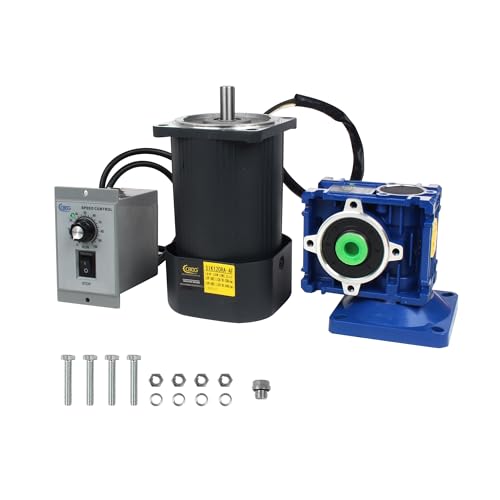
Best for high-torque applications where stable output and long life are priorities. This motor delivers 120W at 110V AC with a speed range of 90-1600 RPM depending on voltage and frequency, and a robust 18 N·m torque with a 14 mm output shaft. The worm gearbox is modeled as NMRV30, featuring high-strength alloy die-casting and a steel casing for durability. It uses all-copper coils designed to reduce heat, and metal gears with high-frequency quenching for wear resistance. Best for: gear-driven machinery, conveyors, and automated tools needing consistent torque in a compact form. Caution: higher voltage operation means it’s best suited for fixed installations with proper electrical safety and cooling in mind. Selection rationale: combines high torque, durable gears, and smooth power delivery for demanding tasks.
Copkim 6 Pack 12v DC Worm Gear Motor Kit

Best for budget-conscious projects needing a complete kit with mounting hardware. This set includes six 12V DC worm gear motors rated for 16 rpm no-load speed, plus a bracket, flange couplings, screws, and a mounting wrench. The motors provide substantial torque with pure copper coils for good conductivity and stable performance. Best for: multi-project builds, automated experiments, and classroom demonstrations. Choose this if you want ready-to-assemble parts with standard mounting options. Caution: the kit is designed for low-speed, high-torque tasks; do not rely on it for high-speed applications, and ensure correct wiring for reversible operation.
GoolRC 1/3 Planetary Gear Reduction for 540 Motor

Best for RC hobbyists needing precise torque management at reduced speeds. The planetary gear unit is designed to slow down a 540 motor and balance torque with compact dimensions, making it well-suited for drivable RC cars or robotic drives that require controlled speed without sacrificing torque. Selected for: reliable slow-speed control and high wear resistance in compact gearboxes. Limitation: compatibility is focused on 540-sized motors; verify motor dimensions and shaft compatibility before use in custom builds.
Greartisan 12V 30RPM Gear Motor

Best for heavy-duty applications requiring all-metal gears and high-temperature resistance. This motor uses a fully metal gear system with a pure copper rotor, delivering strong load capacity and durability. The D-shaped output shaft improves alignment with couplings and gearboxes, increasing bearing life and reducing wobble. Best for: long-running automation tasks, custom gearboxes, and systems needing robust mechanical integrity. Limitation: 30 RPM is very low; ensure your mechanical design accommodates such low speed with appropriate gearing for the desired output.
Greartisan 12V 50RPM Gear Motor
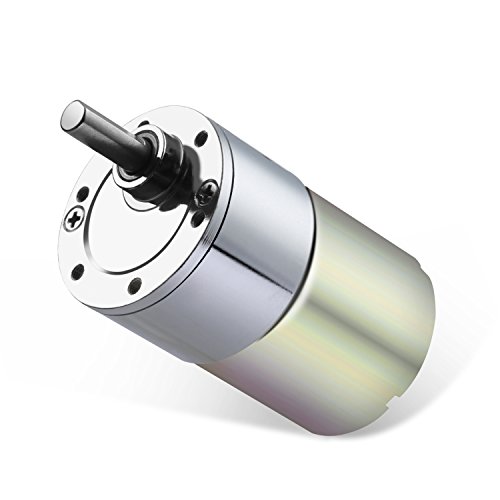
Best for projects needing higher speed stability with good torque density. This model features all-metal gears and a D-shaped shaft, offering reliable performance in compact form. It’s ideal for small automation tasks where you need a smooth, steady rpm at 12V and a robust gearbox to handle repetitive motion. Caution: ensure the power supply can deliver stable 12V under load to avoid speed fluctuation.
12V DC Worm Gear Motor 40RPM (Generic)

Best for fixed-position mechanisms with self-locking capability. This unit includes a 12V motor, worm gear reducer with 1:200 ratio, and a PWM controller plus mounting bracket. It supports bidirectional movement and is suited for access-control systems, curtain tracks, and similar installations that benefit from holding position when power is off. Limitation: lower speed means slower movement; confirm whether this aligns with your motion requirements and control strategy.
Buying Guide
Key considerations when choosing a gear reduction motor:
- Torque and speed balance: Match the torque (N·m) with the required output speed for your application. Higher gear reduction ratios increase torque but reduce speed.
- Voltage and power: Ensure the motor’s voltage aligns with your power supply (12V vs 110V AC) and check if a driver or PWM controller is needed for speed control.
- Gearbox type: Worm gears provide good torque and compact size; planetary gears offer smooth, high-torque performance with efficient heat dissipation for certain loads.
- Shaft and mounting: Confirm output shaft diameter (e.g., 14 mm) and shaft shape (D-shaped) to fit your couplings and mounting hardware.
- Durability: Look for all-metal gears and copper windings for heat tolerance and longevity in continuous operation.
- Size and fit: Compare overall dimensions with your device enclosure or chassis to ensure compatibility.
- Self-locking and direction control: If you need a position-holding feature when power is removed, consider self-locking designs.
- Ease of integration: Kits with mounting brackets, screws, and couplings simplify installation and experimentation.
Frequently Asked Questions
- What is the difference between worm and planetary gear motors?
- How do I choose the right gear ratio for my project?
- Can these motors run continuously at high torque?
- Do I need a driver or controller for speed control?
- What mounting considerations are important for precise alignment?
- Are these motors suitable for 3D printing or hobby robotics?
Buying decisions should balance torque, speed, control, and mechanical fit. The products listed here offer a range of voltages, gear types, and mounting options to support different uses—from DIY projects and educational kits to small automation systems and RC hobby setups. Always verify compatibility with your power supply, control electronics, and mounting hardware before purchase.
Add a Comment