If you need a reliable gas powered well pump for transferring water, draining pools, or dewatering construction sites, these five models offer solid performance and portability. The top picks are selected for different needs: heavy duty farm and construction use, semi-trash capability for dirty water, and easy handling for home projects. This guide helps you compare power, flow, suction, and durability to choose the right pump for you.
Summary of selected products
| Product | Engine / Power | Max Flow | Best For |
|---|---|---|---|
| Honda WB20 2-Inch General Purpose Water Pump | Honda GX series commercial engine | 164 GPM | Heavy-duty commercial tasks, large sites |
| OtaniReno 2 Inch Trash Pump | 6.5 HP, 210cc OHV | 1271 GPH (≈21.2 GPM) | Debris-laden water, flood control |
| BILT HARD Semi Trash Pump 2 inch | 7 HP, 212cc OHV | 158 GPM | Job site water with some solids |
| DC HOUSE 2″ 6.5 HP Semi-Trash | 212cc OHV | 158 GPM | General dewatering and irrigation |
| XtremepowerUS Semi Trash Pump 2 inch | 7.5 HP, 212cc | 158 GPM | Versatile dewatering and pool draining |
Honda WB20 2-Inch General Purpose Water Pump

Best for heavy-duty, long-running projects. The Honda WB20 uses a commercial-grade GX OHV engine, designed for easy starts and reliable power in demanding conditions. It supports up to 5/16″ solids through a large strainer and offers a robust cast iron volute with a high-efficiency impeller. This makes it well-suited for agriculture, construction, and landscaping tasks where uptime matters. Caution: the heavier, commercial build may be less portable than smaller models.
Who it’s best for: contractors, farms, and landscapes needing continuous, high-capacity pumping.
Why selected: best combination of power, durability, and debris handling for large, dirty water transfers.
Limitation: heavier unit means more effort to transport and set up in tight spaces.
OtaniReno 2 Inch Trash Pump

Best for dealing with debris-heavy water at job sites. This semi-trash pump runs on a 6.5 HP 210cc engine and delivers about 1,271 GPH, handling mud, sand, and small stones without frequent clogging. Its 23-foot suction and 92-foot lift enable deep water extraction and vertical discharge, making it suitable for flood control, irrigation, and construction dewatering. Caution: ensure regular cleaning after pumping muddy water to extend life.
Who it’s best for: construction crews and homeowners dealing with dirty water and moderate debris.
Why selected: strong debris tolerance with good suction and lift for typical flood scenarios.
Limitation: flow rate is lower than some larger 2″ models, but debris handling compensates for that in rough conditions.
BILT HARD Semi Trash Pump 2 inch

Best for comprehensive site work with included fittings. This 7 HP, 212cc engine powers a semi-trash design with up to 158 GPM and a complete fittings kit (discharge hose, suction hose, cam lock, filters, and adapters). It’s EPA Phase III compliant, supports straightforward hose connections, and includes a low oil shutoff and idle control for safer operation. Caution: assembly and hoses must be correctly sealed to prevent leaks when connected to long runs.
Who it’s best for: contractors and property managers needing a turnkey package with hoses and fittings.
Why selected: value-packed option with essential accessories for immediate dewatering tasks.
Limitation: heavier weight means careful handling during transport between sites.
DC HOUSE 2″ 6.5 HP Semi-Trash Water Pump

Best for balanced dewatering and irrigation tasks with solid performance. The DC HOUSE pump uses a 212cc OHV engine delivering about 158 GPM and offers a practical 26.2-foot suction and 105-foot lift. It provides good fuel efficiency and straightforward operation, with a focus on reliability for daily use. Caution: avoid pumping large amounts of sludge repeatedly to maximize longevity.
Who it’s best for: rental yards, small farms, and homeowners needing dependable, mid-range capacity.
Why selected: reliable mid-range option that blends power, efficiency, and ease of use.
Limitation: may not handle very large solids as well as heavier-duty models.
VEVIVOOVY 1.6HP Gas Water Pump

Best for compact, light-duty transfer tasks. This 1.6 HP 52cc engine delivers up to 317 ft³/h (about 118 GPM) with a 29.53-foot suction and 59.06-foot lift. It is suitable for small irrigation, pool draining, and light transfer work where portability is a priority. Caution: limited power means it’s less suitable for large or debris-filled water.
Who it’s best for: homeowners and small properties needing a light, portable transfer pump.
Why selected: smallest and lightest option among the list, ideal for quick, simple jobs.
Gosangom 4-Stroke Water Transfer Pump
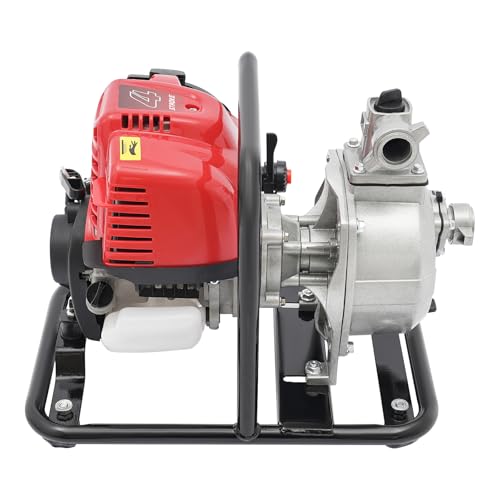
Best for high head and reliable flow in moderate-duty tasks. This 1-inch high-pressure pump delivers up to 135 L/min (≈35.6 GPM) with a 30 m (98.4 ft) head. It is built from carbon steel and aluminum alloys for durability and is geared toward irrigation and general transfer tasks where a compact unit is advantageous. Caution: lower overall flow compared with larger 2″ pumps.
Who it’s best for: gardeners and small-scale irrigation projects needing a compact transfer solution.
Why selected: strong head and compact form factor for tight spaces.
Aceup Energy Gas Water Pump 1.5-Inch

Best for portable, lightweight pumping with solid flow. The Aceup Energy pump offers 2.1 HP at 3600 RPM and up to 79 GPM with a 1.5-inch outlet. It emphasizes portability, with a compact iron base and recoil start, making it suitable for quick, on-the-go water transfers. Caution: limited capacity may require longer operation for large volumes.
Who it’s best for: homeowners needing a compact, easy-to-move unit for small tasks.
Why selected: ideal for quick, light-duty transfers where weight and size matter.
Buying Guide: Key Considerations For Gas Powered Well Pumps
- What will you pump: Clean water vs. debris-laden water? Choose debris-tolerant semi-trash or trash pumps for dirty water.
- Flow rate vs. head: Higher GPM is useful for bulk transfers, while greater head (lift) is important for draining distant or elevated areas.
- Engine power and durability: Commercial-grade engines offer longer life in tough conditions; lighter units are easier to transport.
- Solids handling: If solids are present, verify the maximum particle size (in inches) the pump can pass without clogging.
- Portability: Consider weight, transport wheels, and handles for frequent site-to-site movement.
- Included accessories: Hoses, adapters, and fittings add value; ensure compatibility with your hoses.
- Maintenance: Look for accessible spark plugs, filters, and simple oil shutoff features for safety and longevity.
- Fuel considerations: Ensure fuel availability, storage safety, and proper refueling practices on-site.
Frequently Asked Questions
- What is the difference between a trash pump and a semi-trash pump?
– A semi-trash pump handles some solids, while a trash pump is built to handle larger debris more effectively. - How much water can these pumps transfer per minute?
– Most models listed range from about 79 GPM to 164 GPM, depending on the engine and impeller design. - Can these pumps run continuously on a construction site?
– They are designed for demanding use, but check engine specifications, fuel availability, and maintenance needs for extended operation. - What size hoses should I use?
– Hoses typically match the pump’s discharge and suction ports; verify hose diameter and fittings in the included kit or product page. - Are these pumps suitable for irrigation?
– Yes, many are suitable for irrigation and dewatering; choose models with appropriate head and flow for your irrigation layout. - Do I need a filter or strainer?
– A strainer is often built-in on higher-capacity pumps; for dirty water, an additional strainer can help protect the impeller.
Add a Comment