Finding reliable gas flow calibration equipment helps ensure accurate sensor readouts for gas detectors. This guide highlights five practical options suited for professionals and hobbyists working with MSA, BW Technologies, RKI, ISC, and similar brands. Each pick focuses on fixed or adjustable flow regimes and compatibility with popular calibration gas cylinders. Read on to identify which regulator best matches your gas type and workflow, along with a quick buying table for comparison.
The following table provides a quick reference of the selected products, including compatibility notes and best-use scenarios.
| Product | Best For | Key Benefit | Limitation |
|---|---|---|---|
| Ideal Calibrations 0.25 LPM MSA/RKI Compatible | Altair Pro and related detectors | Compact fixed flow for precise low-flow calibration | Limited to 0.25 LPM |
| Ideal Calibrations 0.5 LPM Nickel Brass Fixed Flow (C10) | Reactive gases; diffusion monitors | Nickel brass for stability with reactive gases | Not for pumped detectors |
| Generic 0-8 LPM Dial A Flow Regulator (C-10) | Multiple brands; broad flow range | Wide flow options in one unit | Some models may lack advanced safety features |
| Ideal Calibrations 0.5 LPM Stainless Steel Fixed Flow (C10) | Ammonia or chlorine calibration | Stainless steel for highly reactive gases | Higher cost; stainless steel may be heavier |
| Ideal Calibrations 0.5 LPM Pumped Regulator (C10) | Pumped detector systems | Fixed 0.1-3.0 LPM range for pumped detectors | Designed for pumped setups |
Ideal Calibrations 0.25 LPM MSA/RKI Compatible Regulator
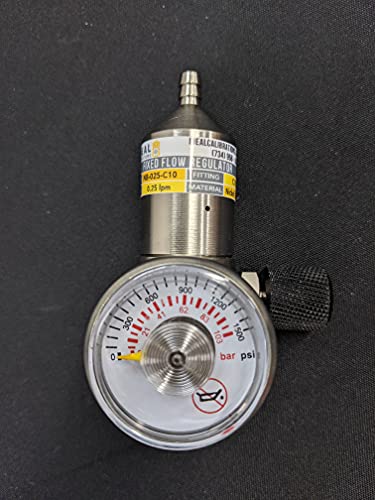
Best for: technicians calibrating MSA diffusion gas detectors such as Altair Pro, Altair 4, Altair 4X, and Altair 4XR. The regulator matches MSA PN 467895 and provides a stable 0.25 LPM flow for precise zero and span calibrations.
Why selected: small, fixed-flow design supports repeatable calibrations with compatible calibration gas cylinders, helping to minimize drift during routine checks. This option is ideal when low-flow accuracy is paramount and space is limited.
Limitation: fixed at 0.25 LPM, which may require a second regulator for alternative flow needs or for different detector models. Choose this if your workflow consistently uses 0.25 LPM.
Ideal Calibrations 0.5 LPM Nickel Brass Fixed Flow Regulator

Best for: diffusion gas monitors by BW Technologies, Industrial Scientific, and RKI that require a nickel brass body for stability with reactive gases. The C10 fitting ensures broad compatibility with standard calibration bottles.
Why selected: the nickel brass construction offers resilience when dealing with reactive gases while preserving flow accuracy. It is not intended for pumped detectors, so it fits static calibration workflows well.
Caution: not suitable for pumped gas detectors. Ensure your calibration setup uses diffusion-based detectors to avoid miscalibration or safety concerns.
Generic 0-8 LPM Dial A Flow Regulator (C-10)

Best for: environments requiring a wide flow range across multiple brands like BW, ISC, MSA, RAE, and RKI. The dial flow offers flexibility to match various calibration tasks from low to mid flow.
Why selected: a flexible option when you need a single regulator to cover several devices and detector families. The C-10 connection maintains broad compatibility with typical calibration gas cylinders.
Caution: flow accuracy depends on the regulator’s calibration and maintenance; regular checks are recommended to maintain consistency across runs.
Ideal Calibrations 0.5 LPM Stainless Steel Fixed Flow Regulator

Best for: gases that are highly reactive, such as ammonia (NH3) and chlorine (Cl2). Stainless steel construction minimizes corrosion and maintains flow fidelity during prolonged calibration sessions.
Why selected: stainless steel offers enhanced chemical resistance, improving longevity when calibrating with aggressive gases. It pairs with most gas bottles that use C10 fittings.
Caution: stainless steel units can be heavier and may have a higher upfront cost; ensure handling logistics align with your workspace.
Ideal Calibrations Pumped 0.5 LPM Regulator (C10)

Best for: pumped gas detector systems that require a controlled flow within the 0.1–3.0 LPM range. The 0.5 LPM default provides a steady baseline for many pumped setups.
Why selected: designed specifically for pumped detectors, offering reliable integration with pump-based calibration workflows. The C10 connection ensures compatibility with standard gas bottles.
Limitation: fixed 0.5 LPM in this model; if your pumped system requires a different flow, consider alternate models or adjustable options within the pumped category.
Buying Guide: Gas Flow Calibration Equipment Essentials
What to consider when choosing a regulator
- Flow rate needs: Determine your detector types (diffusion vs pumped) and required LPM. Fixed-flow regulators are simple and repeatable; dial or adjustable models suit varying tasks.
- Gas compatibility: For reactive gases (NH3, Cl2), select materials such as stainless steel or nickel brass based on chemical resistance requirements.
- Fitting compatibility: Most calibration work uses C10 fittings. Confirm the regulator aligns with your gas bottle and detector ports.
- System type: Choose diffusion-regulator options for static calibrations and pumped-compatible models for pump-assisted workflows.
- Maintenance: Some options include additional support or guidance with calibration procedures. Regular inspection ensures flow accuracy and safety.
How to compare products quickly
- Best for diffusion detectors: choose fixed-flow units with low LPM (0.25–0.5 LPM).
- Best for reactive gases: prefer stainless steel or nickel brass construction with corrosion resistance.
- Wide range needs: consider a dial A Flow regulator offering multiple LPM settings in one device.
- Pumped detector workflows: select regulators explicitly labeled for pumped detectors with compatible flow ranges.
Safety and compliance considerations
- Always verify compatibility with your calibration gas cylinders and detectors per manufacturer guidelines.
- Follow standard handling procedures for reactive gases and ensure proper ventilation.
- Periodic calibration checks of regulators help maintain accuracy and reduce drift over time.
FAQs
- What is the typical flow rate used for diffusion gas detectors? A common fixed flow is 0.25–0.5 LPM for diffusion detectors, depending on the model.
- Can I use a single regulator for multiple detector brands? A dial A Flow regulator with a C-10 connection can cover multiple brands, but confirm each device’s recommended flow range.
- Is stainless steel better than nickel brass for all gases? Stainless steel is preferred for highly reactive gases, while nickel brass works well for less aggressive gases but needs caution with certain chemicals.
- Should I choose fixed-flow or adjustable flow? Fixed-flow regulators offer simplicity and repeatability; adjustable flow is better for workflows requiring multiple test scenarios.
- Do pumped detectors require a dedicated regulator? Yes, pumped detectors typically require regulators designed for pumped systems with compatible flow ranges.
- How often should calibration regulators be serviced? Regular checks and periodic maintenance, following manufacturer recommendations, help maintain accuracy and safety.
Add a Comment