If you’re shopping for a forklift hydraulic control valve, you want parts that deliver precise flow, reliable operation, and compatibility with your system. This guide highlights five strong options, explains who each is best for, and notes practical limitations. Ideal buyers include small- to mid-size forklifts, tractor loaders, log splitters, and other hydraulic equipment operators seeking dependable, easy-to-integrate valves.
Summary table of selected products:
| Product | Best For | Key Benefit | Inlet/Outlet |
|---|---|---|---|
| GYZJ Hydraulic Flow Control Valve 4 Spool | Small tractors and loaders | Four spools, adjustable relief for versatile control | G1/2″ |
| Magister Hydraulic Control Valve 6 Spool | Complex hydraulic setups | Six-spool, open center for multiple actions | SAE 10 |
| GYZJ Hydraulic Flow Control Valve 2 Spool | Compact systems | Two spools, spring return, double-acting | G1/2″ |
| LFC08N Hydraulic Needle Flow Control Valve | Precise flow at high pressure | Needle-adjustment for fine control | 1/2″ NPT |
| Solenoid Hydraulic Control Valve 3 Spool | Automation-ready setups | Solenoid actuation for automated control | 3 spools |
GYZJ Hydraulic Flow Control Valve 4 Spool

Product overview: This 4-spool valve operates at up to 3600 PSI and supports up to 11 GPM. It uses G1/2″ inlet/outlet ports and is designed for double-acting cylinders. Spring-return slides reset to neutral with a light shake for quick repositioning.
Best for: Operators with small tractors, tractor loaders, log splitters, or similar small machinery needing multiple hydraulic functions from one valve block. It offers flexibility with four independent spools, enabling several simultaneous actions.
Why selected: The combination of multiple spools and a robust 11 GPM flow makes it versatile for varied tasks without adding significant footprint. The spring-return feature provides predictable control in dynamic operations.
Limitations: Uses G1/2″ ports; ensure your hoses and fittings match this size. Check that your hydraulic system can handle the 3600 PSI rating to avoid over-pressurization.
Magister Hydraulic Control Valve 6 Spool

Product overview: This 6-spool, 4-way 3-position valve is rated to 3600 PSI with 13 GPM flow and SAE ports. Open Center configuration with spring-centered spool action supports varied hydraulic circuits and passive return conditions.
Best for: More complex hydraulic rigs where multiple independent functions must be controlled from a single valve block, such as multi-tool tractors or loaders with several accessory circuits.
Why selected: The higher spool count enables broader control without needing additional valve blocks, simplifying plumbing and reducing space requirements.
Limitation: Open Center design may require specific system topology; verify compatibility with your tractor’s hydraulic circuit and return lines before installation.
GYZJ Hydraulic Flow Control Valve 2 Spool
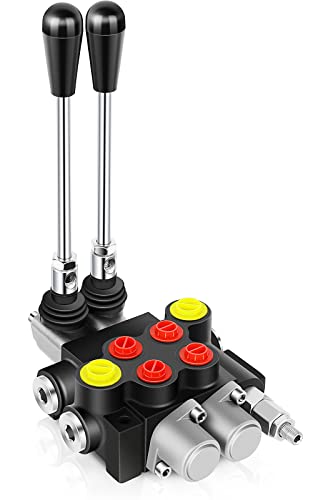
Product overview: This 2-spool valve provides 3600 PSI maximum pressure and up to 13 GPM. It features a spring return and is designed for double-acting cylinders, making it a compact yet capable option for smaller hydraulic setups.
Best for: Systems requiring a compact control valve for one or two actions, such as small loaders or log splitters with limited space.
Why selected: It’s a tight, straightforward choice for simpler tasks where two independent flows are enough, keeping plumbing uncomplicated.
Limitations: Fewer spools mean less functional flexibility; plan your circuit to avoid needing additional valves for future expansion.
Solenoid Hydraulic Control Valve 3 Spool

Product overview: This 3-spool solenoid valve uses a 12V DC coil to automate operation, offering 3625 PSI max pressure suitable for forklifts, small tractors, loaders, and related equipment.
Best for: Operators seeking automation-ready control, where solenoids can be wired to switches or controllers for remote or automatic actuation.
Why selected: The solenoid option adds an automation layer, beneficial for production lines or operators migrating to semi-automatic control without a full electrical retrofit.
Limitation: Solenoid valves require a power source and wiring; ensure your system’s electrical supply and control logic are compatible before use.
Buying Guide: How to Choose a Forklift Hydraulic Control Valve
- Spool count: More spools enable more independent hydraulic circuits. Choose 1–2 spools for simple tasks, 4–6 spools for multi-function control, or more for complex systems.
- Flow rate and pressure: Match the valve’s maximum GPM and PSI to your hydraulic pump and actuators. Higher flow is better for faster cylinder movement; higher pressure supports tougher loads.
- Port size and type: Ensure inlet/outlet ports (G1/2″, SAE 10, etc.) align with hoses, adapters, and existing fittings.
- Centering and actuation: Springs provide self-centering; solenoids enable automation. Consider your preferred control style and wiring requirements.
- Open vs. closed center: Open Center valves are common on tractors and loaders with constant pump flow; Closed Center can be more efficient on machines with variable flow.
- Mounting compatibility: Check valve size, mounting pattern, and block compatibility with your manifold or mounting plate.
- Environmental and duty cycle: For harsh environments or frequent use, select rugged cast-iron or corrosion-resistant materials and verify duty ratings.
Frequently Asked Questions
- What is a hydraulic flow control valve used for? It regulates the speed and flow of hydraulic fluid to actuators, improving control and reducing jerky movements.
- Do I need a solenoid valve for forklift operations? Solenoids enable automated actuation; choose them if you want electrical control integrated with switches or a control system.
- How many spools should my system have? Plan for each independent function (lift, tilt, forks, attachments). More spools allow more simultaneous actions but require more space and plumbing.
- What port sizes are common? Common sizes include G1/2″ and SAE 10. Verify compatibility with your hoses and fittings.
- Can I mix valve brands? Mixing brands is possible but ensure compatible port sizes, pressure ratings, and blockage-free flow paths to avoid inefficiency or damage.
- Are open-center valves better for tractors? Open-center designs are typical for tractors with constant pump flow, while closed-center systems optimize efficiency with variable flow.
Add a Comment