When choosing a fiber laser fume extractor, aim for high airflow, multi-stage filtration, and low noise to keep your workspace comfortable and safe. The top picks below are tailored for laser engraving, soldering, and small to mid-size laser cutting setups. The sections detail who each model is best for and why they were selected.
| Product | Airflow | Filtration | Best For |
|---|---|---|---|
| FumeClear FC-2002A | 260 m³/h | 3-stage (pre-filter, HEPA, main carbon) | Professional hobbyists needing strong suction near the hood |
| FumeClear FC-2003 | 330 m³/h | 3-stage with dual ports | Small studios with multi-machine setups |
| FumeClear FC-2001X | Strong suction with 2.2 kPa | HEPA H13 + carbon, sealed loop | Laser engravers under 10W, precision work |
| FUMEGO XF250 | 280 m³/h | 4-stage with high-iodine carbon | 10–40W lasers, S1/M1/Vista compatibility |
| Zericuf Solder Fume Extractor | 320 m³/h | 3-stage with H13 HEPA | Industrial-style soldering and laser work |
FumeClear FC-2002A Laser Fume Extractor

The FC-2002A is designed for laser engravers and desktop production. It delivers up to 260 m³/h suction, capturing exhaust gases, dust, and chips within a close hood range. It uses a three-stage filtration system (pre-filter, HEPA, main carbon) to achieve a 99.97% purification rate, helping keep lungs and eyes safe from fine particles. The main carbon filter uses highly iodized coconut shell activated carbon for enhanced adsorption and longer life, with an expected service life around 4000 hours depending on usage. Ten replaceable pre-filters support extended operation between changes.
Best for: High-output hobbyists and small studios running 10–40W laser equipment who need strong near-hood capture and durable carbon filtration. Caution: The filter life varies with material type and usage; heavier smoke may require more frequent replacements.
Solder Fume Extractor – 180W 320m³/h (Zericuf)

This model emphasizes industrial-grade suction with a robust 180W motor and 320 m³/h airflow. A soundproof chamber with damping foam keeps noise under control, and the exclusive downward exhaust directs heat away from the workspace. A three-stage filtration stack—double-thickness pre-filter, H13 HEPA, and high-iodine activated carbon—delivers strong purification and helps capture 0.3 micron particles. The setup is well-suited for soldering, laser cutting, and 3D printing exhausts in compact zones where space and noise are considerations.
Best for: Settings demanding powerful, quiet extraction with a downward exhaust path. Caution: The downward exhaust may require precise placement relative to your workspace to maximize capture.
FumeClear FC-100A Solder Fume Extractor
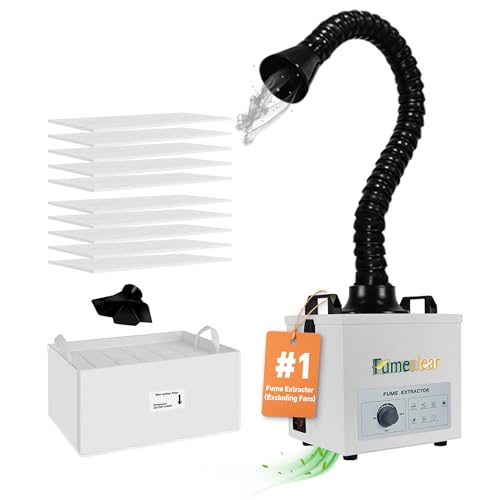
The FC-100A emphasizes compact desktop operation with a 100W no-load power, targeting small bench soldering. It features a three-layer filtration system and 10 pre-filters to block large particles, with a high iodine carbon filter designed for long service life—up to around 3000 hours. Note that it’s not the best fit for large laser engraving tasks; users with higher power or larger emissions should consider FC-2002, FC-2003, or FC-2004 models for optimal results.
Best for: Small, dedicated soldering stations or light-duty laser engraving tasks. Caution: Not ideal for high-output laser systems or heavily smoky environments.
FumeClear FC-2002 Fume Extractor
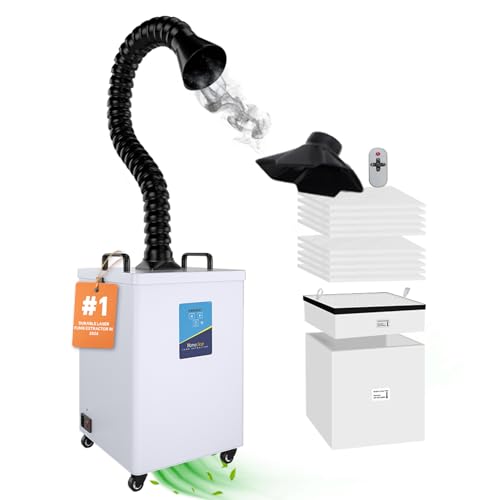
This FC-2002 model provides strong suction in the 260–300 m³/h range, designed for 10–20W laser engravers and soldering setups. It uses a 3-stage filtration system (pre-filter, Hepa, carbon) to 99.97% purification and includes 10 pre-filters for extended life. The main carbon filter uses iodized coconut shell activated carbon for superior adsorption, with service life typically around 4000 hours depending on usage. It is well suited for compact workshops needing reliable, quiet operation and robust smoke capture near the source.
Best for: Laser engravers and small laser cutters that require effective capture with a compact footprint. Caution: Fit with a compatible hood and hose to maximize near-source capture.
Buying Guide: How To Choose The Right Fiber Laser Fume Extractor
- Airflow and capture radius: Look for models with 260–330 m³/h or higher and a capture zone that works within 15 cm of the hood for close-range fumes.
- Filtration stages: A 3-stage system (pre-filter, HEPA, carbon) is common; 99.97% purification at 0.3 microns is a solid benchmark. Some units add an extra stage for stronger odor control.
- Filter life and maintenance: Carbon filters with high-iodine activation last longer and improve adsorption of gases. Check the number of pre-filters included and the expected service life.
- Noise levels: If you work in a shared or quieter environment, prefer models with sound-damping features or downward exhaust designs to reduce noise impact.
- Power and material compatibility: Ensure the unit supports your laser power range (commonly 10–40W) and is compatible with your machine’s exhaust port size.
- Mounting and reach: Consider a flexible hose and a gooseneck or arm if your workstation needs adjustable positioning for maximum capture.
- Ports and configurations: Some models offer dual-port operation or sealed-loop filtration, which can be advantageous in multi-machine setups or beauty/salon applications.
Frequently Asked Questions
- What airflow is best for laser fume extraction? Aimed at 260–330 m³/h with a close-range capture zone for best results near the hood.
- Is 3-stage filtration sufficient for laser fumes? Yes, when combined with a high-iodine carbon filter and good pre-filters; ensures 99.97% purification at 0.3 microns.
- Can I use a fume extractor for both laser engraving and soldering? Yes, many units are designed for both, but verify the optimal power range and filtration for your materials.
- How often should filters be replaced? Filter life depends on usage and materials; heavy smoke requires more frequent changes. Follow manufacturer guidance for life estimates.
- Do I need a dual-port extractor? Dual-port units are beneficial for multi-machine setups or studios with more than one active machine at a time.
- What about noise? Look for soundproofing features or a downward exhaust design to minimize noise in your workspace.
Add a Comment