When searching for fabric laser engraving machines, the goal is to find a reliable, precise tool that can handle textiles, leather, felt, and other fabrics with clean, detailed results. This guide highlights five top options that balance performance, safety, and ease of use for hobbyists, makers, and small businesses. Each pick is chosen for fabric-friendly capabilities, material versatility, and practical features that help you achieve professional results. The buyer’s guide below helps you compare power, software, enclosure, and workflow compatibility at a glance.
Summary of Selected Products
- xTool M2 10W Laser Engraver — Best for color-ready customization and built-in dual cameras.
- BlazeX M3 10W Laser Engraver — Best for ultra-precise engraving on wood, metal, and glass with a beginner-friendly kit.
- Twotrees TTS-55 Pro — Best for spacious work area and advanced compression engraving on diverse materials.
- LaserPecker LP1 Plus — Best for portable, pocket-sized projects and on-the-go crafting.
- ACMER S1 (6000mW) — Best for high-power, precise engraving and 2-in-1 cutting versatility on fabrics and polymers.
Note: This article focuses on fabric-grade capabilities, material versatility, and user-oriented workflows. Prices, warranties, and third-party software considerations are not included to keep the comparisons concise and actionable.
xTool M2 10W Laser Engraver

The xTool M2 offers a dual-camera setup and a built-in enclosure for safer operation around fabrics and other materials. It supports adding a CMYK Inkjet module (sold separately) for color printing on textiles, enabling layered, multicolored designs. This makes it better for creators who want vibrant, customized fabric prints alongside precise engraving. Best for home makers who require integrated vision feedback and plan to expand with add-ons.
Best for: crafters who want precise placement, color-print capabilities through future add-ons, and a compact footprint.
Limitations: Some advanced color-print options require add-on modules not included in the base package.
BlazeX M3 10W Laser Engraver
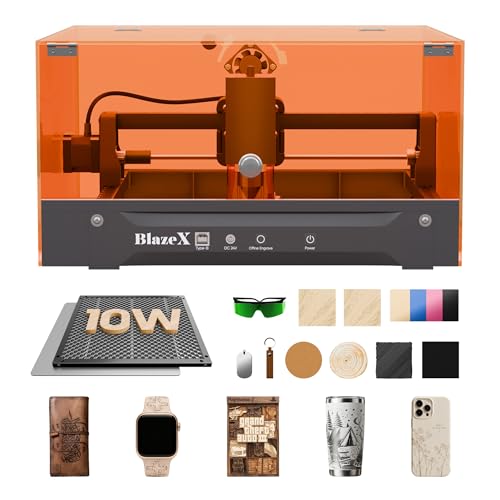
The BlazeX M3 delivers ultra-precision with a 10W laser, achieving 0.01 mm engraving accuracy on a wide range of fabrics, wood, leather, glass, and coated metals. It is designed for beginner-friendly use, including an enclosure and starter kit, making it ideal for first-time fabric projects and small-batch production. Best for: beginners and hobbyists who want high detail without a steep learning curve.
Limitations: The package emphasizes beginner accessibility; advanced color finishing or large-scale production may require additional setups.
Twotrees TTS-55 Pro Laser Engraver

The Twotrees TTS-55 Pro features a large 300 x 300 mm work area and a 5.5W laser with air-assist options. It uses advanced compression technology to deliver sharp engravings and deeper cuts, suitable for fabrics like leather and felt, as well as wood and acrylic. Best for: users needing a bigger workspace and stronger cutting performance for mixed-material projects.
Limitations: The laser power, while strong, may require careful material testing on delicate fabrics to avoid scorching.
ACMER S1 2500mW Laser Engraver

The ACmer S1 2500mW model emphasizes high-precision engraving with 0.01 mm repeatable positioning and up to 10,000 mm/min speeds, powered by a 2 mm focal length diode. It supports wood, bamboo, leather, plastic, PCB, and ceramics, with a 130 x 130 mm working area. Best for: small workshops that need precise detailing on fabrics and compatible substrates in a compact footprint.
Limitations: The lower wattage compared to the 6W variant means slightly slower cutting and shallower penetration on harder materials; test fabrics accordingly.
Algolaser 10W Laser Engraver with Rotary

The Algolaser 10W integrates a rotary roller and riser, enabling engraving on cylindrical fabrics and items like hats and tumblers. A 3.5″ touchscreen and AlgoOS provide user-friendly operation without constant computer connections. Best for: users who want to rotate products for consistent fabric engraving and expand into cylindrical textile items.
Limitations: Rotary attachments can add setup steps; ensure fabrics are securely mounted to prevent skewing during engraving.
Buying Guide
Power and material compatibility: Fabrics respond best to laser gear in the 5W–10W range for clean engraving without scorching. Consider whether you will engrave leather, felt, cotton, or synthetics, and verify the machine’s compatibility with these materials.
Enclosure and safety: Enclosures reduce exposure to laser light and fumes, especially important for indoor fabric work. Class 1 or enclosed designs are preferable for beginners and shared workspaces.
Software and workflow: Some machines come with built-in software, while others rely on external tools. If you plan to add color printing on textiles, consider models that support or offer add-ons for color workflows.
Work area size: Fabric projects often benefit from a larger bed. Choose 300 x 300 mm or larger when feasible to accommodate textiles, leather scraps, and multiple pieces in a single pass.
Precision and repeatability: Look for repeatable positioning accuracy in the 0.01 mm range for detailed fabric engravings, especially on fine leather or coated textiles where precision matters.
Ease of setup: Beginners benefit from quick-start kits, adjustable stands, and straightforward calibration routines. Pocket-sized models suit portable needs, while larger units suit in-studio production workflows.
Upgrade paths: Consider the availability of add-ons such as CMYK inkjet modules, rotary rollers for cylindrical items, and additional safety features to extend the machine’s capabilities over time.
FAQ
- What fabrics are best for laser engraving? Leather, faux leather, cotton, felt, and certain synthetics respond well to laser engraving, producing clean lines and detailed textures with minimal scorch marks when settings are properly tuned.
- Do I need an enclosure for fabric engraving? Yes. An enclosure provides safety, minimizes fumes, and helps maintain consistent engraving quality, especially in home or classroom environments.
- Can I engrave colored designs on fabric? Some machines support color printing or layered effects with add-ons; others are better at monochrome engraving. If color is essential, look for models with optional inkjet or color-print modules.
- Is a higher wattage always better for fabric? Higher wattage enables deeper cuts and faster processing on tougher materials, but it can also increase the risk of scorching delicate fabrics. Always test on a scrap sample first.
- What maintenance is required for fabric engraving machines? Regularly inspect lenses, clean exhaust paths, and replace worn nozzles. Keep the workspace free of dust and fabric fibers that can interfere with optics.
- Can I use these machines outdoors? Portable models like pocket-sized engravers can operate with a power bank, but outdoor use requires stable power and weather considerations for the electronics and enclosure.
Add a Comment