Answering the need for efficient, safe material handling, the following selections center on electric cable hoists with trolley systems. These options suit workshop pros, contractors, and DIY enthusiasts who require smooth horizontal movement across beams while lifting heavy loads. Each product is assessed for compatibility with common I-beams, ease of installation, and reliability in everyday lifting tasks.
| Product | ||||
|---|---|---|---|---|
| SKTREX Cable Trolley for Electric Hoist | Not specified | 1-5/8″ Wide Strut Channel and taller | Two-way rolling trolley | Light-to-moderate loads on 1-5/8″ strut channels |
| VEVOR 4400lbs Electric Chain Hoist with Power Trolley | 4400 lbs | Compatible with overhead tracks; 3-phase power | Horizontal trolley movement with electric lift | Heavy-duty industrial lifting with power movement |
| BEAMNOVA 1 Ton Electric Trolley | 1 ton (2200 lbs) | Pa600–PA1000 hoists; standard or wide flange I-beams | Electric trolley movement | Versatile beam compatibility and strong build |
SKTREX Electric Cable Trolley For Unistrut
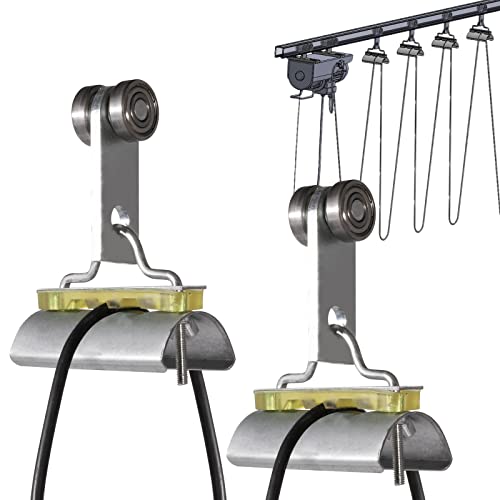
The SKTREX cable trolley assembly is designed to work with 1-5/8″ wide strut channels or taller, combining a walking wheel, bracket, and supporting plate to fix the flexible cable. The system uses a synchronized traction frame and pulley to deliver controlled cable power for lifting tasks. Best for workshop setups where a compact, robust trolley is needed to run along a fixed strut channel, enabling predictable motion with moderate loads.
- Best for: installations on 1-5/8″ wide strut channels and taller
- Strong, rust-resistant build with hot-rolled carbon steel
- Note: Some users may require exact beam compatibility checks before ordering
VEVOR 4400lbs Electric Chain Hoist With Power Trolley

This heavy-duty hoist provides a 4400 lb lifting capacity with a 20 ft lift height and a motorized trolley. It operates on three-phase power (208–240V or 440–480V), enabling efficient horizontal movement along with lifting. Best for manufacturing, warehouses, or job sites needing powerful simultaneous lifting and traversing capabilities. A caution: ensure wiring and control systems meet local electrical codes before installation.
- Best for: high-load, industrial environments needing motorized movement
- Horizontal speed and dual-control options (wired and wireless remotes)
- Limitation: requires appropriate 3-phase electrical supply and setup
BEAMNOVA 1 Ton Electric Trolley

BEAMNOVA’s electric trolley is built for versatility, fitting standard or wide flange I-beams and supporting up to 1 ton. It includes a side locking nut with anti-loose design and a manganese steel frame with a durable finish. Best for mixed beam configurations and installations where a secure, stable trolley is needed to support PA600–PA1000 hoists.
- Best for: universal I-beam compatibility and secure hoist carriage
- Durable steel construction with corrosion-resistant finish
- Limitation: heavier units may require additional mounting hardware
VEVOR Electric Hoist Manual Trolley

VEVOR’s manual trolley accommodates PA600–PA1000 hoists and features adjustable width from 2.68″ to 4.33″, enabling use on various I-beam tracks. With a manganese steel frame and anti-loose locking, it emphasizes safety and durability for horizontal movement with manual control. Best for users who prefer hands-on control and on-site beam flexibility.
- Best for: manual operation with adjustable beam width
- Anti-loose design and rugged construction
- Limitation: requires manual control effort for moving loads
Bigorenda Electric Trolley For Power Hoist

Bigorenda’s trolley offers a 2204 lb capacity with 2.68″–4.33″ adjustable beam width and 360° wheel rotation for navigating tight spaces. The design supports PA200–PA1000 hoists and provides a robust steel construction with polyurethane wheels for smoother operation. Best for workshops with varying beam widths and frequent gear changes, but note that the extended width adjustment requires proper alignment during installation.
- Best for: adjustable beam widths and tight-space maneuverability
- 360° rotating wheels aid navigation on complex routes
- Limitation: heavier and more complex to install compared to smaller trolleys
Buying Guide: Key Considerations For Electric Cable Hoists With Trolleys
- Load capacity: Match the hoist and trolley combination to the heaviest planned lift. Confirm compatibility with your hoist model (PA600–PA1000, 1 ton, etc.).
- Beam compatibility: Identify your beam type (standard I-beam, wide flange, or strut channel) and verify the trolley’s width and adjustment range.
- Power source: Decide between electric drives requiring three-phase power and manual options. Check local electrical codes for installation.
- Movement needs: Choose between electric trolley movement for continuous operation or manual control for simple, cost-effective tasks. Consider two-way vs. single-direction movement based on the workspace.
- Durability and maintenance: Look for steel frames, rust-resistant finishes, and sealed bearings to reduce maintenance and extend lifespan.
- Installation complexity: Some models offer straightforward mounting on a single beam, while others require precise alignment and additional hardware.
- Safety features: Anti-loose nuts, locking mechanisms, and appropriate load balancing are essential for safe operation.
Frequently Asked Questions
- What beam width should I expect from an electric trolley? Answer: Most trolleys support standard or wide flange I-beams and adjust within a specified range (e.g., 2.68″–4.33″).
- Do these systems require professional installation? Answer: Some setups are straightforward, but three-phase powered hoists and complex beam configurations may require professional installation.
- Can a trolley move while lifting a load? Answer: Many models offer synchronized electric movement with the hoist, but always follow the manufacturer’s safety guidelines.
- What maintenance is needed? Answer: Regularly inspect rails, wheels, and bearings; ensure locking nuts remain secure; lubricate moving parts per the manual.
- What safety features matter most? Answer: Anti-loose devices, robust frames, rust protection, and proper load balancing are critical for long-term safety.
- Is a higher capacity hoist always better? Answer: Not necessarily. Choose capacity to cover your heaviest expected load plus a safety margin, while factoring in beam strength and drive reliability.
Add a Comment