Answering the practical need for reliable dry mortar mixing, this guide highlights five top mixer machines that overall balance power, portability, and user-friendly features. These picks are best for small to mid-sized projects, DIY mortar work, tile setting, and light construction tasks. Each product is suited for different materials—mortar, grout, plaster, cement, or concrete—depending on motor power, drum size, and mixing action. Below is a quick comparison to help you decide which mixer matches your project scope and frequency of use.
| Product | Best For | Key Benefit | Approx. Capacity |
|---|---|---|---|
| NorthSpoor 2600W Handheld | Frequent small jobs | High-powered copper motor, six speeds | Small to medium batches |
| Dragro 2100W Handheld | Versatile, on-the-go mixing | Locking function with overheating protection | Moderate batches |
| NorthSpoor 2600W Blue Handheld | Portable, frequent use | Same powerful motor, compact design | Compact batches |
| Bucket Mortar Mixer XC | 5-gallon bucket projects | Auger action for bottom-to-top mixing | Up to 4 gallons dry pack mortar |
| SPECRAFT 4.9 Cu Ft Portable | Site work, wheelbarrow-style | Large drum, heavy material capability | Very large batches |
NorthSpoor Electric Handheld Cement Mixer, 2600W
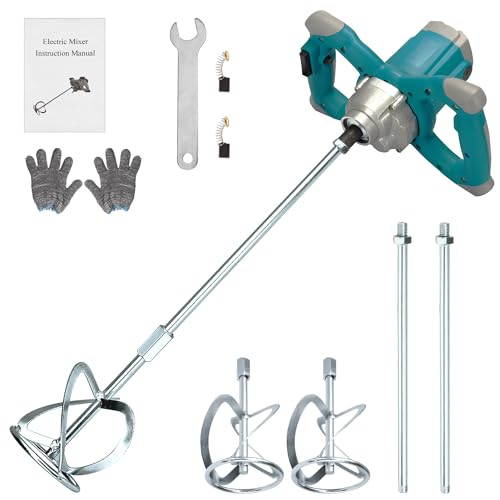
The NorthSpoor 2600W handheld mixer is designed for power and control. It features a copper motor for efficiency and a 110V US plug, with an advanced heat-dissipation system to reduce overheating risk. This model uses six gears and spiral double propellers to ensure thorough mixing with less splashing.
Best for: Homeowners and DIY enthusiasts doing frequent small to medium batches of mortar, grout, plaster, or paint. The six-speed setting allows material-specific mixing without manual intervention.
Limitation: For very large batches, this handheld unit may feel less suited than a stand mixer with a larger drum capacity.
Dragro Electric Cement Mixer, 2100W

The Dragro mixer uses a 2100W copper motor with a 110V plug and a porous heat-dissipation design. It offers a 6-speed control with a locking switch, enabling continuous operation without holding the trigger. Overheat protection helps extend motor life during longer mixing sessions.
Best for: Contractors or DIYers who need a reliable handheld option that can handle mud, cement, mortar, plaster, and paint with less fatigue during extended use.
Caution: Overheating protection is helpful, but avoid prolonged continuous operation beyond recommended duty cycles to prevent heat buildup.
NorthSpoor Electric Handheld Cement Mixer (Blue)

This blue version mirrors the NorthSpoor 2600W design with a powerful copper motor and six-speed control. Its lightweight construction and straightforward assembly support quick setup and teardown on job sites or at home projects.
Best for: Users who need a portable, high-power mixer for repeated small batches of mortar, grout, plaster, or thinset, without heavy equipment investment.
Limitation: As with other handheld units, very large volume mixing remains impractical compared to full-size drum mixers.
Bucket Mortar Mixer XC

The Bucket Mortar Mixer XC is designed for use in a 5-gallon bucket, with auger action that pulls material from the bottom to the top. It’s capable of mixing 4 gallons of dry pack mortar in about 30 seconds, making it highly efficient for small batch continuous work.
Best for: Home projects or small-scale jobs where a bucket mixer provides convenient handling and rapid mixing for deck mud, mortar, or sand-based mixes.
Limitation: Not suitable for large-scale production or very heavy loads; limited to bucket-sized batches.
SPECRAFT Electric Cement Mixer, 4.9 Cu.Ft Portable

Featuring a high-torque 375W motor at 29.5 RPM, the SPECRAFT portable mixer is designed for consistent performance with concrete, mortar, stucco, and farm mixing needs. The wheelbarrow-style frame enables easy transport, and a large 140L drum reduces clogging when mixing heavier materials.
Best for: Small to medium commercial jobs or agricultural use where mobility and steady mixing are priorities. The portable design supports on-site work with moderate batch sizes.
Caution: The 375W motor is efficient for many mixes, but very heavy or dense formulations may require slower, extended mixing to avoid strain.
SPECRAFT Electric Cement Mixer, 4.9 Cu Ft Stand
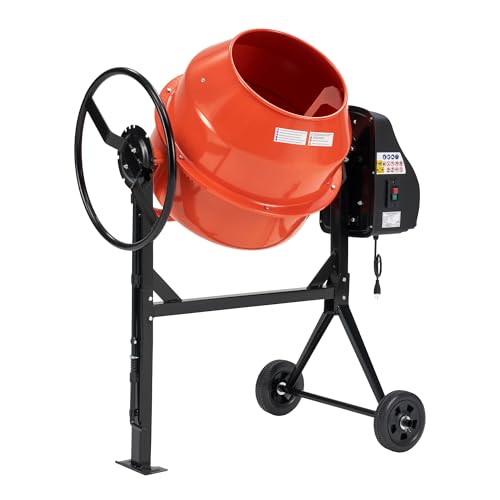
This stand mixer variant adds a foot-pedal design and drum lock for smooth tilting. It uses a 550W motor at 30 RPM and a 140L drum opening for straightforward loading and unloading. The seal on the drum helps prevent leaks during operation.
Best for: Users who value hands-free operation and a secure drum during mixing, ideal for repeated batches of mortar, stucco, or concrete in a shop or job site setting.
Limitation: Foot-pedal control adds convenience but may require some acclimation for users used to traditional trigger-style mixers.
BILT HARD Cement Mixer, 4 Cubic Ft

The BILT HARD mixer delivers a 550W motor with up to 1750 RPM, and a 4 cu ft drum capacity. It combines durable construction with a wide drum opening (15 inches) to simplify adding dry mixes. A sturdy frame and powder-coated finish add durability for regular use.
Best for: DIYers and light commercial users needing reliable single-batch mixing for stucco, mortar, or concrete projects with easier loading and unloading.
Caution: While sturdy, this mixer is best for moderate workloads; very large or dense mixes may slow down or require shorter, repeated batches.
Mud Mixer Portable Wheeled Mudmixer

The Mud Mixer Portable Wheeled Mudmixer emphasizes ease of use with a fully adjustable water input for mixing concrete, mortar, or stucco. It features a hopper-based loading system for drop-and-fold bag mixes, reducing manual measuring and mixing time.
Best for: Quick setups on job sites or home renovations where pre-mixed bags must be quickly turned into a workable batch, minimizing bucket handling.
Limitation: This type favors bagged mixes; dry bulk powders may require different equipment or additional prep for uniform results.
Buying Guide: Dry Mortar Mixer Considerations
- Project size and batch volume: Choose a mixer with drum or bucket capacity that matches your typical batch size to avoid overloading or underutilization.
- Power and motor type: Copper motors are common and reliable; higher wattage supports heavier mixes but may add weight and noise.
- Portability vs. capacity: Handheld and portable wheelbarrow-style mixers offer mobility for small jobs, while larger drums are better for frequent, larger batches.
- Mixing action and accessories: Look for spiral paddles, auger systems, or locking switches to reduce effort and improve consistency.
- Durability and build: Powder-coated frames, sturdy drums, and robust fasteners extend life in rough work environments.
- Safety and maintenance: Overheat protection, easy access to motor vents, and simple replacement parts reduce downtime.
FAQ
- What is a dry mortar mixer best used for?
Best for preparing mortar, grout, plaster, and thinset mixes in small to medium batches for tile work and small construction projects. - Should I choose a handheld mixer or a stand mixer?
Handheld mixers are portable and suited for smaller batches; stand mixers provide larger capacity and steadier operation for frequent use. - What is the importance of a locking switch?
A locking switch allows continuous operation without finger fatigue, especially during longer mixing sessions. - Is a larger drum always better?
Not always; a larger drum is beneficial for high-volume workloads but may reduce maneuverability and require more storage space. - What maintenance helps extend mixer life?
Regularly clear dust, inspect paddles, ensure vent openings are unobstructed, and follow manufacturer duty cycles to prevent overheating.
Add a Comment