Answering the need for reliable, moisture-free air, this guide highlights five top dry air compressor system options. Each is chosen for different industrial environments and tooling needs. Best for heavy workshop use, best for auto repair and painting, best for high-flow demands, best for compact setups, and best for budget-minded shops. The following table summarizes the core strengths of the selected products to help you compare at a glance.
| Product | Best For | Key Benefit |
|---|---|---|
| RVMARINEPAT 1/2″ NPT Air Compressor Water Separator | General shop tools | All-in-one drying with visible safety monitoring |
| VEVOR Air Compressor Filter Regulator | Finely filtered, auto-drain needs | 5μm to 0.1μm stages with auto drainage |
| VEVOR Compressed Air Dryer 85CFM | Medium-to-large 15–20 HP systems | Refrigerated drying with color screen control |
| Gokluuk 3/4″ NPT 4 Stage Air-Dryer | Heavy-duty, high-pressure environments | Four stages with auto drain and inline indicators |
| NANPU DFR-03 3/8″ NPT Air Drying System | Compact setups with reliable filtration | Double 5 micron filters for longer life |
RVMARINEPAT 1/2″ NPT Air Compressor Water Separator

All-in-one air drying system built for industrial environments. Includes 2 x 5 micron filters, 3 x 0.01 micron elements, desiccant beads, and necessary fittings. The filter and regulator combo traps water and stabilizes pressure, while the coalescing filter captures moisture and oil aerosols. A visible indicator shows when replacement is needed, helping maintain air quality. Best for shops that need a complete, ready-to-install drying solution without extra parts.
- Best for: Small to mid-sized shops that want an integrated dryer with clear monitoring.
- Why selected: Combines filtration, regulation, and desiccant drying in one unit, reducing setup complexity.
- Caution: The 0.01-micron element requires periodic replacement to maintain performance.
VEVOR Air Compressor Filter Regulator
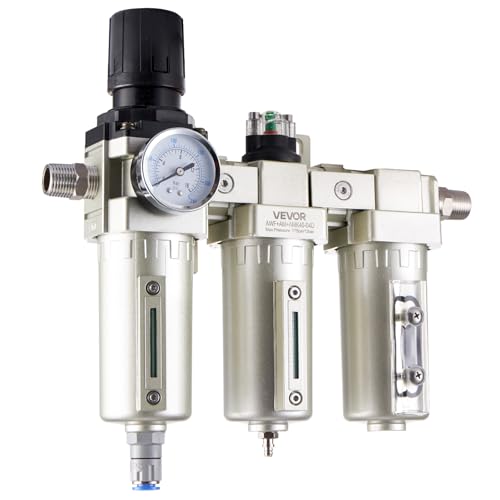
This three-stage filtration and desiccant system delivers clean, dry air with a robust filtration stack: 5μm brass filter, 0.3μm sponge filter, and a desiccant stage down to 0.1μm. An auto drain minimizes maintenance, lowering risk of moisture-related tool failures. Best for tools that demand consistently dry air and low maintenance.
- Best for: Tools and finishes that require very dry air with minimal manual draining.
- Why selected: Auto drainage and multi-stage filtration improve reliability in variable environments.
- Caution: Auto drain requires power; ensure the control line is wired correctly in your setup.
VEVOR Compressed Air Dryer 85CFM

Designed for mid-to-large industrial systems with 85 CFM capacity. It uses a refrigeration-based approach to remove moisture quickly and efficiently, suitable for 15–20 HP compressors. A color control panel helps monitor performance and dew point. Best for shops needing steady, high-volume dry air.
- Best for: Industrial setups with higher airflow demands.
- Why selected: Refrigeration-based drying delivers consistent dew point across a range of operating conditions.
- Caution: Higher upfront cost and energy usage compared to smaller or desiccant-only dryers.
Gokluuk 3/4″ NPT 4 Stage Air-Dryer

Industrial-grade, high-pressure drying with four stages and auto drain. Includes Stage 1/2 filter (5 micron) to remove most contaminants and moisture, plus Stage 3 coalescing filter (0.01 micron) for final purification. Best for plasma cutting, painting, and other higher-demand processes where moisture and oil must be minimized before finishing.
- Best for: Heavy-duty environments that require low moisture at high pressures.
- Why selected: The top-view sight window helps schedule replacements, improving downtime planning.
- Caution: Not recommended for horizontal installation as noted in specs.
NANPU DFR-03 3/8″ NPT Air Drying System

Compact piggyback air filter/regulator with dual 5-micron elements and a semi-auto drain. Suitable for smaller shops or setups where space is limited but filtration performance remains essential. Best for budget-conscious users needing reliable basic filtration and drainage.
- Best for: Small workshops or service bays with limited space.
- Why selected: Double filtration allows longer filter life and better air quality for smaller lines.
- Caution: 3/8″ NPT size may limit compatibility with larger hoses or ports in some systems.
Buying Guide
Key considerations when choosing a dry air system:
- Air demand: Match CFM/PSI to your compressor size and tools. Higher flow systems are necessary for painting, plasma cutting, or sandblasting.
- Drying method: Refrigerated dryers work best for high-volume air streams, while desiccant-based and coalescing filters excel at removing moisture to very low dew points.
- Filtration stages: More stages (coarse, fine, then desiccant) generally yield drier air but cost more and require maintenance.
- Auto drain: Auto-drain features reduce manual maintenance but require a power source and proper wiring.
- Maintenance access: Choose units with clear indicators, replacement filters, and easy access to components for minimal downtime.
- Installation space: Consider footprint and port sizes (NPT) to ensure compatibility with existing lines and fittings.
- Environmental conditions: Extreme temperatures or dusty environments can affect performance and filter life.
FAQ
- What is the main difference between refrigerated and desiccant drying?
Refrigerated dryers remove moisture by cooling and condensing water vapor, suitable for higher air volumes. Desiccant systems adsorb moisture at very low dew points, often used where ultra-dry air is essential. - Do I really need an auto drain?
Auto drains reduce maintenance by releasing condensate automatically, preventing water buildup that can cause corrosion and equipment damage. - Can I install these vertically or horizontally?
Some designs specify horizontal installation only. Always follow manufacturer guidance to avoid leaks or reduced efficiency. - What size of dryer do I need for painting applications?
Painting often requires very dry air (low dew point) and stable pressure; consider a multi-stage dryer with auto drain and a higher CFM rating. - How often should I replace filters in these systems?
Replacement intervals depend on usage and moisture load. Look for indicators and plan routine maintenance accordingly.
Add a Comment