When choosing a drinking water filling machine, the goal is accurate, sanitary, and efficient bottle filling for low- to mid-volume needs. This guide highlights five reliable options that are well-suited for water and other low-viscosity liquids. The featured products range from manual to automatic and pneumatic filling systems, making it easier to pick the right fit for personal use, small offices, or micro-bottling setups. Below, you’ll find concise comparisons, best-use scenarios, and practical purchase considerations.
| Product | Best For | Key Benefit |
|---|---|---|
| Hannayah Liquid Filling Machine (Automatic) | Small to medium operations | Automatic counting and high accuracy |
| Moonshan Liquid Filling Machine | Low-volume batches | Automatic, high flow, portable |
| VEVOR Manual Paste Liquid Filling Machine | Manual control and precision | Adjustable 5-100 ml, durable |
| VEVOR Pneumatic Paste Liquid Filling Machine | Hands-free filling | Pedal operation, 5-50 ml range |
| CSY-3200 Weighing Diaphragm Pump | Precise dosing by weight | 10-3000 g, high-precision |
Hannayah Automatic Digital Water Filler

Best for: small to medium bottling operations that need automation without manual counting. The Hannayah model offers a built-in LCD display and automatic counting to control fill volumes precisely, making it suitable for water, juice, and other low-viscosity liquids. Its stainless steel construction supports hygienic use and repeatable results over time. A potential limitation is that it’s designed for non-carbonated liquids; avoid carbonated beverages to prevent foam and spill issues.
Moonshan 2-118 Oz Liquid Filling Machine

Best for: portable, budget-conscious setups that require a higher flow for water or cosmetic liquids. Moonshan emphasizes a large flow rate and multi-data saving with automatic and manual modes, plus an automatic bottle counting function. It suits small batch production and mobile use. Not ideal for carbonated liquids or highly viscous pastes, as performance drops at very low volumes.
VEVOR Manual Paste Liquid Filling Machine

Best for: users who want precise, hands-on control over fill volumes in a compact, stainless steel unit. It offers an adjustable 5-100 ml range and easy-to-read scale for repeatable results. It’s suitable for water, milk, juice, and light cosmetic liquids. A limitation is that manual filling may be slower for larger batches compared to automatic systems.
VEVOR Pneumatic Paste Liquid Filling Machine

Best for: hands-free filling in small-batch production. This model uses a pedal-operated pneumatic system and covers a 5-50 ml range with food-grade 304 stainless steel, making it suitable for water, shampoo, and light liquids. Caution: it requires a compatible external air compressor; not ideal if you only need a fully electric solution.
CSY-3200 Weighing Diaphragm Pump Filler
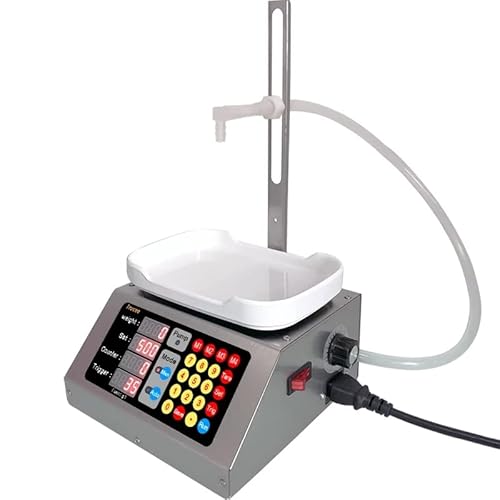
Best for: precision dosing by weight, useful when volume accuracy is critical. The CSY-3200 supports 10-3000 g with 1 g divisions, making it suitable for water and other liquids with strict fill targets. Best used where weight-based accuracy is prioritized, but it may be more complex to operate than simple volume-fillers.
Buying Guide: Practical Purchase Considerations
- Filling Type: Choose manual, pneumatic, or automatic based on batch size, labor availability, and desired throughput. Manual is simplest; automatic and pneumatic boost speed and consistency.
- Volume Range: Match the liquid’s typical fill volume. Lower ranges (5-50 ml) suit small bottles; higher ranges (3500 ml) suit larger containers or concentrates.
- Materials And Hygiene: Look for 304 stainless steel or food-grade components to ensure compatibility with drinking water and easy cleaning.
- Compatibility: Verify nozzle sizes and bottle heights to ensure proper alignment and minimal spills. Adjustable shelves or brackets help handle various bottle sizes.
- Maintenance: Check for availability of replacement parts (gaskets, diaphragms, seals) and ease of disassembly for cleaning.
- Power And Air Requirements: Electric and pneumatic systems may require outlets or compressors. Ensure your workspace can supply the necessary power or air pressure.
- Warranty And Support: Consider vendors offering clear documentation and responsive support for quick troubleshooting.
Frequently Asked Questions
- What is the typical fill range for water bottles? Answer: Most small-batch fillers operate in a range from about 5 ml to 3500 ml, with some models focused on 10-3000 g depending on weight-based dosing.
- Can these machines handle carbonated water? Answer: Many fillers are designed for non-carbonated liquids; carbonation can cause foaming and inconsistent fills, so confirm liquid compatibility with the supplier.
- Is a pneumatic filler dependent on an air compressor? Answer: Yes. Pneumatic fillers require a suitable air supply, typically around 500W equivalents, to operate the pedal mechanism.
- Which filler is best for small business use? Answer: Automatic or semi-automatic fillers (like Hannayah or Moonshan) offer higher throughput and repeatable results with less manual effort.
- Are these fillers easy to clean? Answer: Most models use stainless steel components and removable nozzles; however, cleaning procedures vary by model, so follow the manufacturer’s guidance to prevent contamination.
- What should I consider for future expansion? Answer: Evaluate scalability, such as the option to upgrade to automatic counting, larger nozzle configurations, and compatibility with different bottle sizes.
Add a Comment