Double shaft shredder blades are designed to work with dual-rotor shredders to tackle bulky waste, tires, plastics, and metal scraps. This article helps buyers identify the best options for different needs, from small workshops to mid-size recycling facilities. The top picks below emphasize blade durability, torque, and compatibility with common double-shaft configurations. Each product is evaluated for who it’s best for, its key strengths, and potential limitations. Use the quick comparison table to compare core features at a glance.
| Product | Best For | Why It Stands Out |
|---|---|---|
| 1.5KW Industrial Double Shaft Shredder | Small facilities, metal/plastic/waste mixes | High-torque 400Nm, 21 blades for uniform output |
| Heavy-Duty Industrial Tire Shredding Machine | Bulk tire and bulky waste | Large hopper, PLC control, safety features |
| JARYANNIX 220V Universal Biaxial Crusher | Versatile, small- to mid-scale operations | 21 precision blades, robust steel frame |
| Heavy Duty Dual Shaft Shredder Tire Recycling Equipment | Rubber and tyre recycling | Dual shaft design for continuous operation |
| Heavy-Duty Tire Shredder With PLC | High-volume tire processing | PLC control, customizable models |
1.5KW Industrial Double Shaft Shredder

Best for small facilities that process mixed waste. This model features a 1.5KW motor with a K47 gear reducer delivering 400Nm torque at 25 RPM, ensuring steady, heavy-duty shredding performance. It handles light metals, plastics, wood, and kitchen waste with consistent results, making it well-suited for workshops, recycling corners, or waste management setups that require reliable fragmentation without frequent blade changes.
Why chosen: High-torque output and a long blade life are critical for facilities with varied feedstock. The 21 pieces of Φ90×8 9CrSi alloy blades provide hardness and wear resistance for durable operation.
Best-for: Buyers needing a compact, robust dual-shaft shredder capable of handling plastics, light metals, wood, and organic waste in a single pass. Limitation: blade replacement frequency depends on material composition and throughput; ensure blade shape and gap settings match feedstock.
Heavy-Duty Industrial Tire Shredding Machine
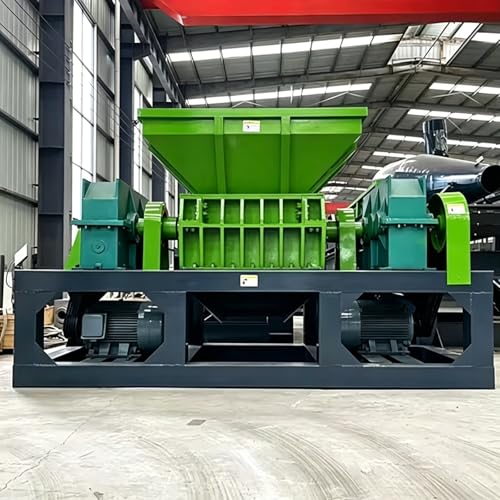
Best for tire recycling and bulky waste streams. This double-shaft shredder is built with a large-caliber hopper and a thickened outer frame for stability during heavy feeds. It uses a large-angle hexagonal rotating shaft design and a professional PLC automatic control system that supports one-key start, stop, and reverse operations, providing safety during overloads and oversized materials.
Why chosen: The combination of a robust frame, safe feeding, and PLC control makes it suitable for continuous tire processing and rubber recycling lines. It’s particularly strong for facilities that require automated safety safeguards and straightforward operation. Limitation: price and scale may be higher than smaller workshop units; verify compatibility with existing conveyors and discharge systems.
JARYANNIX 220V Universal Biaxial Crusher

Best for versatile, mid-size operations needing dependable dual-shaft performance. This unit features 21 9CrSi alloy blades with a heavy-duty steel frame and moving knives designed for quick replacement. It’s well-suited for mixed plastic, wood, and rubber waste streams where consistent size reduction is essential for downstream processing.
Why chosen: Alloy blades and robust frame deliver long blade life and stable operation under variable loads. Limitation: data on exact torque or motor speed isn’t specified; ensure it matches your throughput and feedstock characteristics.
Heavy-Duty Dual Shaft Shredder Tire Recycling Equipment

Best for rubber and tyre recycling projects requiring a dual-shaft setup. This machine combines a dual-shaft design with sturdy construction to support continuous operation in tyre recycling and rubber material processing environments. It is suitable for facilities seeking reliable throughput with durable components.
Why chosen: Dual shafts support stable feeding and efficient size reduction for bulky rubber items. Limitation: detailed specifications (torque, blade count) aren’t provided; confirm with supplier before purchasing for a specific throughput target.
Heavy-Duty Tire Shredder With PLC

Best for high-volume tire processing in larger shops or recycling facilities. This tire shredder emphasizes PLC control with customizable models, enabling operators to tailor feed rates, rotation directions, and safety interlocks to match workload variations. It supports diverse materials beyond tires when configured appropriately.
Why chosen: PLC control and model customization support scalable operations and safer, automated workflows. Limitation: multiple models mean a need for careful specification to avoid over- or under-capacity for your site’s throughput requirements.
Buying Guide
What should you check before buying a double-shaft shredder blade system?
- Material compatibility: Determine if the machine is designed for tires, plastics, metals, or mixed waste, and ensure blade geometry suits your primary feedstock.
- Torque and power: Higher torque supports tougher materials but may increase energy consumption. Match power to expected throughput.
- Blade design and life: Look for alloy blades (like 9CrSi) with heat treatment and replaceable knives to maximize uptime.
- Feeding features: A large hopper and safe loading mechanisms reduce operator fatigue and improve throughput consistency.
- Control systems: PLC-based controls offer auto-reverse, overload protection, and process automation—important for high-volume lines.
- Maintenance and service: Consider ease of blade replacement, frame rigidity, and the availability of spare parts.
- Scalability: If growth is likely, choose units with upgrade paths or modular components to expand capacity over time.
- Safety: Ensure built-in emergency stops, guards, and interlocks are adequate for your operation’s risk profile.
Practical Buying Questions
- What type of waste will you process most often (tires, plastics, wood, metals)?
- Do you need continuous operation or batch processing?
- Is PLC control essential for your workflow and safety requirements?
- What is your target through-put, and does the machine meet that demand?
- Are spare blades and parts readily available from the supplier?
- Can the system integrate with your conveyors and downstream separation equipment?
FAQ
- What is a double shaft shredder blade best used for? It is designed to reduce bulky waste with two counter-rotating rotors, enabling efficient material cutting and uniform fragment sizes.
- Do all double-shaft shredders require PLC control? Not all, but PLC controls add automation, safety, and repeatable performance, especially in high-volume shops.
- Are 9CrSi alloy blades necessary? They provide excellent hardness and wear resistance, extending blade life under challenging feeds.
- Can these machines process rubber tires only? Some models are tuned for tires; others handle mixed waste. Check feedstock compatibility carefully.
- Is maintenance costly? Maintenance costs depend on blade wear, replacement intervals, and the availability of spare parts.
- What capacity should I expect? Capacity varies by motor power, blade design, and feed size; consult the supplier with your specific material mix.
Add a Comment