Answering your search for reliable conveyor belt splicing tools, this guide highlights five top options suited to professional workshops and on-site repairs. Each product is chosen for durability, ease of use, and compatibility with common fasteners like wire hooks, spikes, and buckles. Ideal buyers include maintenance technicians, plant supervisors, and engineers seeking faster belt maintenance without compromising belt integrity.
| Product | Best For | Key Benefit |
|---|---|---|
| KONLEYA 24″ Conveyor Belt Lacing Tool | Medium to large belts | Integrated one-piece design for stable splicing |
| Zonon Lacing Tool Kit | Industrial installations | Power-assisted installation speeds up work |
| Trallyer 2″ Staple Fastener Tool | Small to mid-size belts | Lightweight, adjustable for multiple models |
| Victeut 48″ Fasteners Clips | Split belt assemblies | Long, three-section design with hinge pin |
| KOTENTOP 48″ Roller Lacer | Large, wide belts | Strong, welded splicing area for smooth operation |
KONLEYA 24″ Conveyor Belt Lacing Tool

Best for mid-to-large belt widths, this tool features an integrated one-piece design to prevent detachment of hook legs, improving safety and reliability during splicing. The welded assembly creates a flat splicing area, reducing belt resistance and ensuring a smoother run. It supports customizable stainless steel fasteners offering chemical and acid resistance, plus anti-magnetization options for diverse industrial settings, including food processing. Best for plants needing durable, stable fastener installation in repetitive cycles. Caution: larger units require sufficient workspace and handling strength for optimal operation.
Zonon Lacing Tool Kit Pack

Best for fast-paced installations, Zonon’s kit includes a standard 1/2-inch drive compatible with most impact wrenches, speeding up belt fastening. The set is built for industrial durability with high-strength treated steel, suitable for harsh environments. It supports precise punching and secure fastening with reduced manual effort. Choose this if you need to accelerate installations on multiple or large belts. Limitation: the kit is more expensive than purely manual tools and relies on compatible power tools for maximum benefit.
Trallyer 2″ Staple Fastener Tool

Best for small to medium belts that require reliable staple lacing, this tool is full-metal, strong, and adjustable to accommodate various staple lacing models (RS62, RS125, RS187, MR1S, MR2S, MR3S). Weighing about 2.5 pounds, it is portable and straightforward to use. This choice is ideal for shops needing a cost-effective, durable manual option. Limitation: may be less efficient for very wide belts without additional handling or multiple passes.
Victeut 48” Fasteners Clips
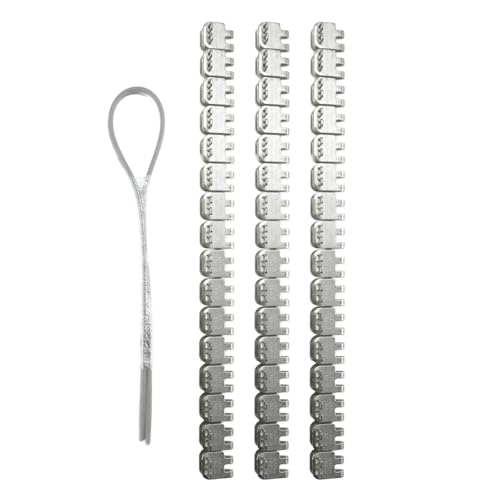
Best for long, sectional belt assemblies, this 48-inch set is designed to split into three 16-inch sections, making assembly and transport easier. It includes a 27.5-inch hinge pin to simplify on-site installation of leather-like fasteners. The design focuses on compatibility with 5–6 mm belt thicknesses, suitable for heavy-duty industrial belts. Choose this when you need a long, modular solution for large or complicated splices. Caution: ensure belt thickness matches the specified range for best results.
KOTENTOP 48″ Roller Lacer

Best for wide belts and higher-volume splicing, this 48-inch manual roller lacer features a welded, one-piece structure that prevents hook legs from detaching and reduces belt resistance during operation. It comes with two installation templates to standardize splicing and improve consistency. Choose this for larger industrial belts or when frequent, quick repairs are required. Limitation: heavier tool may require more storage space and physical effort during long sessions.
Buying Guide: Key Considerations When Choosing Conveyor Belt Splicing Tools
How wide is your belt? Select tools with compatible width ranges to ensure a secure, clean splice. Consider whether you need a manual tool or a power-assisted kit to speed up installation in high-volume environments. Durability matters: look for one-piece designs and welded splicing areas to minimize belt resistance and prevent hook leg detachment. Material compatibility is essential if you work with food-grade or chemically aggressive environments; seek options offering stainless steel fasteners and corrosion resistance. Portability and weight influence on-site handling, while the availability of installation templates or guides helps ensure consistent results.
What installation scenario will you encounter? For on-site repairs, portable manual tools may suffice. For maintenance shops with multiple belts, power-assisted sets can drastically reduce cycle times. If working with very wide or long belts, modular components like three-section assemblies can simplify handling. Always verify belt thickness compatibility and proper fastener types (wire hook, spike, or buckles) before purchasing.
FAQ
- Q: Are these tools suitable for food processing belts?
A: Some tools offer customizable stainless steel fasteners and corrosion resistance; verify material specifications with the seller before use in food settings. - Q: Can I use these tools for belts wider than 14 inches?
A: Yes, several options support larger widths, including 24 to 48 inches, but check each model’s stated width range. - Q: Do I need power tools to use the Zonon kit?
A: The Zonon kit includes a power-wrench option; without power tools, the installation will be slower with manual effort. - Q: Is a one-piece roller lacer more reliable than a multi-piece design?
A: A one-piece design reduces the risk of individual hook legs detaching and generally provides steadier operation. - Q: What maintenance is required for these tools?
A: Regular cleaning, lubrication of moving parts, and inspecting fasteners for wear will extend tool life and maintain performance. - Q: Do these tools come with installation templates?
Note: Always follow manufacturer instructions for assembly, operation, and safety. This guide presents a structured overview of available tools based on listed features and typical industrial needs.
Add a Comment