Answering the need for reliable, oil-free, and continuous-duty vacuum pumps for labs, electronics work, and HVAC service, the following selections emphasize oil-free or maintenance-free operation, low noise, and durable construction. These models are suited for continuous operation, long-term projects, or service environments where uptime matters. Best for labs and electronics technicians, best for HVAC technicians, and best for DIY enthusiasts needing low-maintenance performance.
Product overview table (selected models):
| Product | Best For | Key Benefit | Approx. Flow |
|---|---|---|---|
| ScitoLAB Vacuum Pump 50 L/Min | Laboratory and electronics work | Oil-free, maintenance-free with switch; compact and quiet | 50 L/min |
| Orion Motor Tech 2 Stage 9 CFM | HVAC service and R-series refrigerants | Deeper vacuum to 1.5 microns; decent duty cycle | 9 CFM |
| Orion Motor Tech 14.4 CFM 2 Stage | High-volume evacuation for AC systems | Fast, deep vacuum with low noise | 14.4 CFM |
| YINGMALE Oilless Vacuum Pump 50 L/Min | Laboratories and electronics DIY | Oil-free, ultra-quiet, compact | 50 L/min |
| VEVOR Vacuum Pump 7 CFM | Automotive A/C and resin degassing | Two-stage, robust, various inlet ports | 7 CFM |
ScitoLAB Vacuum Pump 50 L/Min

Oil-free and maintenance-free: The upgraded version includes an on/off switch for easy power management. It operates without lubrication, reducing maintenance downtime and boosting production. Best for labs that require a quiet, reliable pump with minimal fuss.
- Silencer reduces noise for a quieter workspace.
- Compact design with clear interfaces for quick setup.
- Includes multiple connectors and a side port for a pressure gauge.
Best for: Laboratories and electronics labs that value low maintenance and steady performance. Choose this if you need a compact, oil-free option with switch control. Caution: Ensure compatible connectors when integrating with existing setups.
Orion Motor Tech 2 Stage Vacuum Pump

Stronger motor and deeper vacuum: This 3/4 HP two-stage pump achieves deep vacuums to 1.5 microns and a fast 9 CFM evacuation. It’s suited for HVAC servicing with refrigerants such as R12, R22, R134a, R410a. Best for: HVAC technicians seeking fast evacuations and reliable dual-stage performance.
- High pumping efficiency with a copper motor.
- 2-hour duty cycle supports moderate continuous use.
- Low-noise operation with an exhaust cap).
Caution: Suitable for compatible refrigerants; verify system compatibility before use.
Orion Motor Tech 14.4 CFM 2 Stage
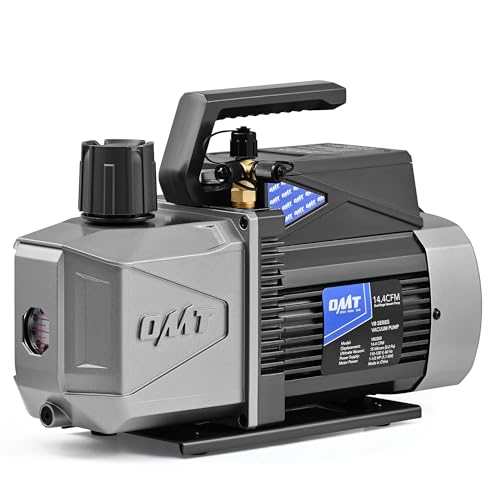
Dual-stage design for fast evacuations: This pump draws down to 1.5 microns quickly, making it ideal for servicing R134a, R410A, R22, R142b, and R152a systems. Best for: Professionals needing higher flow and faster service times in automotive or residential HVAC projects.
- Minimized oil mist with a combined oil fill/exhaust port cap.
- Under 70 dB for quieter operation.
- High-performance copper motor and sturdy build.
Limitation: Higher power draw; ensure electrical availability for extended use.
YINGMALE Oilless Vacuum Pump 50 L/Min

Oil-free, maintenance-free operation: Reaches a vacuum down to -86 kPa with no oil, reducing downtime and maintenance costs. Ultra-quiet (<50 dB) due to an upgraded aluminum silencer. Best for: Labs and workshops needing a compact, low-noise pump without lubrication requirements.
- Integrated on/off switch on the power cord for instant control.
- Lightweight and durable with simple installation.
- 4 hose connectors included for flexible setups.
Caution: While quiet, ensure the available space accommodates its airflow and heat dissipation needs.
VEVOR Vacuum Pump 7 CFM
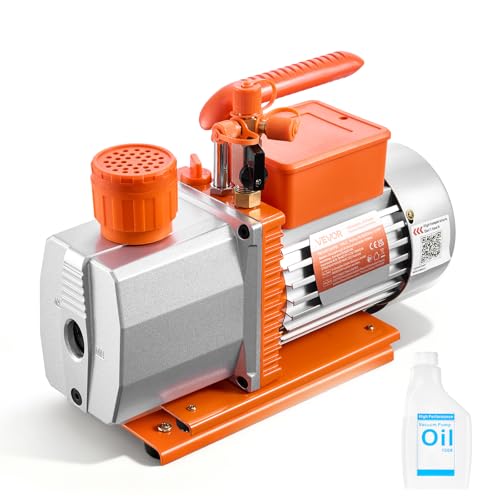
Two-stage design for reliable HVAC maintenance: Delivers 7 CFM with a robust 3/4 HP motor, suitable for automotive A/C service and resin degassing. Best for: Technicians needing a balance between flow and portability with multiple connection options.
- Cast-iron and die-cast aluminum housing with built-in cooling.
- 1/4 SAE, 1/2 ACME, and 3/8 SAE inlet ports for versatile connections.
- Oil included option? Note that this model can be used with or without oil depending on version; verify your unit’s configuration.
Limitation: Some users may prefer oil-lubricated designs for certain continuous-duty tasks; verify ongoing oil needs for your workflow.
Buying Guide: Continuous-Duty Vacuum Pumps
What to consider when choosing a continuous-duty vacuum pump for labs, electronics, or HVAC service:
- Oil-free vs oil-lubricated: Oil-free systems require less maintenance and avoid oil contamination; ideal for labs and electronics. Oil-lubricated pumps may offer longer life in some heavy-duty applications but require oil management.
- Vacuum depth and flow: Two-stage pumps provide deeper vacuums (often down to 1.5 microns) and higher flow rates (CFM). Choose based on the target vacuum level and the system volume.
- Duty cycle and noise: A longer duty cycle supports continuous use; look for pumps rated for constant operation. Noise levels matter in shared spaces; silencers and low dB ratings are favorable.
- Port compatibility: Check inlet/outlet sizes (SAE, ACME, etc.) and included connectors to ensure seamless integration with existing hoses and gauges.
- Safety features: Sparkless operation or ignition-proof switches are important when handling flammable refrigerants (A2L or similar). Ensure appropriate electrical specifications for your environment.
- Maintenance and accessibility: On/off switches on the cord, simple configuration, and easy-to-replace seals or rings reduce downtime and maintenance costs.
Frequently Asked Questions
- What makes a vacuum pump suitable for continuous duty?
Look for a two-stage design, robust motor, adequate cooling, and a duty cycle rated for extended operation without overheating.
- Are oil-free pumps better for electronics labs?
Yes, oil-free models minimize oil contamination risk and reduce maintenance in sensitive electronics environments.
- What is a microns vacuum rating, and why does it matter?
Micron rating indicates how deep the vacuum can reach. Lower microns mean a deeper vacuum, which is important for faster processing and cleaner evacuations.
- How important is noise level?
Lower noise improves comfort in shared spaces and can reduce ear fatigue during long sessions.
- Can these pumps handle refrigerants and HVAC work?
Yes, several models are designed for HVAC service and compatible refrigerants; verify exact refrigerant support and safety guidelines for your system.
- Do I need a pump with a pressure gauge port?
A pressure gauge port helps monitor system pressure during evacuations, which is useful for precise servicing.
Add a Comment