Answer: If your goal is steady, household water pressure without frequent pressure-tank cycling, a constant pressure jet pump is typically the best choice. This guide highlights five reliable models suited for homes, gardens, and small farms, explaining who each product is best for and why. The selection prioritizes pumps that maintain steady pressure as water demand changes, with attention to depth, flow, and power needs. Whether you’re upgrading a shallow-well system or boosting municipal pressure, the right pump can stabilize flow across showers, sinks, and irrigation.
Summary table of chosen products:
| Product | Best For | Key Benefit | Power | Head / Flow |
|---|---|---|---|---|
| Bur-Cam 506532SS ¾ HP | Shallow wells up to 25′ or municipal boost | Corrosion-resistant body with constant pressure | ¾ HP | Shallow well compatibility |
| GEARBONE 80 PSI 3/4 HP | Whole-house pressure with real-time demand | Intelligent constant pressure, energy-efficient | ¾ HP | Variable speed, 22-80 PSI |
| Red Lion RJS-100-PREM 1 HP | Higher flow, larger homes or farms | Cast-iron durability, steady pressure | 1 HP | Up to ~23 GPM |
| Rioflybee 1.5 HP | Large yards, irrigation, mixed indoor/outdoor use | Self-priming with high head and flow | 1.5 HP | Up to 1320 GPH, 160 ft head |
| AQUASTRONG 1.5 HP | Large lawns and irrigation systems | High flow with broad compatibility | 1.5 HP | Max 4250 GPH, 108 ft head |
Below are five products chosen for reliability in maintaining constant pressure across a range of homes and setups. Each listing includes who it’s best for, why it’s selected, and a practical caution.
Bur-Cam 506532SS ¾ HP Dual Application Jet Pump
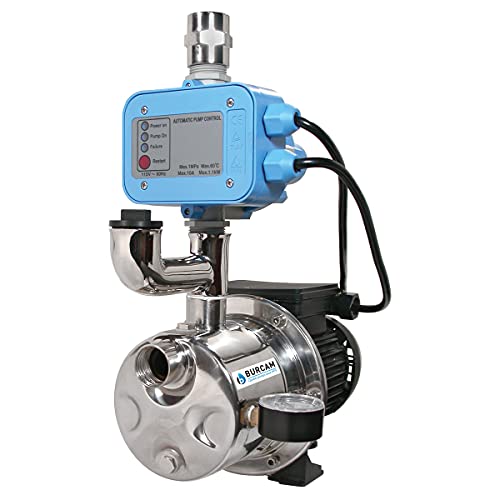
Features include a dual-application design for shallow wells up to 25 feet or municipal pressure boosting, constant pressure delivery for whole-home use, and a corrosion-resistant stainless steel pump body. Best for homeowners with shallow wells who want stable pressure without a separate pressure tank. Caution: ensure compatibility with your well depth and electrical supply.
Best for: Shallow-well users and single-home installations needing steady pressure without a tank.
GEARBONE 80 PSI Water Pressure Booster Pump, 3/4 HP

This pump provides automatic constant pressure to the entire home with real-time demand monitoring, delivering 22-80 PSI to all fixtures simultaneously. It uses energy-efficient variable speed technology to adjust motor speed as needed, helping reduce energy use and noise. Best for mid-sized homes or apartments seeking consistent pressure. Caution: verify your electrical supply and required PSI range for all fixtures.
Best for: Homes needing steady pressure across multiple fixtures with energy-conscious operation.
Red Lion RJS-100-PREM 1 HP Shallow Well Jet Pump

Premium cast iron shallow well jet pump with a 1-1/4” suction and 1” discharge; up to 23 GPM. Durable cast iron construction supports long life, with a capacitor for starting power. Best for larger households or small farms needing reliable, higher-flow performance. Caution: ensure power supply corresponds to 115 or 230 volts before installation.
Best for: Higher flow needs and tougher-duty residential systems.
Rioflybee 1.5 HP Shallow Well Booster Pump

With a 1.5 HP motor, it delivers up to 1320 GPH and a 160 ft head, suitable for irrigation on large yards or farms and for homes with substantial water needs. Self-priming design handles suction lift up to 26 ft, reducing manual priming. Best for properties with higher water demands and larger irrigation systems. Caution: heavier unit; ensure proper mounting and electrical capacity.
Best for: Large yards, irrigation-heavy properties, and mixed indoor/outdoor use.
AQUASTRONG 1.5 HP Shallow Well Jet Pump

Designed for high-volume water needs with 4250 GPH max, 108 ft head, and dual voltage (115/230 V). Features a reinforced impeller and diffuser for efficiency and strong flow, and factory set at 230 V for easy setup. Best for irrigation and large lawn systems requiring consistent delivery. Caution: verify head and flow requirements match your irrigation layout.
Best for: Irrigation systems and larger properties needing robust, constant-pressure performance.
Buying Guide: Key Considerations For Constant Pressure Jet Pumps
What is constant pressure and why does it matter? Constant pressure systems regulate motor speed and pump output to maintain a steady flow regardless of simultaneous demands at multiple fixtures. This helps prevent temperature fluctuations in showers and ensures reliable irrigation. Factors to compare include pump head (maximum vertical lift), flow (GPM or GPH), motor horsepower, voltage compatibility (115V vs 230V), material durability (cast iron vs stainless), and whether the unit is self-priming or requires external priming.
How do I determine the right pump for my home? Start with maximum daily water demand. For apartments or small homes, a ¾ HP model with 22-80 PSI may suffice. For larger homes or properties with irrigation, consider 1 HP or 1.5 HP models and confirm head capacity matches well depth and piping layout. Look for corrosion-resistant bodies if you have water with minerals. Consider energy efficiency features like variable-speed operation to reduce electricity use.
What installation considerations matter? Ensure compatible voltage, confirm piping size (inlet/outlet), and verify the pump’s priming method. A dedicated circuit and proper grounding are essential. If you have municipal water, verify that the pump can maintain pressure without excessive cycling of your existing pressure tank (some setups eliminate the tank altogether). For wells, confirm maximum drawdown depth and suction capabilities to prevent loss of prime.
Which features improve reliability? Stainless or corrosion-resistant bodies, robust impellers and diffusers, large unblocked intake, and proper wiring with appropriate fuses or breakers. A capacitor can aid starting power in high-head configurations. CSA or UL listings can provide peace of mind about safety and compliance for North American homes.
FAQ
- What is a constant pressure jet pump? A pump that automatically adjusts its output to maintain a steady water pressure as demand changes, often without using a traditional pressure tank.
- Do I need a pressure tank with these pumps? Some models are designed to operate without a tank, delivering constant pressure directly. Check the product specifications for tank-less operation compatibility.
- What head should I look for? Head indicates vertical lift. Choose a pump with head equal to or greater than your well depth and piping setup to maintain pressure at all fixtures.
- Is a higher horsepower always better? Not necessarily. Higher HP supports higher flow and head but consumes more energy. Match HP to your actual water demand and supply depth.
- Can these pumps handle both well water and municipal supply? Yes, many models are suitable for both, but verify compatibility with your system’s pressure characteristics and any local codes.
- What maintenance is required? Routine inspection of seals, wiring, and connections; ensure clean water intake and monitor for unusual noises or vibration that might indicate wear.
Add a Comment