Confined space ventilation is essential for safety and air quality in environments like manholes, crawl spaces, and industrial pits. This guide highlights five reliable options suited to different needs—from portable spot ventilation to heavy-duty air movers. The top picks cater to contractors, facility managers, and DIY enthusiasts who need effective airflow without complex setup. Below, compare performance, best-use scenarios, and practical considerations to help you choose the right system for your space.
| Product | Approximate Use | Best For | CFM |
|---|---|---|---|
| XPOWER X-12 Industrial Blower | 12″ portable | Small to mid-size confined spaces | 2600 |
| GarveeTech 12″ Utility Blower | 12″ exhaust with duct | Quick odor removal | 3500 |
| Allegro 9504-50 | Dual 8″ ports | Large spaces with flexible routing | 1570 |
| Global Industrial 16″ Portable Ventilation Fan | 16″ fan with ducting | Medium to large spaces | 2850 |
| VAF3000A Confined Space Ventilation Blower | 12″ duct kit included | Job-site ready kit | Unknown (kit) |
XPOWER X-12 Industrial Blower — 12” Portable Ventilation Fan

The XPOWER X-12 combines a 1/2 HP induction motor with high airflow and energy efficiency. Best for compact confined spaces like corn mills, manholes, and sewage lines where reliable ventilation is needed without heavy energy use. The 2600 CFM maximum airflow and low 6-amp draw support effective air exchange in smaller pits or ducted setups. A variable speed control adds versatility for different tasks, from gentle ventilation to strong exhaust. Consider this option if you prioritize portability, simple controls, and solid power in tight spaces.
Best for: small to medium confined spaces where portability and adjustable airflow matter. Limitation: for extremely large areas, you may want higher CFM than 2600.
GarveeTech 12 in Utility Blower Exhaust Fan

This 12-inch blower offers a powerful 580W motor capable of up to 3500 CFM, making it well suited for quicker odor removal and air exchange in mid-sized confined spaces. The included flexible PVC ducting expands placement options for intake or exhaust setups. It’s ideal for workshops, manholes, and crawl spaces where rapid air turnover is beneficial. The design emphasizes portability with a handle and a stable, low-vibration base. Caution: high CFM can create strong drafts; ensure ducting ends are properly sealed to avoid recirculation.
Best for: environments needing robust air movement with flexible ducting. Limitation: higher airflow can require secure mounting or distance management to prevent drafts from interfering with work.
Allegro 9504-50 Ventilation Blower

The Allegro 9504-50 delivers high output with a 3/4 HP electric motor and dual 8″ intake and exhaust ports, offering flexible airflow for industrial confined spaces. It provides up to 1570 CFM with real-world performance changes depending on duct routing. CSA-certified and designed for rugged industrial use, this unit is suitable for larger spaces needing controlled airflow in multiple directions. Choose this if you need durable construction and flexible porting in a single unit.
Best for: larger confined spaces or setups requiring dual-port configuration. Limitation: real-world CFM can vary with bends; plan duct layout accordingly to achieve target airflow.
Global Industrial 16″ Portable Ventilation Fan

This 16″ portable fan pushes up to 2850 CFM, making it a good choice for medium-to-large confined spaces like tanks or crawl spaces. It includes 16 feet of ducting (on some models) and is built to withstand temperatures from -20° to 180°F, which helps in challenging environments. ETL-listed for safety in industrial settings, this unit balances airflow, portability, and durability. Best for: spaces that require strong airflow with some temperature tolerance. Caution: larger size may require more floor space and stable placement to avoid tipping.
STANIOS VAF3000A Confined Space Ventilation Blower
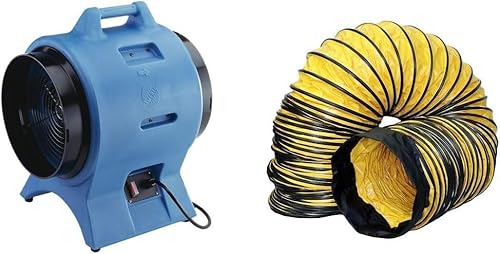
The VAF3000A kit includes a 12″ blower with a 25′ ducting hose, offering a ready-to-use solution for confined spaces and job sites. Its rugged dual-wall polyethylene housing provides durability in harsh environments, while the included ducting supports immediate setup for air movement. The high-performance motor is designed for long operation, making it suitable for continuous or frequent use. Best for: contractors needing a portable, complete kit with ducting. Limitation: specific airflow figures are kit-dependent and may vary with duct length and routing.
Buying Guide
What size confined space are you ventilating? For tight pits or manholes, look for compact, high-velocity units with 2000–3500 CFM. For larger spaces, a bigger blower with dual ports or longer ducting helps achieve thorough air exchange.
Are you ducting or ductless? If you plan to exhaust air outside, ensure your ducting kit is compatible with the unit and has the right diameter and length. If the space recirculates air, consider models with adjustable speed to prevent re-circulation.
Electrical requirements matter. Select a motor with appropriate voltage and power for continuous operation without overloading circuits. For outdoor or extreme temperatures, check temperature tolerance and enclosure durability.
Portability vs. fixed setups: lightweight, handle-equipped blowers are ideal for quick job-site moves, while heavier units with robust bases suit stationary use. For frequent transport, include weight and mounting options in your evaluation.
Durability and safety: look for ETL or CSA certifications where applicable, corrosion-resistant coatings, and sturdy housings to withstand job-site conditions. Noise level may matter in shared spaces; consider models with quieter operation if needed.
Frequently Asked Questions
- What CFM is best for confined space ventilation? – For small to medium spaces, 1500–3500 CFM typically covers most needs, with higher CFM for larger or odorous spaces.
- Do I need ducting with a confined space blower? – Ducting helps direct and control airflow, reduce recirculation, and remove contaminants efficiently; choose a unit that includes or supports ducting.
- Is CSA or ETL certification important? – Certifications indicate adherence to safety standards and can improve reliability in industrial environments.
- Can I use these fans for cooling hot equipment? – Yes, many models move air effectively in hot spaces, but check temperature tolerance and airflow requirements for your specific setup.
- How do I choose between one big blower and multiple smaller ones? – A single high-CFM unit simplifies setup, while multiple smaller blowers can target multiple areas or create directed airflow patterns.
- What maintenance is required for confined space blowers? – Regularly inspect for loose or damaged ducts, clean dust from grilles, and check electrical connections and motor temperature during use.
Add a Comment