For workers entering confined spaces, real-time gas monitoring is essential. This guide highlights five reliable confined space air testers, chosen for accuracy, ease of use, and reliability. Best for industrial technicians, rescue teams, and maintenance crews, these devices monitor common hazards like H2S, CO, O2, and combustible gases. The list compares battery life, alarms, calibration, and data logging to help you pick the right model for your environment. A quick buying table follows to summarize each option at a glance.
Quick product table
- TopTes Guard-101: 4-gas detector with multi-mode alarms
- Forensics Detectors FD: 4-gas with NIST calibration
- Forensics Detectors FD (Pump): 4 sensors with pump for pre-entry checks
- CDQL 9-in-1: Indoor air quality monitor with multiple metrics
- MSA ALTAIR 4XR: Durable, multi-gas detector with long run-time
TopTes Guard-101 4-Gas Detector
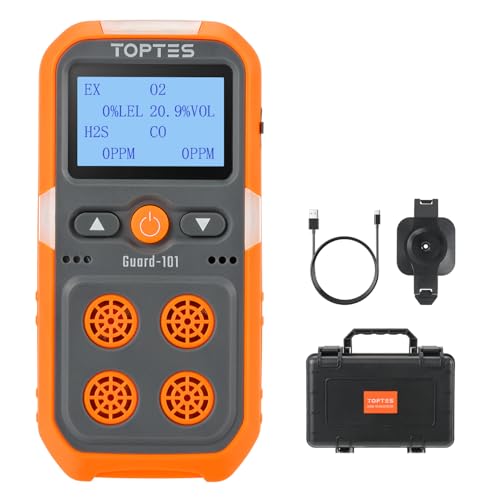
The TopTes Guard-101 is a compact, four-gas monitor designed for rapid detection of H2S, CO, LEL, and O2. It offers up to 14 hours of battery life and a back-clip for easy carrying in work environments. The device uses LED, vibration, and audible alarms to notify users immediately when gas levels rise, and it stores alarm records for later review. This model is best for mobile workers who need a rugged, explosion-proof monitor with straightforward password protection to prevent accidental operation.
Best for: field technicians and maintenance crews who need a lightweight, reliable four-gas monitor with clear alarms. Caution: password protection starts with “69” by default; ensure you update it to a secure code to prevent unauthorized changes.
Forensics Detectors FD Pump 4-Gas Monitor

This device combines a 4-gas sensor set with a pre-entry pump, making it suitable for confined-space entry testing. It carries an adjustable alarm system (audio, visual, vibration) and a NIST calibration certificate. The unit emphasizes USA-based testing and QA, with a log of alarm events and timestamps. It is best for teams needing pre-entry verification and robust data traceability for compliance. A potential limitation is a heavier footprint due to the integrated pump, which may affect portability in very tight spaces.
Best for: teams performing pre-entry checks and requiring formal QA documentation. Choose this if: you need a pump-enabled setup for faster sampling in larger spaces.
Forensics Detectors FD 4-Gas With Pump (NanoSensors)
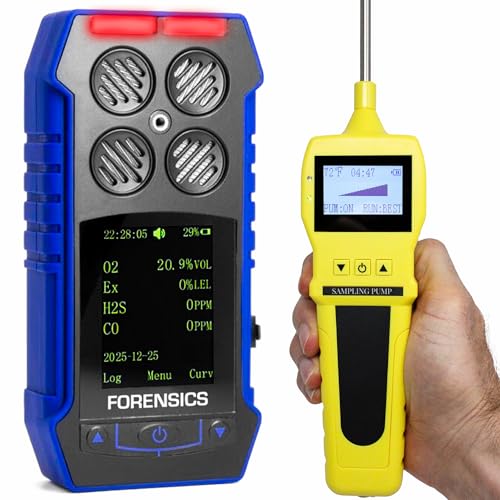
This monitor emphasizes a pre-entry testing workflow with pump-assisted sampling and four gas sensors (CO, H2S, O2, LEL). It is calibrated to the USA NIST standard, enabling consistent cross-site comparisons. The device supports logging of gas readings and times, which helps with regulatory traceability. Best for contractors who need a ready-to-use confined-space entry tester with systematic data capture. Limitation: the primary focus is pre-entry checks, so real-time continuous monitoring may be less emphasized than other models.
Best for: pre-entry testing teams needing NIST-calibrated results and timely data records. Better for: sites prioritizing standardized calibration over long-duration continuous monitoring.
CDQL 9-in-1 Indoor Air Quality Monitor

This unit measures a broad set of indoor air metrics, including CO2, PM2.5, PM10, TVOC, HCHO, and more, with occasional support for real-time data display and mobile app monitoring. It is suited for spaces where comprehensive indoor air quality tracking is necessary rather than just gas hazards. It integrates a high-precision electrochemical sensor and NDIR technology for CO2 accuracy. Best for building managers and safety officers who need a broad overview of air quality in addition to gas hazards. A limitation is that it is not a dedicated combustible-gas detector, so it should complement a dedicated gas monitor in confined-space work.
PinoTec 5-in-1 Indoor Air Quality Monitor

Another 5-in-1 option, the PinoTec instrument monitors CO2, HCHO, TVOC, temperature, and humidity with a color LED display and USB-rechargeable battery. It is suitable for long monitoring sessions in confined spaces where multiple air-quality indices matter. The color display and alert system help users quickly interpret conditions. Best for facilities that need ongoing monitoring with a portable device. Limitation: mainly consumer-grade sensors; for high-hazard industrial spaces, pairing with a dedicated gas detector is advised.
Buying Guide: Confined Space Air Tester Factors
- Gas coverage: Determine which gases you must detect (H2S, CO, O2, LEL) and whether a 4-gas or 5-in-1 monitor best fits your operation.
- Alarms and alerts: Look for multi-modal alerts (visual, audible, vibration) and data logging for incident reviews.
- Calibration and certification: Prefer devices with NIST or USA calibration options when regulatory compliance matters.
- Portability: Consider weight, back clip, and pump presence if you perform pre-entry or continuous monitoring in tight spaces.
- Battery life: Longer run-time supports extended shifts; check recharge time and spare battery options if applicable.
- Durability: Explosion-proof or rugged housings are essential for harsh environments; waterproof and dustproof ratings add reliability.
- Data handling: Alarm history, timestamp logs, and app connectivity help with audits and trend analysis.
Practical Buyer Questions
- What is the best detector for pre-entry testing? A pump-enabled monitor with NIST calibration is ideal for pre-entry checks and traceability.
- Should I choose a 4-gas or 9-in-1 monitor? If your focus is confined-space gas hazards, a 4-gas model is usually sufficient; 9-in-1 devices are better for general indoor air quality in addition to gases.
- How important is battery life? For long field shifts, select models with 12–24 hour run-time and consider spare batteries or USB charging.
- Is calibration necessary for compliance? Yes, NIST or standard calibration certificates improve reliability and regulatory acceptance.
- Can a device be used for both personal protection and area monitoring? Yes, devices with alarms and logs can support both roles, but dedicated fixed monitors may be better for facility-wide monitoring.
- What is the risk of relying on a single device? Use a combination of a dedicated gas detector and indoor air quality monitor for comprehensive safety in confined spaces.
FAQ
- What gases are typically monitored in confined spaces? Common gases include O2, CO, H2S, and LEL (flammable gases).
- Do these devices log alarm events? Many models include alarm records and timestamps for review after work.
- Is NIST calibration important? NIST calibration ensures standardized accuracy across devices and sites.
- Can I use indoor air quality monitors for confined spaces? They can complement gas detectors by tracking CO2, VOCs, and particulates, but may not detect all hazardous gases.
- What should I do if an alarm sounds? Evacuate to safe air, follow your site’s safety procedures, and assess gas concentrations with the monitor before re-entry.
Add a Comment