Answering the common buyer question: which compressed air pressure switch best fits your setup and budget? This guide highlights five solid options for different use cases—from home DIY rigs to more demanding shop leads. Each product is evaluated for who it’s best for, its key strengths, and notable limitations. The accompanying table helps you compare core specs at a glance.
| Product | Best For | Key Feature |
|---|---|---|
| Heavy Duty Pressure Switch for Air Compressor 135-175 psi (Huivlei) | Mid-range to high-demand single or two-stage compressors | Four 1/4″ ports and adjustable range 135-175 PSI |
| Square D Pumptrol Pressure Switch 95-125 psi | Light- to medium-duty installations | Unloader with on/off lever |
| QWORK Air Compressor Pressure Switch 90–120 PSI | Precise control with standard BSP/JIS options | Automatic 90–120 PSI range; sturdy housing |
| Dreyoo 135-175 4-Port Switch | Flexible expansion with extra ports | Four ports; includes gauge and safety features |
| EINDER 135-175 psi 4-Port with Unloader | Reliable, easy-to-mount setup | Adjustable 135-175 PSI; relief valve |
Heavy Duty Pressure Switch for Air Compressor 135-175 psi

Brand: Huivlei. Features: A 6.3 mm unloader valve and a 1/4 inch NPT female connection; factory-set cut-in/cut-off at 135-175 PSI; includes a relief valve to prevent overload. Four-port manifold enables directional mounting and addition of a gauge or additional air outlets. Best for: builders upgrading mid- to high-capacity single or two-stage compressors that require flexible porting. Limitation: Data indicates 135-175 PSI tuning; check compatibility with your existing gauge or relief valve setup.
Square D Pumptrol Pressure Switch 95-125 psi

Brand: Square D. Features: 1-port pressure switch with unloader and on/off lever; pressure range 95-125 PSI. Best for: small-to-medium shop setups needing a simple, reliable control switch with manual unloading. Limitation: Fewer ports reduce expansion options; ensure compatibility with any additional gauges or valves you plan to add.
QWORK Air Compressor Pressure Switch 90–120 PSI

Brand: QWORK. Features: Precise 90–120 PSI switching, G1/4 BSP joints (not NPT), robust metal housing with corrosion-resistant fittings. Best for: users with BSP-threaded components or existing BSP-compatible assemblies seeking stable, accurate control. Limitation: Not compatible with NPT-threaded systems—verify thread standards before purchase.
Heavy Duty Air Compressor Pressure Switch 90-125 psi

Brand: Huivlei. Features: 26A contacts for durability; single-port connection for straightforward installation; designed for 90-125 PSI air compressors. Best for: straightforward setups needing strong electrical contacts and simple mounting. Limitation: Single port means fewer expansion options without additional components.
Dreyoo Air Compressor Pressure Switch 135-175 4-Port
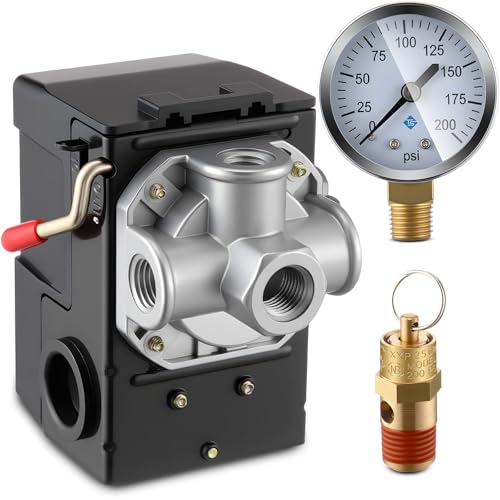
Brand: Dreyoo. Features: 4 ports, 135-175 PSI range, includes a 0-200 PSI gauge and a 200 PSI brass safety relief valve; red lever adjusts cut-in/cut-out; 110-120V operation. Best for: users needing a flexible 4-port setup with extra protection and monitoring. Limitation: Assembled with a relatively narrow 0-200 PSI gauge; ensure gauge visibility meets your needs for real-time monitoring.
EINDER Air-Compressor Pressure Switch 135-175 psi 4 Port

Brand: EINDER. Features: Pre-set 135-175 PSI with 30-40 PSI differential; includes unloader and relief valve; 4-port base for mounting gauges and valves. Best for: setups needing straightforward high-PSI control with reliable unloader action. Limitation: With multiple ports, correct sealing and threading across all connections is essential to prevent leaks.
Buying Guide
What should you consider when choosing a compressed air pressure switch?
- Pressure range: Match the switch’s cut-in/cut-out range to your compressor’s operating window to avoid short cycling or overload.
- Port configuration: Four-port switches offer expansion options (gauges, safety valves, outlets). Single-port units are simpler but less flexible.
- Thread type: Ensure compatibility with your system’s NPT or BSP threads. Mixing mismatched threads can cause leaks or failed mounts.
- Unloader and relief: An integrated unloader makes maintenance easier; a relief valve protects against over-pressurization.
- Electrical rating: Check amperage (e.g., 20A, 26A) to match motor surge requirements and prevent contact wear.
- Material and durability: Metal housings and corrosion-resistant fittings extend life in dusty or humid shop environments.
- Mounting and installation: Four-port models should be evaluated for ease of wiring and clearance around gauges and fittings.
FAQ
- What is a pressure switch in an air compressor?
A pressure switch turns the compressor on and off based on the system’s air pressure, helping maintain target pressure and protect the motor from overload. - Do I need a 4-port pressure switch?
A 4-port switch provides options for gauges, relief valves, and multiple outlets; choose if you plan to expand or customize your system. - Can I use a BSP-threaded switch with an NPT system?
No. BSP and NPT threads are not interchangeable. Use adapters or choose the correct thread type for a proper seal. - What maintenance is typical for a pressure switch?
Periodic inspection for leaks, verifying gauge accuracy, and ensuring the unloader mechanism operates smoothly are common maintenance steps. - How do I know the correct PSI range for my compressor?
Refer to your compressor’s manual or label on the air tank to match the recommended cut-in/cut-out range for optimal performance. - Should I choose a switch with a relief valve?
Yes, a relief valve adds protection against sudden pressure spikes and can extend compressor life when used with proper safety practices.
Add a Comment