Choosing a commercial walk-behind floor scrubber involves balancing cleaning power, tank capacity, and maneuverability. The following selections represent top-performing models designed for heavy use in warehouses, offices, schools, and retail spaces. This guide highlights five reliable options, with key features aligned to high-traffic environments and diverse floor surfaces.
| Product | Brand | Key Strength | Approximate Capacity |
|---|---|---|---|
| KARHDIR Walk-behind Floor Scrubber | KARHDIR | Large cleaning width and corrosion-resistant housing | 15.9 gal solution, 18.5 gal recovery |
| SUNMAX RT50 Walk-behind | SUNMAX | Strong 22″ cleaning path, complete parts set | 14.5 gal recovery |
| SUNMAX RT15AC 14” Walk Behind | SUNMAX | Compact, high-efficiency for tight spaces | 3 gal clean, 4 gal sewage |
| SUNMAX RT35 Walk-Behind Scrubber | SUNMAX | 17″ disc brush, anti-collision | 7.9 gal solution, 9.2 gal recovery |
| Hantinstom 20″ Walk Behind | Hantinstom | Cordless, long runtime, high-efficiency | 14.5 gal tank |
KARHDIR Walk-Behind Floor Scrubber
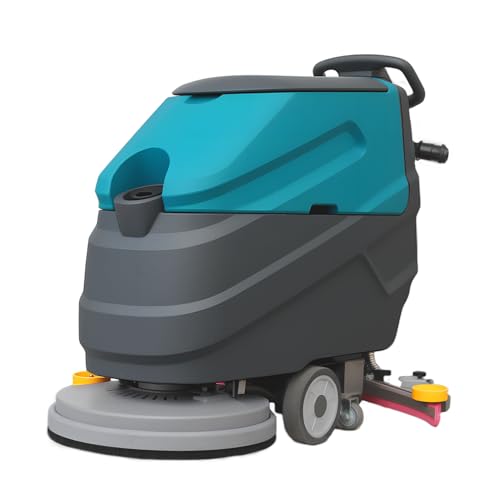
The KARHDIR model offers a broad cleaning footprint with a 22-inch cleaning width and a 31.5-inch squeegee suction width, enabling efficient coverage in a single pass. Its 32,000 square feet per hour capacity supports busy settings, helping reduce cycles and labor. The machine is designed for diverse hard floors, including concrete, tile, marble, epoxy, PVC, emery, terrazzo, and sealed hardwoods. A sizable 15.9-gallon solution tank and an 18.5-gallon sewage tank help manage water during extended cleaning sessions. The rotationally molded polyethylene housing resists corrosion and impact, while an anti-collision design enhances maneuverability.
SUNMAX RT50 Walk-Behind Floor Scrubber

The SUNMAX RT50 provides a 22-inch cleaning width and a 31-inch suction width for comprehensive floor coverage in a single pass, capable of handling up to 30,000 square feet per hour. It is compatible with a variety of hard floors, including concrete, tile, marble, epoxy, PVC, emery, terrazzo, and sealed hardwood. The model ships with a complete set of parts for quick assembly and start-up, designed for straightforward operation in demanding environments.
SUNMAX RT15AC 14” Walk Behind Scrubber Dryer

The compact SUNMAX RT15AC focuses on maneuverability in tight spaces with a 14-inch brush cleaning width and an 18-inch squeegee. It can cover up to 14,500 square feet per hour, which helps reduce labor time in offices, cafes, and boutiques. With a 3-gallon clean water tank and 4-gallon recovery capacity, it remains a budget-friendly option without sacrificing essential cleaning capabilities in smaller facilities.
SUNMAX RT35 Walk-Behind Scrubber Polisher

The SUNMAX RT35 combines a 17-inch disc brush with a 22-inch squeegee width and features a 7.9-gallon solution tank and a 9.2-gallon recovery tank. This model supports operation for extended periods with a built-in auto shut-off when the dirty water tank is full, an adjustable brush height, and anti-collision wheels. It is designed for robust cleaning on various hard floors, including tile, concrete, and epoxy.
Hantinstom 20″ Walk Behind Scrubber

The Hantinstom 20-inch model is cordless with a 14.5-gallon large solution tank and a 4-hour runtime, powered by a 25.6V/100Ah lithium battery. It integrates a high-efficiency cleaning system using a 500W brush motor and a 180 RPM motor speed. The combination of multi-surface compatibility and cordless operation supports flexible cleaning in large areas without being tethered to power outlets.
Buying Guide: Key Purchase Considerations
- Floor compatibility: Ensure the scrubber is suitable for your surfaces—concrete, tile, marble, or epoxy—and check pad or brush options for tailored cleaning intensity.
- Cleaning width vs. maneuverability: Larger widths speed up coverage but can hinder navigation in tight spaces. Match width to your facility layout.
- Tank capacity and water management: Bigger solution and recovery tanks reduce refills but increase weight and size. Consider your water usage and drain availability.
- Power source: Corded models offer consistent runtime; cordless models improve mobility but require battery management and charging cycles.
- Maintenance and parts availability: Look for machines with readily available replacement parts, sensors, and brushes, as well as documented maintenance steps.
- Ease of use: Features like automatic shut-off, anti-collision wheels, adjustable brush height, and simplified assembly contribute to safer, faster operations.
- Operational cost: Evaluate energy consumption, water and chemical use, and the expected lifespan of components to estimate total cost of ownership.
- Service and warranty: Consider brands with local support, warranty terms, and accessible service networks for downtime minimization.
- Cordless vs. corded workflows: In large facilities with many rooms, cordless models reduce plugging and unplugging, while corded units may offer unlimited run time on a single outlet.
- Safety features: Anti-collision wheels, clear liquid level indicators, and overload protections help prevent damage to floors and equipment.
Add a Comment