Finding a reliable cold press oil machine for commercial use requires evaluating power, durability, and versatility. This guide highlights five top options that balance continuous operation, multi-material capability, and smart controls. Each product is designed to support both home and small business oil extraction with cold and hot pressing modes to maximize quality and yield. Below is a quick overview of the chosen models to help you compare features at a glance.
| Product | Key Strengths | Ideal For |
|---|---|---|
| Oil Press Machine, 820W By Rkazes | Dual modes, steel gear, real-time temp display | Small commercial setups and busy kitchens |
| 1500W Oil Press Machine With Double Outlets By SISAYWEY | Two independent motors, dual oil outlets, energy efficient | Medium-volume production |
| CGOLDENWALL 1000W Oil Press | Automated temp control, both cold/hot press | Consistent quality across materials |
| Automatic Cold/Hot Oil Press By FrameFirm | Compact stainless steel, multi-material support | Space-conscious operations |
| JOYKUVA 1800W Electric Oil Press | High power, fast preheat, versatile temperatures | Small commercial or high-demand home setups |
Oil Press Machine From Rkazes — 820W, Dual Press Modes

The Rkazes Oil Press Machine provides two pressing modes: hot pressing to maximize oil yield and nutrient extraction, and cold pressing to preserve natural flavors. It features a sturdy all-steel gear system capable of continuous operation and a large output rate, reported as 9-13.5 pounds per hour in its specifications. An intelligent panel displays real-time oil temperature and guides users through the process, enabling precise control over pressing cycles. The machine uses a wear-resistant press rod and is constructed to endure long-term use in semi-professional environments. Applications include peanuts, sesame, coconut, soybeans, sunflowers, and walnuts. The design emphasizes reliability and ease of operation for daily production tasks.
SISAYWEY 1500W Dual-Motor Oil Press

The SISAYWEY oil press integrates dual independent 1500W motors enabling simultaneous processing of different materials or continuous multi-material runs. Its dual-outlet design allows for separate oil streams and higher throughput. Built with four-stage gears to reduce wear, it is designed for 24-hour operation in commercial settings. The machine emphasizes energy efficiency, using intelligent power-saving technology that reduces electricity consumption to around 0.5-0.6 kWh per hour, with noise levels kept below 70dB. Materials supported include a wide range of nuts and seeds, making it suitable for bustling workshop environments or small production lines.
CGOLDENWALL 1000W Automatic Oil Press

This CGOLDENWALL model blends precise temperature control with automatic heating, ensuring consistent oil quality. It supports both hot and cold pressing, and its temperature range (32-572°F) allows customization based on raw materials. The innovative oil press rod design improves material extraction, reducing residue and increasing yield. Real-time temperature monitoring helps operators adapt to different seeds or nuts, making it suitable for frequent recipe variations in a commercial kitchen or small processing facility.
FrameFirm Automatic Cold/Hot Oil Press

FrameFirm offers a compact stainless steel oil press designed for space-conscious operations. It handles over 30 types of raw materials, including castor, coconuts, peanuts, and sesame. The machine supports both cold pressing to preserve nutrients and hot pressing to boost oil yield, with a straightforward design that facilitates easy cleaning and maintenance. Its stainless steel construction helps resist corrosion and is adaptable for routine daily use in small-scale commercial settings or busy home-based production environments.
JOYKUVA 1800W Commercial Oil Press
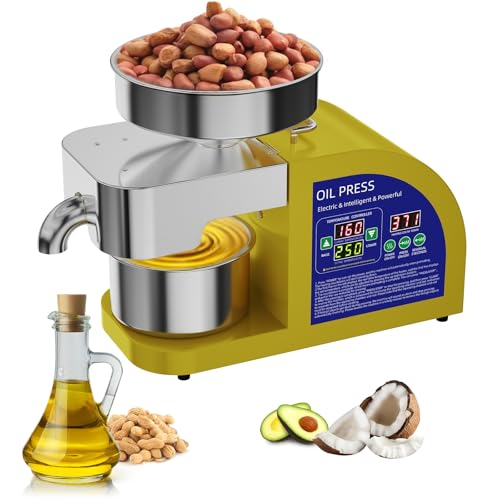
The JOYKUVA model delivers 1800W of power for faster preheating and continuous operation, making it suitable for small commercial setups or demanding home-based production. It supports hot and cold pressing, with temperatures reaching up to 300°C (572°F) to unlock richer flavors in certain seeds and oils. The system is designed for quick startup, with a claimed heat-up time around a few minutes, and emphasizes versatility across nuts and seeds like sesame, coconut, sunflower, and soybean. This makes it a flexible option for varied oil pressing tasks in compact spaces.
Buying Guide
When choosing a commercial cold press oil machine, consider the following factors to align with production goals and budget:
- Output and power: Look for higher wattage and dual-motor designs if you plan continuous operation and multi-material processing. Higher horsepower generally translates to faster throughput.
- Press mode flexibility: Machines offering both cold and hot pressing provide broader product options, with cold pressing preserving nutrients and hot pressing maximizing yield.
- Durability and materials: Stainless steel construction and wear-resistant components support longer service life in busy environments and are easier to sanitize.
- Temperature control: A precise temperature controller helps optimize oil quality for different seeds and nuts; real-time monitoring reduces guesswork.
- Noise and energy efficiency: Lower noise levels and energy-saving features reduce operator fatigue and operating costs over time.
- Maintenance and cleaning: Machines with accessible cleaning points and simple disassembly save time between batches and maintain hygiene.
- Footprint and footprint adaptability: For smaller spaces, compact stainless models with efficient layout can fit more easily into kitchens or workshops.
Additional considerations include after-sales support, availability of spare parts, and compatibility with a wide range of feed materials. If possible, review independent user feedback focusing on reliability, maintenance requirements, and consistency of oil yield across different seeds and nuts. For high-volume applications, calculate total daily throughput and compare it against motor capacity and cooling performance to avoid overheating during continuous runs.
Add a Comment