Answering your need for reliable CO2, temperature, and humidity data, these sensors help optimize indoor environments for plants, homes, or offices. The best options vary by use case: growers may prioritize real-time CO2 control, while home setups may value battery life and easy alerts. Below you will find five top picks, each with clear strengths and practical cautions.
Summary table of selected products
| Product | Best For | Key Strength | Limitations |
|---|---|---|---|
| VIVOSUN 4-in-1 Sensor | Indoor growing and climate-controlled spaces | Real-time CO2, VPD, and light data with compatibility with GrowHub | Requires calibration per manual |
| Temtop CO2 Monitor | Home, office, classroom air quality | NDIR sensor accuracy and long standby | CO2 range limited to 400–5000 PPM |
| U UNNI CO2 Monitor | Home environments needing multiple alarms | 3 alarm volumes, 3 backlights, high-precision sensor | Battery/plug-in options not specified |
| SwitchBot CO2 Detector | Smart homes needing app alerts | 21st-century display, app notifications, precise CO2 range | Hub required for notifications |
| INKBIRD WiFi Air Quality Monitor | Grow tents and workspaces with WiFi logging | Smart NDIR sensor with data logging | Manual calibration recommended on setup |
VIVOSUN 4-in-1 Sensor Review

The VIVOSUN 4-in-1 Sensor combines temperature, humidity, CO₂, VPD, and light detection in one compact device. It is designed to help growers monitor environmental conditions and adjust climate controls in real time. A key feature is its ability to work with fans or CO₂ systems to maintain optimal air balance for efficient photosynthesis and faster growth.
Best for: Indoor growers seeking integrated environmental data and direct control compatibility. The sensor is helpful for maintaining ideal VPD conditions and ensuring CO₂ remains in the optimal range for plant health.
Limitations: The device requires calibration per the manual before use to ensure accuracy. Real-time readings are advantageous, but users should perform setup steps to avoid drift in measurements.
Temtop CO2 Monitor Indoor Air Quality

The Temtop model provides a multifunctional all-in-one readout for CO₂, temperature, and humidity. It uses a Swiss-engineered NDIR CO₂ sensor with an impressive accuracy window and a rapid 5-second refresh rate. Its long standby time is aided by a dedicated photoacoustic sensor approach, making it suitable for health-sensitive environments and classrooms.
Best for: Home, office, or classroom users who want precise CO₂ monitoring with fast updates and reliable readings. The device’s compact form suits spaces where quick checks are frequent.
Limitations: CO₂ range tops at 5000 PPM, which may be limiting in high-output environments. Real-world performance depends on stable power or battery operation as described in the product details.
U UNNI CO2 Monitor For Home
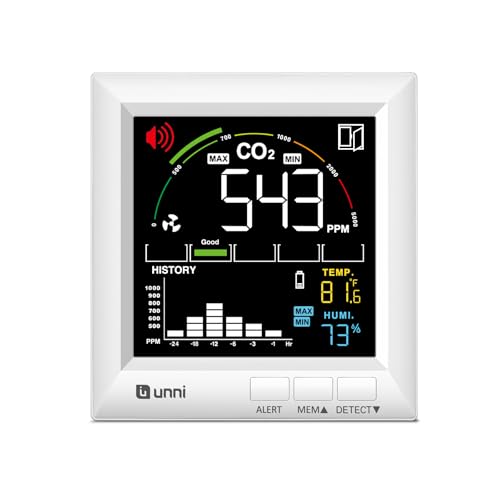
The U UNNI device emphasizes user-configurable alarms and backlighting, along with a high-precision sensor. It reports CO₂, temperature, and humidity with a history view and adjustable alert volumes. The device is designed for homes, RVs, grow tents, and areas where air quality visibility matters.
Best for: Homeowners or small spaces that require clear alarms and multiple display options to stay informed about air quality. It is well-suited for users who want a quick visual cue and proactive ventilation prompts.
Limitations: While the sensor is accurate in typical ranges, users should consider calibration practices to ensure ongoing reliability, especially in changing environments.
VETOUCH 3-in-1 CO2 Detector

The VETOUCH 3-in-1 monitor captures CO2, temperature, and humidity with a large color display for easy interpretation. It emphasizes plug-and-play operation, direct out-of-the-box visibility, and a real-time CO₂ level readout. It is suitable for homes, offices, and grow tents where quick decisions are needed to ventilate appropriately.
Best for: Users who want a straightforward, wall-plug device with an easy-to-read display and rapid setup. It’s a practical option for spaces where immediate environmental awareness is critical.
Limitations: It detects CO₂ rather than carbon monoxide, so it should not replace dedicated CO detectors for CO risks and should be used as part of a broader safety system if needed.
SwitchBot CO2 Detector And Display

The SwitchBot Meter Pro CO2 provides a 5-in-1 display that shows CO2, temperature, humidity, time, and comfort level. It uses Swiss-made NDIR sensors for precision and supports app-based notifications through a hub. This model is ideal for users seeking integrated data visualization and smart alerts.
Best for: Tech-forward homes and offices that leverage smart hubs and notifications to manage indoor air quality. The device helps automate ventilation decisions by combining sensor data with alerts.
Limitations: Hub integration is required for app notifications, which adds a setup step and possible additional cost for some users.
INKBIRD WiFi Air Quality Monitor

The INKBIRD model offers a WiFi-enabled 3-in-1 sensor for CO₂, temperature, and humidity with data logging capability. It is designed for grow tents, offices, and homes that want remote monitoring and accessible data history. The device highlights easy interpretation via a bright LCD and straightforward setup.
Best for: Grow tents and workspaces needing WiFi-enabled monitoring with data logging for trend analysis. It suits users who want access to historical data and remote visibility.
Limitations: Initial setup often benefits from manual calibration to avoid measurement drift, particularly in very dynamic environments.
Buying Guide: CO2, Temperature, And Humidity Sensor Considerations
What should you look for when choosing a CO2, temperature, and humidity sensor?
- Sensor technology: NDIsense vs photoacoustic readings impact accuracy, response time, and long-term drift. NDIs tend to excel at stable CO2 readings, while photoacoustic can offer low power and long standby in some models.
- Calibration needs: Some devices require manual calibration for accuracy. Look for models with straightforward calibration instructions and accessible maintenance.
- Display and alerts: A large display and configurable alerts (sound, visual, and app-based) help with quick decision-making in dynamic spaces.
- Connectivity: USB, WiFi, or hub-based ecosystems affect how you access data, set alerts, and log history. Consider whether you need remote monitoring or automatic ventilation control.
- Measurement range and resolution: Ensure the device covers the expected CO₂ range (often 400–5000 PPM is common) and provides adequate resolution for subtle fluctuations.
- Target environment: Grow tents, homes, offices, and classrooms each benefit from different feature sets—plants benefit from CO₂ data and VPD tracking; homes benefit from alarms and easy readability; offices may prefer app alerts and data logging for compliance.
- Power options: Battery-powered units offer portability but may require routine replacements; plug-in models provide continuous operation with a power source.
Frequently Asked Questions
- What is the ideal CO2 range for indoor plants?
- Do I need multiple sensors in a single room?
- How often should readings be calibrated?
- Can I automate ventilation with these sensors?
- Is NDIR better than photoacoustic for home use?
- What features matter most for a grow tent?
Typically, many indoor grow setups aim for CO₂ levels around 800–1200 PPM during photoperiods; however, exact targets depend on plant species and grow stage. Use sensors with real-time monitoring to adjust ventilation or CO₂ supplementation accordingly.
Multiple sensors can improve accuracy in larger spaces or rooms with uneven air distribution. Place sensors away from direct vents or heat sources, and consider zones that reflect distinct microclimates.
Calibrate per manufacturer instructions, especially after relocation or long-term use. Regular calibration minimizes drift and preserves measurement reliability.
Yes, many models support integration with fans or CO₂ systems via hubs or direct connections. Verify compatibility with your ventilation equipment and any required hubs or apps.
Both have merits. NDIDR sensors are common, reliable, and widely supported. Photoacoustic sensors can offer energy efficiency and long standby life in some configurations. Choose based on your needs for speed, power usage, and maintenance.
In grow tents, prioritize CO₂ monitoring, VPD data, real-time updates, and robust alerts. A weather-tight enclosure often benefits from a device that integrates with your existing climate control system.
Add a Comment