Answering buyers seeking durable, high-strength nylon blends reinforced with carbon fiber. These filaments boost stiffness, heat resistance, and load-bearing performance while maintaining workable printability. Ideal for industrial tools, automotive parts, and lightweight components. The top picks below are best for users who need rigid parts with good dimensional stability, from hobbyist printers to small-scale production.
The following quick-reference table summarizes the five selected products to help you compare at a glance.
| Product | Brand | Filament Type | Notable Strength | Best For |
|---|---|---|---|---|
| PA612-CF15 Carbon Fiber Nylon Filament | Polymaker | 80% Nylon / 20% Carbon Fiber | Low moisture sensitivity and good first-layer adhesion | Industrial tooling and high-speed prints |
| ePA-CF Carbon Fiber Nylon Filament | SainSmart | Nylon with 20% Carbon Fiber | High rigidity and lower warp | Precision parts with complex geometry |
| PA6-CF20 Carbon Fiber Nylon Filament | Polymaker | 80% PA / 20% Carbon Fiber | Excellent stiffness and heat resistance | Bike components, brackets, fixtures |
| YXPOLYER Carbon Fiber Nylon Filament | yxpolyer | 15% Short Carbon Fiber | Strong tensile properties and dimensional stability | Mechanical parts with high load |
| ELEGOO PAHT Carbon Fiber Filament | ELEGOO | Carbon Fiber Nylon | High temperature stiffness | Enclosed/FDM printers and high-temp parts |
Polymaker Fiberon PA612-CF15 Carbon Fiber Nylon Filament

Best for high-speed printing with strong mechanical properties and low moisture sensitivity. This filament aims to deliver reliable performance on mainstream 3D printers, enabling durable end-use parts and tooling components. Suitable for industrial tooling and automotive applications.
Best for: users needing a robust nylon-based composite with easier handling in typical print environments.
Caution: Some printers may require temperature tuning for optimal layer adhesion and to avoid warping.
SainSmart 1.75mm ePA-CF Carbon Fiber Filament
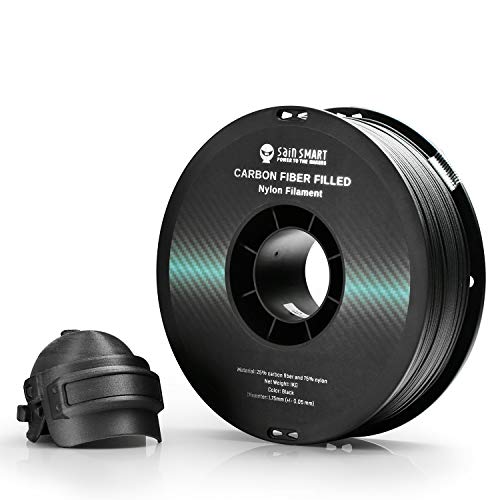
This filament blends nylon with added carbon fiber for rigidity, aiming to reduce warp and improve surface finish. It’s positioned for projects requiring strong, precise parts with good dimensional stability. Great for functional prototypes and mechanical components.
Best for: projects demanding high stiffness and predictable tolerances on mid-range printers.
Caution: Carbon fiber fillers can be abrasive to nozzles; consider hardened steel or ruby-coated nozzles for long-term use.
Polymaker Fiberon PA6-CF20 Carbon Fiber Nylon Filament
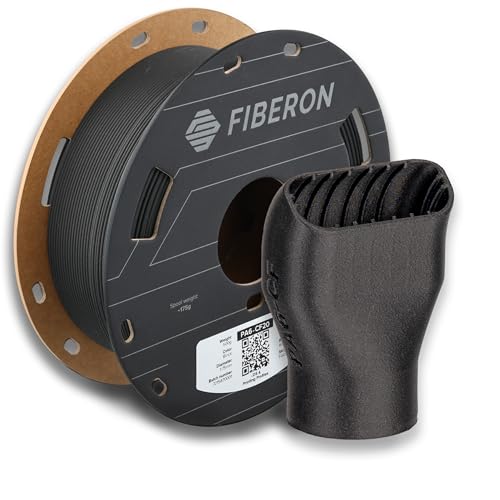
High stiffness and heat resistance come from the 80/20 nylon-carbon fiber blend. This filament is well-suited for torsional and load-bearing parts that must maintain shape under thermal stress. Ideal for bike components, brackets, and drone frames.
Best for: applications requiring strong, heat-resistant parts with good layer adhesion.
Caution: Higher printing temperatures may be needed; ensure your printer’s nozzle and bed are properly configured to avoid adhesion issues.
YXPOLYER Carbon Fiber Nylon Filament 3D Printer Filament PA6-CF

Featuring 15% short carbon fibers for strength and rigidity, this filament emphasizes dimensional stability and resistance to deformation under load. It’s positioned for mechanical parts, housings, and fixtures where precise tolerances matter.
Best for: parts that demand stable geometry under mechanical stress.
Caution: Filament batches may vary; verify storage to minimize moisture uptake that can affect print quality.
ELEGOO Carbon Fiber PAHT Filament

Designed for high-temperature performance, this PAHT filament blends carbon fibers with nylon to deliver strength and corrosion resistance. It is suitable for enclosed FDM printers and parts that require stability in warmer environments.
Best for: high-temperature components and environments where corrosion resistance is essential.
Caution: Requires controlled print environments to achieve consistent results; enclosure use is recommended.
Buying Guide: Key Considerations for Carbon Fiber Nylon Filaments
- Compatibility: Check your 3D printer’s nozzle material and temperature range. Carbon fiber filaments can be abrasive and may wear traditional nozzles faster; consider hardened steel nozzles.
- Print Temperature and Bed: Carbon fiber nylon blends typically print at higher temperatures than standard nylon. Verify recommended ranges for best layer adhesion and minimal warping.
- Moisture Sensitivity: Nylon absorbs moisture, which can affect print quality. Store spools in a sealed container with desiccant and dry as needed before printing.
- Strength vs. Toughness: Carbon fiber adds stiffness and heat resistance but can reduce impact resistance. Choose a formulation aligned with your part’s function.
- Dimensional Stability: For parts with tight tolerances, consider formulations highlighted for low shrinkage and warp resistance.
- Surface Finish: Carbon fiber filaments often produce a textured surface; plan post-processing accordingly if a smooth finish is required.
FAQ
- Q: Do all carbon fiber nylon filaments require high printing temperatures? A: Most do, but exact ranges vary by brand; always consult the filament’s recommended temperature range.
- Q: Will carbon fiber filaments wear out my nozzle? A: Yes, especially with standard nozzles. Use hardened steel or replaceable nozzles for longer life.
- Q: How should I store nylon carbon fiber filament? A: Store in a dry, airtight container with desiccants to minimize moisture pickup.
- Q: Are these filaments suitable for consumer-grade printers? A: Many are compatible with mainstream printers, but ensure your printer supports the filament’s temperature and feed requirements.
- Q: Can carbon fiber filaments be used for functional aerospace-like parts? A: They are suitable for high-strength parts and lightweight components, but verify engineering requirements and regulatory considerations for critical aerospace applications.
Add a Comment