This guide highlights top carbon arc gouging rods widely used in welding and metalworking. Each product features copper-coated carbon-graphite compositions designed for stable arcs and good conductivity. We compare key attributes, including coating quality, compatibility with common metals, and intended applications such as shipbuilding, construction, and maintenance welding. Use this overview to select rods that fit your current gouging needs and power setup, while avoiding underperforming choices. The featured items are widely available on major retailers and backed by practical user feedback and industry standards.
| Product | Brand | Key Strengths | Metal Compatibility |
|---|---|---|---|
| SÜA – Copper-Coated Arc Gouging Carbons | SÜA | High conductivity, stable arcing, copper coating | Carbon steel, stainless steel, copper, aluminum, cast iron, nickel alloys |
| Blue Demon ACGE-CC X 3/16″ Gouging Carbon | Blue Demon | Improved conductivity, cooler operation | Carbon steel, stainless steel |
| PATIKIL 10pcs 10mmx305mm Gouging Rods | PATIKIL | Copper-graphite coating after baking, high-temp resistance | Widely used in shipbuilding, bridges, oil pipelines |
| Blue Demon ACGE-CC-14 1/4″ Gouging Carbon | Blue Demon | Copper coating for better conductivity | General gouging on common metals |
| PATIKIL 10pcs 6mmx305mm Gouging Rods | PATIKIL | Copper-graphite coating, high-temperature resilience | Industrial cutting and gouging applications |
SÜA Copper-Coated Arc Gouging Carbons

The SÜA Carbon Gouging Rods are designed for the carbon-arc metal removal process, where an electric arc melts metal and a compressed air jet removes the molten material. The copper coating is engineered to deliver high conductivity and arc stability across varying current levels and temperatures. Suitable for carbon steel, stainless steel, copper, aluminum, cast iron, nickel alloys, and manganese steel, these rods emphasize reliable performance in diverse metalworking tasks. Their copper coating reduces resistance, promoting cooler operation and smoother arc initiation.
Key points: copper-coated surface aids arc stability; broad metal compatibility; stable arc performance at multiple current levels; suitable for general gouging and metal removal in industrial settings.
Blue Demon ACGE-CC X 3/16 Inch Gouging Carbon

This Blue Demon gouging carbon features a copper coating to improve conductivity, enabling more efficient and cooler operation. An electric arc melts the target metal, while compressed air blows the molten metal out of the groove. The typical chemistry is 80% graphite and 20% copper, providing a balanced combination of arc stability and metal-removal efficiency. The 3/16″ diameter variant is a common choice for medium-duty gouging with standard equipment, offering predictable performance across a range of materials including steels and alloys.
Key points: copper-coated for conductivity; arc-driven material removal; compressed-air assist; suitable for mid-range gouging projects in shop environments.
PATIKIL 10pcs 10mmx305mm Gouging Rods
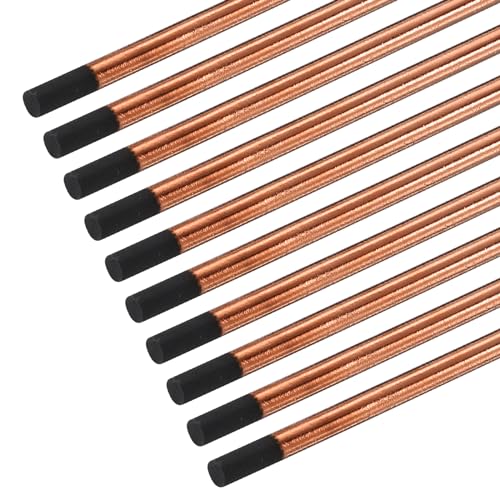
PATIKIL’s 10mm diameter gouging rods come with a copper-graphite coating after baking at 2200°C. The coating offers high-temperature resistance and good electrical conductivity, reducing the likelihood of breakage and minimizing noise during operation. These rods are designed for carbon-arc gouging and are widely used in shipbuilding, highways, bridges, steel production, and oil pipelines. They are formed by extrusion and are intended for full-penetration weld formation in double-sided welding contexts.
Key points: copper-graphite coating for durability and conductivity; high-temp tolerance; suitable for large-scale metal removal and cutting tasks; common in heavy industries.
PATIKIL 10pcs 6mmx305mm Gouging Rods

The 6mm variant from PATIKIL mirrors the 10mm line with a copper-graphite coating after baking at 2200°C, delivering high-temperature endurance and reliable electrical conductivity. The rods are designed for pre-welding cutting in carbon arc gouging and are well-suited for full-penetration welds in various heavy industries. The extrusion-based manufacturing supports consistent diameter and coating integrity across the 12-inch length, allowing stable, controlled gouging performance on thicker sections.
Key points: copper-graphite coating; robust high-temp performance; ideal for heavy fabrication tasks; consistent dimensions for repeatable gouging results.
PATIKIL Flat Gouging Carbon Electrode Rod

PATIKIL’s flat gouging carbon electrode rod provides a broad 355x12x5mm footprint, optimized for removing residual weld beads and achieving smooth, controlled gouge cuts. The rod is copper-coated for improved electrical conductivity and heat management after baking at 2200°C. It is widely used in foundries, boiler rooms, shipyards, chemical plants, and related fields, offering a practical option for recommended gouging workflows and double-sided welding preparations.
Key points: flat form aids bead removal; copper coating enhances conductivity; versatile for foundry and shipbuilding environments; supports consistent gouging geometry.
Buying Guide: Key Purchase Considerations
- Coating quality and conductivity: Copper-coated carbon-graphite blends improve arc stability and reduce heat buildup, which helps extend tip life and reduces electrode consumption.
- Diameter and length: Match rod size to your gouging machine’s amperage and the thickness of the material. Common sizes include 3/16″, 1/4″, 5/16″, 6mm, and 10mm variants.
- Material compatibility: Ensure the rods are suitable for the metals you commonly work with (carbon steel, stainless steel, aluminum, cast iron, copper alloys, etc.).
- Manufacturing method and consistency: Extruded rods tend to offer consistent diameter and coating integrity, which supports predictable gouging performance.
- Application scope: Consider whether you need rods for general metal removal, full-penetration weld gouging, or specialty tasks like double-sided welding projects in shipyards or pipelines.
- Availability and packaging: Rods are sold in various pack sizes—single, tens, or hundreds. For frequent use, larger packs can lower costs and reduce downtime.
- Storage and handling: Keep rods dry and protected from contaminants to preserve coating integrity and electrical performance over time.
- Safety and compatibility with equipment: Ensure your wiring, air supply, and power source meet the electrical and airflow requirements specified for the rods.
Add a Comment