Answering the question “which bottle label applicator should I choose?” this guide reviews top automated and manual options designed to speed up label application on round bottles. Best for small businesses, home crafters, and small-scale manufacturers, these machines help reduce bubbles, improve placement accuracy, and boost productivity. Below, you’ll find concise picks, a buyer’s table, and practical tips to compare features and fit for your operation.
| Product | Best For | Key Benefit |
|---|---|---|
| VEVOR Manual Round Labeling Machine | Small batches, budget-conscious makers | Fast, simple operation with bubble-free labeling |
| VEVOR Semi-Automatic Round Labeling Machine | Mid-volume operations | Smart sensor and durable build for consistent results |
| Sumeve Manual Round Labeling Machine (White) | Lightweight, compact setups | Wide bottle compatibility with extended label range |
| Hanchen Semi-Automatic Round Bottle Labeling Machine | Small businesses needing precision | Automatic optical positioning for accurate placement |
| Sumeve Manual Bottle Labeling Machine (Black) | Flexible, aesthetic labeling | Pressing bar helps conform labels to curves |
VEVOR Manual Round Labeling Machine

Best for: Small-batch producers who want fast, bubble-free labeling on round bottles without electricity. This model excels in craft kitchens, hobby bottlers, and home-based cosmetic makers pursuing quick turnaround with minimal setup. The device labels 15-20 bottles per minute, helping reduce labor costs and shorten production cycles. The design includes a round bottle press bar and a rubber roller to minimize air bubbles and ensure neat, professional-looking results.
Why chosen: It provides an adjustable fit for round bottles from 0.78 to 4.72 inches in diameter and works with both transparent and adhesive labels. The combination of speed, simple operation, and versatile label width/length support makes it a practical starter option for diverse rounds and label formats.
Limitations: Manual operation means consistent throughput depends on user pace. Best results come from steady handling rather than batch automation. Ensure your label stock width and length stay within the supported ranges (10–130 mm width, 10–300 mm length).
VEVOR Semi-Automatic Round Labeling Machine

Best for: Mid-volume operations in food, beverage, cosmetics, and small-scale manufacturing that need reliable, motor-assisted labeling with precise placement. The unit supports a higher throughput than manual models and includes a round bottle range of 0.78-4.72 inches in diameter.
Why chosen: It features a smart fiber optic sensor for accurate label detection and a robust aluminum alloy body designed to endure repeated use. The sensor helps minimize mis-applied labels, while the high-power motor delivers steadier performance across diverse bottle shapes.
Limitations: Not suitable for transparent labels, so ensure your label stock is opaque if you plan to reuse this device. Also, the machine’s weight and power requirements may be better suited for semi-fixed installations rather than portable use.
Sumeve Manual Round Labeling Machine (White)

Best for: Small batch labeling where portability and simplicity are priorities. Suitable for glass, plastic, or metal containers with round shapes, making it a good fit for home-brewed beverages, small canning operations, and craft cosmetics.
Why chosen: It handles a wide diameter range from 0.6 to 4 inches and supports a broad label size spectrum. The extended length option adds flexibility for more label sizes, and the metal body emphasizes stability during operation.
Limitations: Not compatible with oddly shaped or non-cylindrical bottles. Users should verify label roll inner diameter and width to ensure proper fit before use.
Hanchen Semi-Automatic Round Bottle Labeling Machine

Best for: Small to medium enterprises seeking precise, automatic labeling for cylindrical bottles with consistent results. The device is designed for efficiency and reliability in professional settings, such as small-scale production lines.
Why chosen: It uses automatic optical fiber positioning for accurate labeling, with a durable aluminum alloy body and adjustable roller height to accommodate various cylinder sizes. The labeling sensor reduces missing labels and waste, contributing to lean operation.
Limitations: It is a semi-automatic model, so some manual intervention may be required during setup or after changing bottle sizes. Ensure the bottle range 0.6-4.7 inches aligns with your product lineup.
Sumeve Manual Bottle Labeling Machine (Black)
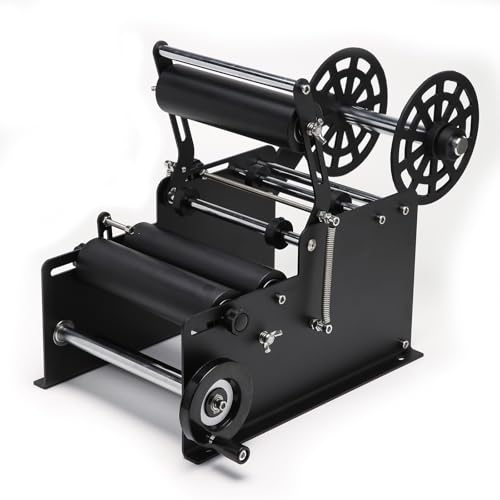
Best for: Users seeking a practical, versatile manual option that works across several round bottle types while maintaining a neat appearance. Suitable for cosmetic containers, glass bottles, and basic beverage labeling tasks.
Why chosen: It supports bottles from 0.6 to 4 inches in diameter and accommodates label rolls with varied inner diameters. The pressing bar helps the label conform to curved surfaces, improving overall alignment and appearance.
Limitations: Like other manual models, throughput depends on operator pace. Confirm that your label dimensions fit within the 1″–5.1″ wide and 1″–10″ long range for best results.
Buying Guide: Bottle Label Applicator Essentials
What type of bottle labeling do you need?
Manual labeling machines are cost-effective for low-volume or weekend projects. Semi-automatic units strike a balance between speed and control, ideal for small businesses. If you’re handling larger batches, consider a fully automatic system with optical sensors for precise placement.
What bottle diameter and label size matter?
Most devices in this roundup cover 0.6–4.7 inch bottle diameters. Check your typical bottle sizes and ensure the label width/length fits within each machine’s supported range. An adjustable press bar helps with diverse cylinder shapes.
Is label visibility or bubble reduction a priority?
Preferring bubble-free labels and smooth adhesion points to the presence of a pressing bar and a rubber roller. For delicate or glossy surfaces, ensure the label material can adhere cleanly without wrinkling.
Where will you operate the machine?
Consider whether you need a portable handheld model or a fixed, semi-automatic machine for a small production line. Semi-automatic units typically require stable placement and accessible power, while manual tools offer more flexibility on the go.
What about durability and materials?
Look for durable bodies (aluminum alloys) and corrosion resistance for long-term use. A robust build reduces maintenance and replacement costs in busy environments.
What are practical limitations to expect?
Manual models depend on operator speed; semi-automatic models require setup adjustments when changing bottle sizes; certain units exclude transparent labels. Confirm compatibility with your label stock (material, width, inner diameter) before purchase.
Frequently Asked Questions
- Which labeler is best for small-batch cosmetic bottles? A semi-automatic or manual round labeling machine with a stable platform and precise sensor features is typically well-suited for cosmetics due to the need for neat, consistent placement.
- Can these machines handle glass and plastic bottles? Yes, most models support round glass and plastic bottles within the stated diameter range (roughly 0.6–4.7 inches). Check each product’s compatibility notes for specific materials.
- Do I need an electric model for my operation? Electric (semi-automatic) models offer higher throughput and consistent results, making them better for mid-volume workflows. Manual models are cheaper and portable for light use.
- What should I verify about labels before buying? Confirm label width, length, and inner diameter compatibility, as well as whether the labels can adhere to non-glossy or glossy surfaces and whether bubbles are likely to form.
- Are there accuracy features to look for? Look for optical sensors, fiber optic detection, and adjustable rollers to ensure precise positioning and minimize misalignment or label waste.
- Is a press bar necessary? A press bar helps the label conform to curved surfaces and reduces air pockets, improving overall adhesion on round bottles.
Add a Comment