Answering the need for efficient, reliable pellet production, this guide features top biomass wood pellet machines suited for home, small-farm, and workshop use. The selections emphasize consistent output, robust build, and practical feeding and discharge design. Best for small farms, woodworking hobbyists, and rural workshops, these machines transform sawdust, straw, and other agricultural waste into usable fuel pellets. Each option is explained with clear advantages and a practical limitation to help buyers compare quickly.
Device choices vary by output, power, and feed handling. The top picks below highlight which buyer profiles each model serves best—whether you need high-throughput production, portable operation, or simple home use. A compact buying table at the end of the introduction summarizes core specs to aid quick comparisons.
| Product | Best For | Output (approx.) | Voltage |
|---|---|---|---|
| THUXEON 220V Wood Pellet Machine | Small farms and workshops needing robust 60 kg/h capacity | 60 kg/h | 220V |
| Bonxrdun Wood Chip Pellet Press | High-demand, three-phase setups | 300 kg/h | 220V 3-phase |
| Yokoma Wood Pellet Machine 6MM | Compact, efficient pellet production | 60 kg/h | 220V 3-phase |
| JARYANNIX 6mm Wood Pellet Maker | Small farms and agricultural waste recycling | ~130 lbs/h (approx. 60 kg/h) | 220V 3-phase |
| Yokoma Wood Pellet Machine 8MM | Better for denser hardwood pellets | 60 kg/h | 220V 3-phase |
THUXEON 220V Wood Pellet Machine

Best For: Small farms and hobby workshops needing a dependable 60 kg/h output along with practical safety features. The THUXEON unit operates at 7500W with a 220V supply, supported by a wide feed port and an enlarged discharge to reduce feeding splash and improve collection. This makes it a solid choice where space is limited but consistent pellet production matters.
Why selected: It balances power and usability with an enlarged feed port for easier loading and a safety-oriented air switch. The design supports converting waste wood into usable biomass fuel efficiently, aligning with low-emission goals. The machine’s structure helps reduce downtime and improve workflow during pellet pressing.
Limitation: The 60 kg/h capacity is suitable for smaller operations; higher-volume plants may require multi-unit setup or a larger model to meet demand.
Bonxrdun Wood Chip Pellet Press
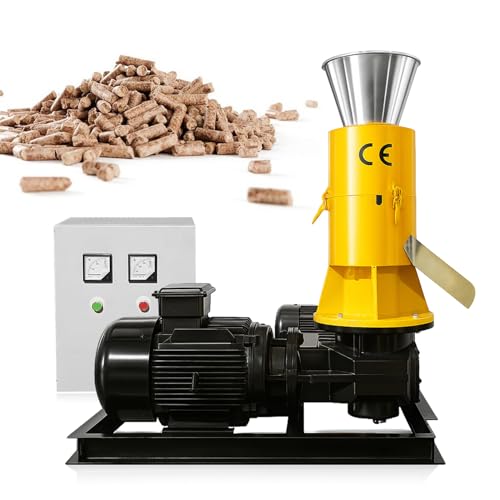
Best For: Medium to high-demand biomass pellet production in three-phase setups. The Bonxrdun model delivers a true 300 kg/h output with a 15 kW motor, designed for continuous operation. It is well-suited for farms or small industrial settings that require reliability across longer production runs.
Why selected: The high-powered motor and robust die (250 mm Ø 4 mm) with dual rollers enable more consistent pellet formation. It’s a practical choice when converting abundant agricultural residues into premium fuel pellets is a daily requirement.
Limitation: Three-phase power demand and higher initial footprint may limit use to facilities with a stable three-phase electrical supply and adequate space.
Yokoma Wood Pellet Machine 6MM

Best For: Small-scale operators seeking energy efficiency and straightforward operation. This machine mirrors the THUXEON in 6MM pellet capability and 60 kg/h output, with emphasis on an enlarged discharge port to prevent splashing and facilitate collection.
Why selected: The unit emphasizes practical feeding and discharge design, making it easier to manage material flow during long sessions. It’s a good match for those prioritizing ease of use and predictable pellet quality in a compact footprint.
Limitation: The 6MM die may limit pellet size options; if you need 8MM or different diameters, consider alternative models in this guide.
JARYANNIX 220V Three-Phase 6mm Wood Pellet Maker

Best For: Small farms and agricultural waste recycling projects, especially where straw, sawdust, and other residues are abundant. The JARYANNIX unit uses a 7.5KW class motor and three-phase power to achieve around 130 lbs/h (roughly 60 kg/h) with a 6mm die, making it suitable for seasonal pellet production and on-farm energy solutions.
Why selected: The product highlights expanded feed and discharge ports, improving loading and pellet collection. It also notes the high calorific value (3000–4300 kcal/kg), which helps buyers estimate fuel quality and potential heating efficiency.
Limitation: Pellet calorific value varies by material; users should plan for feedstock variability and adjust process parameters accordingly.
Yokoma Wood Pellet Machine 8MM
Best For: Operators seeking higher-density pellets with a larger diameter to suit specific boilers or stoves that benefit from 8MM pellets. The 8MM version shares the same three-phase 7500W setup and 60 kg/h production rate as the 6MM variant, with a slightly different die size for pellet dimension control.
Why selected: It is a natural alternative when the application calls for slightly larger pellets or different combustion characteristics. An enlarged discharge design continues to support efficient processing and collection.
Limitation: Slightly larger pellets may affect burner compatibility and require stock management to ensure consistent quality across batches.
Buying Guide
Key considerations help buyers pick the right biomass wood pellet machine for their operation. Use these practical questions to compare models side by side.
- What is my projected pellet output per hour? Choose a machine that meets or slightly exceeds monthly demand to minimize downtime.
- Is a three-phase power supply available? Heavier units typically require 220V three-phase power; confirm electrical readiness before purchase.
- What feedstock will I process? Some machines handle sawdust, straw, and agricultural waste equally well, while others are optimized for specific materials.
- What pellet diameter do I need? Common diameters are 6mm and 8mm; ensure the die matches your stove or boiler requirements.
- How easy is feeding and discharge? Expanded ports reduce clumping and splashing, improving workflow in busy settings.
- What about safety features and maintenance? Look for safety switches, clear access to wear parts, and straightforward cleaning routines.
Frequently Asked Questions
- What is the typical output range for small biomass pellet machines? Most compact units produce between 50–60 kg/h, with higher-end models reaching around 300 kg/h in shared or larger systems.
- Do these machines require special ventilation or safety equipment? Standard electrical safety and proper handling of hot components are essential; follow manufacturer guidelines for ventilation in enclosed spaces.
- Can I pelletize all types of agricultural waste? Many models handle sawdust, straw, and similar residues, but moisture content and material composition affect pellet quality.
- Is three-phase power mandatory for all units? Heavier models typically require three-phase power; lighter, benchtop variants may run on single-phase power depending on design.
- What maintenance is commonly needed? Routine inspection of dies, rollers, and feed mechanisms; regular cleaning of ash and residue improves throughput and longevity.
- How should I compare pellet quality? Look at calorific value ranges (often listed as kcal/kg) and pellet density; these influence heating efficiency.
Add a Comment