When selecting an automatic epoxy dispensing machine, look for precise droplet control, reliable seals, and options that fit your workflow. This guide highlights five top options suited for electronics, manufacturing, and lab settings. Best for high-precision tasks, best for continuous production, and best for budget-conscious buyers are covered. The buyer can compare dispensing accuracy, materials compatibility, and ease of use to choose the right model.
| Product | Best For | Key Benefit |
|---|---|---|
| FEITA 983 Auto Digital Display Glue Dispenser | Precision tasks, manual/semi-automatic control | Two control modes with long service life |
| 10L Digital Silicone Adhesive Glue Dispenser (Aoleaby) | Durable large-tank dispensing | 304 stainless steel, robust sealing |
| 220V Automatic Digital Dispensing Epoxy Machine | Electronics and aerospace projects | 0.0001 ml precision, fast start |
| 10L Digital Silicone Adhesive Glue Dispenser (GENTERUN) | Industrial adhesion tasks | Stainless steel construction, smooth interior |
| Semi-Automatic Glue Dispenser (mignonnememe) | High-precision manual and trigger control | Vacuum back suction, 0.01 ml drip |
FEITA 983 Auto Digital Display Glue Dispenser

The FEITA 983 uses a 0.18CV constant flow solenoid valve and includes an indicator switch with adjustable air suction up to 15 inches of mercury (Hg). It supports two controlling modes: manual and semi-automatic. In manual mode, dispensing can continue until the operator releases the foot pedal. This model is best for operators who need immediate, on-demand control and long service life. Best for small-batch work where precise drop control is essential, and for users who value dual-mode operation. Caution: ensure the air supply and wiring are properly configured to prevent misoperation in busy lines.
10L Digital Silicone Adhesive Glue Dispenser (Aoleaby)

This dispenser features a 304 stainless steel tank for durability and purity of contents. It is suitable for dispensing adhesives and sealants across manufacturing, laboratories, and workshops. Its robust sealing and smooth interior simplify cleaning, promoting reliable long-term use. Best for production lines needing larger-volume dispensing with straightforward maintenance. Choose this if you require a sturdy tank that resists contamination and is easy to clean. Limitation: bulkier footprint may be less suitable for compact workstations.
220V Automatic Digital Dispensing Epoxy Machine

Designed for electronics, aerospace, optical, chemical, automotive, and medical applications, this model emphasizes precision with a minimum fixed infusion volume and a repeatable cycle. It features a clean, modern appearance and high-end construction. Best for users needing tiny droplet control and repeatable dispensing in diverse mechanical fields. Caution: verify compatibility with your exact adhesive chemistry and substrate materials before large-scale deployment.
10L Digital Silicone Adhesive Glue Dispenser (GENTERUN)

GENTERUN’s stainless steel 10L tank ensures durability and content purity. The unit provides excellent sealing and pressure resistance due to robust welding, with a smooth interior for easy cleaning. Best for industrial adhesive and sealant workflows that demand robust construction and reliable cleaning. Choose this if you prioritize a durable tank and straightforward maintenance. Limitation: larger size may require dedicated dispensing space.
AOIDFOA Automatic Dispensing Machine

The AOIDFOA unit features vacuum reverse suction to prevent dripping and achieve accurate glue drops, improving the cleanliness of the workspace. It uses a high-quality electronic valve for rapid start and has a minimum infusion volume of 0.01 mL with adjustable intervals. Best for tasks requiring fast cycling and high precision. Limitation: may require careful calibration to maintain accuracy over long runs. Manual control switch allows precise timing when needed.
Semi-Automatic Glue Dispenser (SanBouSi)
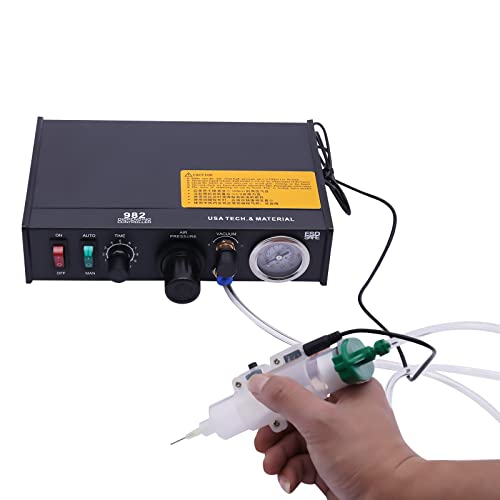
SanBouSi offers vacuum back suction with a semi-automatic design, allowing both automatic dripping and manual single-hole control. The minimum drip volume is 0.01 mL with repeat accuracy around 0.5%. Best for precise tasks in electronics or jewelry crafting where hands-free operation or manual control is beneficial. Limitation: as a semi-automatic device, it may require ongoing setup for automatic cycles in high-volume environments.
Mignonnememe Glue Dispenser (Semi-Automatic)

Equipped with vacuum back suction and a 0.01 mL precision drip, this semi-automatic device emphasizes clean operation and high accuracy. It offers dual operation modes: automatic timed dispensing or manual single-hole control. Best for precision assembly lines where hands-free operation is helpful, and for crafts requiring steady drip control. Caution: ensure power stability to avoid cycle timing drift in sensitive applications.
Buying Guide
- Dispensing precision: Look for minimum drip volume (often 0.01 mL) and repeat accuracy (< 1%).
- Control modes: Choose models with both automatic and manual modes if your tasks vary in cadence and hands availability.
- Tank material and size: Stainless steel tanks (304) offer durability and purity; larger tanks support longer runs but require more space.
- Sealing and cleaning: Robust sealing and smooth interiors simplify maintenance and reduce cross-contamination.
- Vacuum back suction: Helpful to prevent drips and keep a tidy work area, especially for high-precision jobs.
- Compatibility: Ensure the machine can handle your adhesive/material type and viscosity and the substrate you use.
Frequently Asked Questions
- What is the typical minimum drip volume for these dispensers? Answer: Many models specify around 0.01 mL for precise drops.
- Do these machines support automatic and manual operation? Answer: Several models offer both modes, allowing flexible workflows.
- Is stainless steel tank material important? Answer: Yes, it improves durability and content purity, especially for chemical adhesives.
- Can I use these for non-epoxy adhesives? Answer: Most are designed for a range of adhesives, sealants, and pastes; verify viscosity and material compatibility.
- What maintenance is needed? Answer: Regular cleaning of the interior, checking seals, and ensuring proper valve operation.
- Which model is best for high-volume production? Answer: Models with larger tanks and faster start/stop cycles are generally suited for higher throughput.
Add a Comment