Answering the need for quick, at-a-glance air quality data in confined spaces, these meters detect key pollutants like CO2, HCHO, TVOC, and particulate matter while also tracking temperature and humidity. They’re ideal for industrial tasks, maintenance crews, or small workspaces where air quality directly affects safety and comfort. This guide highlights five practical options, explains who benefits most from each, and provides clear buying considerations to help you choose without confusion.
Buyer’s quick reference table
| Product | Main Focus | Best For | Limitations |
|---|---|---|---|
| PinoTec 5-in-1 (Bright White) | CO2, HCHO, TVOC, temp, humidity | Small spaces, quick reads | Battery life depends on use |
| YNAK 16-in-1 | 9 parameters, 7 alerts | Families, offices needing broad coverage | Complex data may require setup |
| FORENSICS DETECTORS FD 4 Gas | O2, CO, H2S, LEL | Confined spaces with gas hazards | Only gas sensors, no PM or HCHO |
| PinoTec Ruby Black | CO2, HCHO, TVOC, temp, humidity | Colorized readings, portable | Similar to Bright White in features |
| CoillBlow 5-in-1 | CO2, HCHO, TVOC, temp, humidity | Home, office, travel | LCD readability varies by lighting |
5-in-1 Professional Indoor Air Quality Monitor (Bright White) by PinoTec

The device combines CO2, HCHO, TVOC, temperature, and humidity sensing in a single compact unit. It features a color LED screen that clearly displays real-time readings and uses alert colors to indicate unsafe conditions. A built-in 1200mAh battery supports USB charging for extended use, making it suitable for space-limited environments like confined rooms or tool sheds. Best for quick, at-a-glance checks in small workplaces or temporary work areas.
Who it’s best for: individuals needing a straightforward, portable air-quality reader for confined spaces, with easy-to-read visuals and rechargeable power. Why selected: it offers essential 5-in-1 monitoring with a clear display and practical alerts. Caution: battery life will vary with display brightness and alert activity; monitor may require frequent charging in high-use scenarios.
YNAK Professional 16-in-1 Indoor Air Quality Monitor
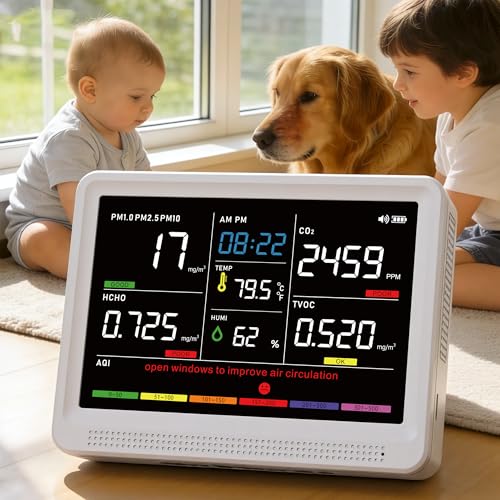
This model measures CO2, PM2.5, PM1.0, PM10, HCHO, TVOC, temperature, humidity, AQI, and time, with seven distinct AQI alert buzzers. Its external high-precision sensors claim 0.001 accuracy and direct air sampling for rapid detection. Best for larger spaces or environments needing comprehensive pollutant data and multiple alert options. Choose this if you require extensive parameter coverage and proactive alerts.
Who it’s best for: households, offices, or workshops that need detailed pollutant tracking and multiple alert modes. Why selected: broad measurement range and high-resolution sensors support precise decision-making. Caution: avoid touching sensors or exposing them to perfumes to maintain accuracy; setup may be more involved than 5-in-1 models.
4 Gas Monitor – USA NIST Calibrated (FORENSICS DETECTORS FD)
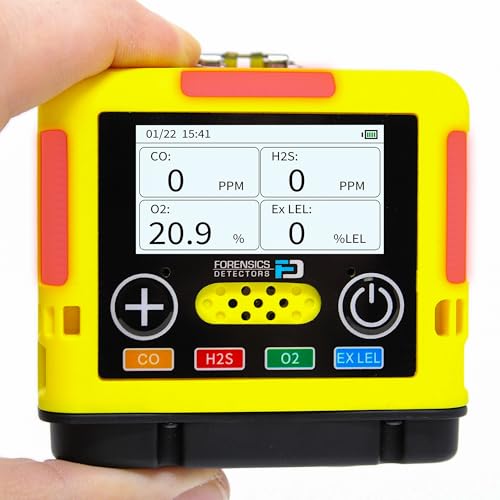
This compact gas detector covers Oxygen (O2), Carbon Monoxide (CO), Hydrogen Sulfide (H2S), and LEL (combustibles). It is factory-calibrated and supports adjustable alarms when preset levels are reached. Best for confined-space work where combustible or toxic gas hazards are a concern. Choose this for focused gas monitoring rather than broad air-quality metrics.
Who it’s best for: workers in environments with potential gas hazards or ventilation concerns. Why selected: reliable 4-gas coverage with factory calibration. Caution: does not measure particulates or VOCs; use alongside a broader air-quality monitor if needed.
5-in-1 Indoor Air Quality Monitor (Ruby Black) by PinoTec
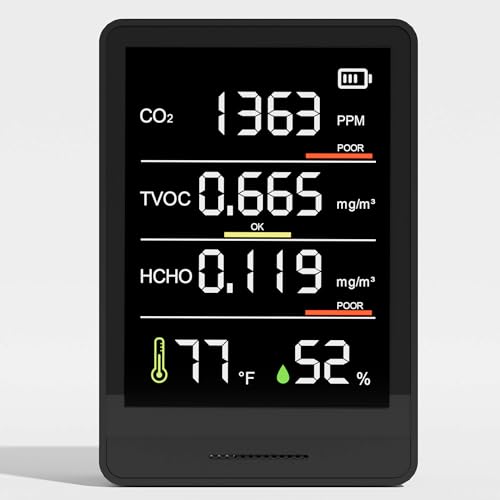
This variant mirrors the Bright White model’s 5-in-1 capabilities—CO2, HCHO, TVOC, temperature, and humidity—with a distinct color-themed display. The color LED screen supports quick interpretation of overall air quality and gas-specific values. Best for users who prefer a darker aesthetic or need consistent color cues for safety monitoring. Choose this if you want the same core features in a different color finish.
Who it’s best for: users who favor a visually distinct unit with the same 5-in-1 monitoring capabilities. Why selected: clear color cues help users quickly gauge air safety. Caution: color or finish should be considered if the device will be used in bright environments where glare could affect readability.
5-in-1 Portable Indoor Air Quality Monitor (CoillBlow)

CoillBlow’s device detects CO2, HCHO, TVOC, temperature, and humidity with a clear LCD display. It includes a built-in air quality level indicator and an alarm reminder when readings exceed safe ranges. Best for home offices, travel, or cars where portability and quick readings matter. Choose this if you need a compact, readable monitor with actionable alarm features.
Who it’s best for: travelers or users who need a portable option for quick checks. Why selected: practical LCD readout and alert reminders aid in immediate ventilation actions. Caution: LCD readability can be affected by direct sunlight or strong indoor lighting.
Buying Guide: Key Considerations for Confined Space Air Monitors
What should you look for when selecting an air monitor for confined spaces?
- Parameter coverage: For basic safety in tight spaces, 5-in-1 devices (CO2, HCHO, TVOC, temperature, humidity) are often sufficient. For broader safety, consider 9–16 parameter monitors.
- Sensor accuracy and response: External or high-precision sensors improve reliability. Look for devices that sample air directly and provide real-time updates.
- Alerts and alarms: Weigh the value of multiple alarm modes (visual, audible, vibration) and whether you need a mute option for quiet environments.
- Power and portability: USB-rechargeable units are convenient for ongoing monitoring in mobile or remote spaces.
- Display readability: Color-coded readings and LCD brightness affect ease of use in different lighting conditions.
- Maintenance: Consider factory calibration needs and whether sensors require special handling to preserve accuracy.
- Data and logging: For ongoing safety planning, choose meters with time stamps or data export if needed.
Practical tips for confined-space monitoring
- Place monitors away from direct airflow sources to avoid skewed readings.
- In spaces with potential gas hazards, run a monitor alongside a dedicated gas detector for redundancy.
- Keep units charged and test alarms before critical tasks.
- Use color cues and audible alarms to trigger ventilation or evacuation as needed.
FAQ
- What is the minimum parameter set needed for confined-space monitoring?
A: Typically CO2, temperature, and humidity are essential, with HCHO and TVOC as additional safety layers for many indoor environments. - Do these monitors require calibration?
A: Some models are factory calibrated; others may require periodic recalibration or sensor maintenance per manufacturer guidance. - Can I use any of these for car or travel use?
A: Yes, several are portable and USB-rechargeable, suitable for cars or travel, but confirm power options per device. - Are readings instant or delayed?
A: Most shown devices provide real-time or near real-time readings, with frequent refresh rates (often every 2 seconds to a few seconds). - Which device is best for a small workshop?
A: For a small workshop needing quick reads, a 5-in-1 monitor with a color display is typically easiest to use. - Is PM2.5 measurement necessary in confined spaces?
A: If dust or aerosol hazards are possible, PM2.5 measurement adds valuable context; otherwise, focus on CO2, HCHO, and TVOC for most spaces.
Add a Comment