Seeking an adjustable hydraulic pressure switch that protects equipment while providing precise control? This guide highlights top options designed for trucks, trailers, pumps, and industrial hydraulics. Each choice suits different needs—from ON/OFF control to multi-range monitoring—so you can pick the best match for your system and operating environment. The top picks cover a range of PSI settings, voltages, and connection types to fit most hydraulic circuits while signaling pressure irregularities for immediate action.
Buyer’s quick table: The following products are chosen for versatility, reliability, and clear signaling in hydraulic and related systems.
| Product | Best For | Key Range |
|---|---|---|
| Buyers PS2501K | Trucks and trailers with 1/4 NPT fittings | 250–1000 PSI |
| Bailey SPDT 220265 | ON/OFF control in pumps and motors | 500–2500 PSI |
| Buyers PS2575 | Compact hydraulic systems | 25–75 PSI |
| LiebeWH Hydraulic Relay | Multi-system monitoring | General hydraulic range |
| Qinlorgo JCS-02H | Industrial hydraulic relays | 60–350 kg/cm² (approx. 60–3500 PSI) |
Buyers Products PS2501K Adjustable Hydraulic Pressure Switch
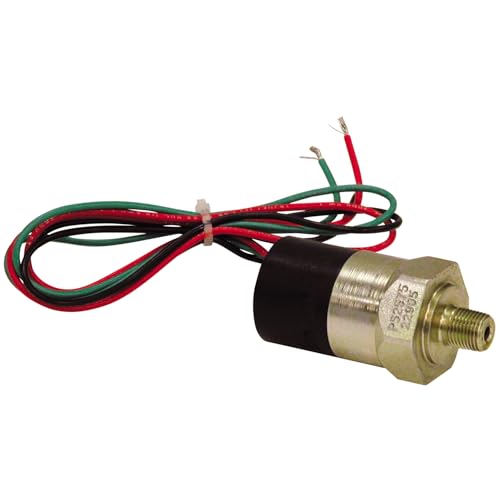
The PS2501K is designed to safeguard hydraulic circuits in trucks and trailers. It offers adjustable PSI settings to keep pressure within safe limits and signals irregularities for immediate action. The switch can be wired normally open or normally closed, providing installation flexibility for various hydraulic configurations. Best for heavy-duty hydraulic lines in vehicle applications where accurate pressure monitoring is critical and space is at a premium. Caution: wiring configuration may affect signal behavior; ensure correct normally open/closed selection for your circuit.
Bailey Adjustable Electronic Pressure Switch — SPDT, 500–2500 PSI

Bailey’s SPDT pressure switch provides a wide adjustable range (500–2500 PSI), ideal for ON/OFF control in hydraulic pumps and motors. It supports multiple voltages (5 Amps at 12/24VDC or 125/250VAC), enabling reliable operation across DC and AC systems. The unit withstands extreme temperatures and high burst pressures, making it suitable for industrial or mobile use. Best for systems requiring reliable cross-compatibility and robust switching. Limitation: complex wiring may require careful setup to avoid chatter during rapid pressure changes.
Buyers Products PS2575 Adjustable Hydraulic Pressure Switch

The PS2575 offers a compact option with a lower PSI range (25–75 PSI), ideal for smaller hydraulic systems or auxiliary circuits where gentle monitoring is required. It supports standard electrical configurations and provides reliable signaling with a simple setup. Best for auxiliary or secondary hydraulics and systems where precise low-pressure monitoring is essential. Caution: not suited for high-pressure mainlines where 75 PSI would be exceeded.
LiebeWH Hydraulic Pressure Switch Relay Adjustable Control

LiebeWH offers a multi-system compatible hydraulic pressure switch relay suitable for pneumatic, hydraulic, and oil circuits. It features a clearly marked scale for quick, tool-free adjustments and uses PT1/4 inch threading for easy integration with common industrial equipment. Best for multi-application monitoring where a single relay can cover several subsystems. Limitation: installation depends on compatible threading and environmental exposure; verify fit for your equipment’s enclosure and vibration levels.
Qinlorgo Pressure Relay JCS-02H — PT1/4 Thread

The Qinlorgo JCS-02H offers a robust hydraulic pressure relay with a PT1/4 thread and a usable range suitable for 60–350 kg/cm² (approximately 60–350 PSI, depending on conversion). It’s designed for pneumatic, hydraulic, and oil systems, with a gold-plated handle for precise adjustments. Best for industrial environments requiring a durable, adjustable relay with solid sealing. Caution: confirm actual PSI range in your region’s units to avoid misinterpretation of the setting when wiring and calibrating.
Buying Guide
What to consider when choosing an adjustable hydraulic pressure switch
System compatibility is crucial. Check port size (NPT/PT threads) and whether your line uses 1/4 NPT, PT1/4, or another standard. Consider the electrical demands—voltage rating and current rating should match your control circuit. If you need ON/OFF control across multiple devices, SPDT or DPDT switches provide versatility. Temperature range and burst pressure affect durability in mobile or harsh environments, so verify suitability for your operating conditions.
How to pick the right PSI range
For main hydraulic lines, opt for higher ranges (hundreds to thousands of PSI). For auxiliary or low-pressure circuits, select lower ranges (tens to a few hundred PSI). Adjustable ranges enable fine-tuning to prevent nuisance alarms while ensuring fast response to genuine pressure issues. If you require signaling across multiple subsystems, a relay-type switch with clear scale marks improves reliability and maintenance.
Signal type and wiring considerations
Normally Open setups trigger when pressure rises above the setpoint, while Normally Closed configurations do the opposite. SPDT switches can provide both signals, enabling more complex control logic. Ensure wiring is compatible with your vehicle, pump, or controller enclosure to avoid short circuits or EMI interference.
Environmental and durability factors
Industrial and mobile environments demand rugged construction. Look for durable housings, temperature tolerance, and resistance to shock or vibration. Sealing and thread integrity matter for fluids mixing with air or dirt ingress. If installation is outdoors or in dusty settings, IP protection and corrosion resistance are beneficial.
Installation and maintenance considerations
Choose devices with straightforward installation and clearly marked adjustment scales. Tools-free adjustments save service time, while accessible connectors simplify maintenance. Regular inspection of wiring, seals, and mounting hardware minimizes leakage risks and ensures reliable signaling over time.
Compatibility and integration tips
Match the switch’s electrical and mechanical specs to your hydraulic system’s controller or relay logic. When integrating with existing dashboards or alarms, plan signal routing and annunciation paths to avoid false positives. In mobile setups (trucks, trailers), verify vibration tolerance and secure mounting to prevent movement-induced misreads.
FAQ
- What PSI range should I choose for a main hydraulic line? Choose a higher range (several hundred to thousands of PSI) to cover normal operation and safe shutoffs. Verify equipment tolerances to avoid false alarms.
- Do I need SPDT for hydraulic systems? If you want an alarm or dual signaling path, SPDT is helpful. For simple on/off control, a standard NO or NC switch may suffice.
- Is 1/4 NPT common for these switches? Yes, 1/4 NPT is a common port size for many hydraulic switches, including several in the chosen products.
- Can these switches handle both AC and DC circuits? Some models support both, but verify voltage ratings for your specific unit and control circuit.
- Are these switches easy to replace in existing systems? Replacement is generally straightforward if thread size, electrical connections, and mounting align with your current hardware.
- What about durability in off-road conditions? Look for models rated for severe temperatures and shock/vibration resistance to ensure consistent performance.
Add a Comment