Looking for reliable 800 WOG ball valves for water, oil, or gas lines? This guide highlights five top choices that balance strength, serviceability, and corrosion resistance. The selections favor stainless steel and full-port designs to minimize pressure loss and ensure long-term sealing. The buyers most likely to benefit include professionals needing durable, maintenance-friendly valves for industrial plumbing, irrigation, and mechanical systems, as well as DIY enthusiasts installing water or gas lines in controlled environments.
Below is a quick comparison of the featured products to help you decide at a glance. The table focuses on compatibility, construction, and maintenance notes.
| Product | Material / Port | Max Pressure / Temp | Best For |
|---|---|---|---|
| U.S. Solid 3/4″ Stainless Steel 316 Ball Valve (One-Piece) | 316 SS, full port, one-piece | 1000 PSI WOG @ 70°F; 800 PSI @ 392°F | Direct-assembly lines needing minimal leak paths |
| U.S. Solid 3/4″ Ball Valve 304 Stainless (Anti-Misoperation) | 304 SS, full port, NPT | 1000 PSI WOG @ 70°F; 800 PSI @ 392°F | Industrial control lines requiring misoperation protection |
| TAOKIHAI 2-Pack 3/8″ Ball Valve (Locking) | 304 SS, full port, 2-piece | 1000 WOG; -60°F to 450°F | Harsh environments needing locking handle |
| MONVA 1-PC Stainless 1″ NPT Ball Valve | Stainless, 1-PC | 1000 WOG | Maintenance-friendly installations |
| U.S. Solid 3/4″ 316 SS 3-Piece Ball Valve | 316 SS, 3-piece | 1000 WOG @ 70°F; 800 PSI @ 392°F | Serviceable design for maintenance without pipeline removal |
U.S. Solid 3/4″ Stainless Steel 316 Ball Valve

This is a one-piece, 316 stainless steel valve with PTFE seals. Best for lines where minimal leak paths and robust structural strength are priorities. Suitable for water, oil, and gas with a wide operating range. Consider for new installations where a welded or forged body is beneficial.
Best for: systems requiring high corrosion resistance and a compact one-piece design. Limitations: not ideal if you need field disassembly without removing the pipeline.
U.S. Solid 3/4 in Ball Valve 304 Stainless Full Port
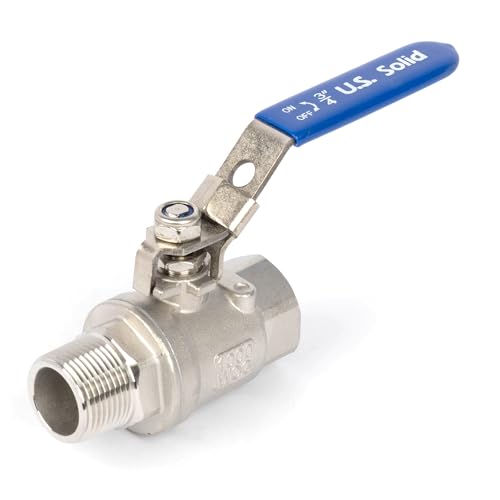
Full port design with 304 stainless steel body and PTFE seals. Better for irrigation, HVAC piping, or industrial fluid control where full bore flow reduces pressure drop. The anti-misoperation feature helps prevent accidental valve movement in busy environments.
Best for: applications needing low-pressure drop and anti-misoperation security. Caution: ensure PTFE seals are compatible with the fluids involved and temperatures stay within spec.
TAOKIHAI 2Pack 3/8″ Ball Valve With Lock

304 stainless steel, full port, two-piece construction, and a locking device on the handle for safety. Best for busy workspaces and environments where preventing tampering or accidental operation is important. The locking feature adds a security layer but may slightly complicate maintenance.
Best for: safer operation in public-facing or high-traffic installations. Caution: ensure room for two-piece maintenance and locking hardware during servicing.
MONVA 1-PC Stainless Steel 1″ NPT Ball Valve

1-inch, one-piece stainless steel valve for straightforward maintenance and reliable WOG performance. A solid pick where field replacements and simple bolted disassembly are needed without removing the valve from the line. Works well for water, oil, and gas lines with moderate to high flow requirements.
Best for: installations prioritizing serviceability without pipeline removal. Caution: verify compatibility with the specific fluid media and temperature range.
U.S. Solid 3/4″ 316 Stainless 3-Piece Ball Valve

This 3-piece design allows disassembly without removing the valve from the pipeline, offering maintenance flexibility and thorough cleaning. It uses PTFE seals certified up to 200°C, with 1000 PSI WOG at 70°F and 800 PSI at 392°F. Best for work that prioritizes serviceability and long-term sealing.
Best for: projects needing on-site maintenance while keeping the line in service. Limitation: 3-piece assemblies can be more complex to install initially than one-piece designs.
Buying Guide: Key Considerations for 800 WOG Ball Valves
- Material choice: Stainless steel (304 or 316) provides corrosion resistance in water, oil, and gas lines. 316 is preferred for harsher environments.
- Port design: Full port vs. standard port. Full port minimizes flow restriction, which is important in irrigation and high-flow systems.
- Valve body design: One-piece reduces leak paths, while 3-piece designs offer serviceability in the field.
- Temperature and pressure rating: Ensure the valve supports your operating temperatures and up to 1000 PSI WOG where needed.
- Seals: PTFE seals provide broad chemical compatibility but verify temperature limits and chemical exposure for your application.
- Safety features: Locking handles help prevent accidental operation in busy environments.
- Installation context: Consider whether you need misoperation protection, anti-tamper features, or easy maintenance without pipeline removal.
Frequently Asked Questions
- What does WOG stand for?
WOG means Water, Oil, and Gas. It’s a rating indicating the valve’s suitability for these fluids at a given temperature and pressure.
- What is full-port versus standard-port?
Full-port valves have a bore equal to the pipe diameter, yielding minimal flow resistance. Standard-port valves have a smaller bore and can create slight pressure drop.
- Which material is best for outdoor use?
316 stainless steel offers superior corrosion resistance in outdoor or humid environments compared with 304 stainless steel.
- Are locking handles necessary?
Locking handles are useful in busy or industrial settings to prevent unintended valve movement. They are optional for residential uses.
- Can these valves be serviced in-line?
3-piece designs allow disassembly for maintenance without removing the valve from the pipeline, which is advantageous for long-term systems.
- How do I choose between one-piece and 3-piece valves?
Choose one-piece for compactness and fewer leak paths; choose 3-piece for easier maintenance and cleaning in complex systems.
Add a Comment