Whether you’re setting up a home shop or outfitting a small machining studio, an 8-inch rotary table is a versatile addition for precise angular cutting, drilling, and indexing. This guide identifies five solid 8″ options and explains who benefits most from each. For shoppers who need horizontal and vertical versatility, stable HT200 construction, and precise vernier readings, these selections deliver dependable performance for hobbyist to light-industrial tasks. The following table highlights core details to compare at a glance.
| Product | Best For | Key Benefit | Notes |
|---|---|---|---|
| VEVOR HV8 | Builders needing dual orientation | Vertical/horizontal design with precise graduations | HT200 casting; 360° indexing; 10-second vernier |
| KAKA HV-8 | Precision circle cutters | High-precision 10-second vernier; sturdy HT200 cast iron | Dual position with T-slots |
| CME IN-TSL8-C6 | Compact setups needing a chuck | 8″ table with adapter and 6″ 3-jaw chuck | 3 T-slots; 1/2″ slot width |
| CME 8″ 3-T-Slot (B0DDVBDS1L) | Versatile general milling | 3 T-slots; 360° rotation; precise 0.002″ flatness | 4 1/8″ height |
| CME 8″ 4-T-Slot (B0DDVW6DP8) | Heavy duty clamping | 4 T-slots; precise 360° rotation | Similar height to 3-slot version |
VEVOR 8-Inch HV8 Rotary Table

Best for: shop owners who need both vertical and horizontal operation in one compact unit. The HV8 uses HT200 casting, which provides durability and good vibration damping for milling, drilling, and boring tasks. The table offers a full 360° graduated indexing plate and a high-precision readout. The braking and resetting mechanism lets you reposition with confidence.
Why chosen: The VEVOR HV8 emphasizes dual orientation, enabling quick transitions between milling orientations without repositioning the setup. The 360° indexing plate and a 10-second vernier readout support precise angle work, which is ideal for circular patterns or gear-cutting experiments in hobbyist-to-pro workshop environments.
Caution: The data highlights mechanical precision, but users should confirm the mounting compatibility with their existing spindle and tailstock geometry before purchase. Ensure the milling machine’s spindle nose matches the table’s mounting interface.
KAKA Industrial HV-8 Horizontal Vertical Rotary Table

Best for: users who need precise circle cutting and boring in a robust HT200 cast iron body. The HV-8 features a 10-second vernier and a 4° per revolution handle, enabling quick setup for complex tasks and tight-tolerance work in metalworking projects.
Why chosen: The dual-position design with T-slots improves clamping flexibility and allows easier integration with tailstocks and dividing plates for multi-axis operations. Its durable construction helps maintain accuracy under heavier milling operations compared with lighter duty tables.
Caution: While precision is strong, users should verify tool clearance when working with large workpieces; ensure the machine has enough spindle travel to avoid collisions at extreme angles.
CME 8″ Horizontal/Vertical Rotary Table with 6″ 3-Jaw Chuck (IN-TSL8-C6)

Best for: hobbyists and small shops that want a ready-to-use package with a chuck included. The 6″ 3-jaw chuck works well for holding round workpieces and offers convenient quick clamping for repeated operations.
Why chosen: This CME option combines an 8″ table with a pre-mounted chuck, simplifying setup for routine milling or drilling tasks. The 3-T-Slots are designed to support a variety of fixtures, making it adaptable for fixtures and primitive work-holding solutions.
Caution: The included chuck limits stock size to the chuck’s capacity. For large or odd-shaped parts, consider a different holding method or an additional tailstock support to prevent runout.
CME 8″ Precision-Adjustable Rotary Table, 3 T-Slots
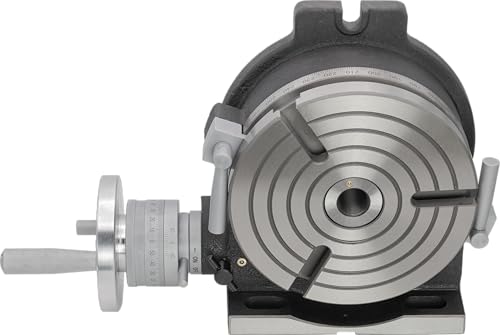
Best for: users who need tight flatness and a robust 8″ table for milling with precise angular positioning. It includes a 3 T-Slot configuration and a 360° rotation, supporting a broad range of fixtures and workholding strategies.
Why chosen: The table delivers a 0.002″ flatness tolerance and a 4 1/8″ overall height, making it suitable for precision work where surface accuracy and repeatable angular cuts matter. The Morse Taper 2 center bore ensures stable mounting to compatible machines.
Caution: The 3-slot design may limit clamping options for certain custom fixtures. If you frequently require more clamping positions, the 4-slot variant might be preferable.
CME 8″ Precision-Adjustable Rotary Table, 4 T-Slots

Best for: projects requiring more versatile fixtures and additional clamping positions. The extra T-slot improves adaptability for holding irregular parts or multiple-workpiece setups.
Why chosen: Matching the 8″ diameter, this version provides four T-slots and a 360° rotation, supporting more complex setups without sacrificing precision. It suits workshops performing frequent angle-dividing tasks or circular pattern work.
Caution: The increased slot count adds potential for slight alignment changes when reconfiguring fixtures. Confirm clamp arrangements and ensure consistent workpiece alignment after reassembly.
Buying Guide: Key Purchase Considerations
- Size and capacity: An 8″ rotary table balances workpiece size with table stiffness. Ensure the table can handle your typical workpieces and mounting footprint on your milling machine.
- Orientation: Dual horizontal/vertical capability saves space and simplifies setups. Verify the mounting interface matches your machine’s spindle and tailstock.
- Slots and clamping: The number of T-slots affects fixture versatility. More slots offer flexible workholding but may require more fixtures and clamping hardware.
- Precision and durability: Look for high-density cast iron, stable graduations, and vernier readings. A 0.002″ flatness tolerance or better indicates high accuracy for precise machining.
- Rotation and indexing: A fine vernier (e.g., 10 seconds) supports precise angular indexing. Confirm the angular range and gearing to suit your typical tasks like circle cutting or gear work.
- Accessories: Some models include chucks or adapters. Consider whether you need a chuck, a tailstock, or dividing plates to expand capabilities.
- Compatibility: Check Morse taper compatibility and whether adapters are needed to fit your machine. Verify bolt patterns and mounting hole alignments.
Frequently Asked Questions
- What is the main benefit of an 8″ rotary table?
It provides a compact yet capable platform for precise angular machining and indexing on common milling machines, suitable for many hobbyist and light-industrial tasks.
- Should I choose a 3-slot or 4-slot table?
Choose 3-slots for simpler setups; choose 4-slots if you need more clamping flexibility for varied fixtures or larger workpieces.
- Is vertical orientation necessary?
Vertical orientation is helpful for certain milling operations and drilling patterns where gravity and clamping stability are factors. Dual orientation adds versatility.
- Do rotating tables require special maintenance?
Regular cleaning, light lubrication, and careful clamping help maintain accuracy. Avoid overtightening and protect against corrosion in humid environments.
- What should I verify before buying?
Mounting interface compatibility, spindle clearance, table height, and whether a chuck or accessory set is included or needed for your typical tasks.
- Are these tables suitable for gear cutting or dividing tasks?
Yes, many models support dividing plates and indexing operations; ensure you select a version compatible with the plates you intend to use.
Add a Comment