Answering the search for reliable 60-gallon air compressors, this guide highlights five sturdy options suited for professional garages and serious DIY workshops. These choices balance high CFM output, oil-lubricated longevity, and oil-free simplicity for different workflows. The best buyers are professionals needing consistent power, hobbyists upgrading from smaller tanks, and workshop managers seeking durable, low-maintenance units. Below, a quick table compares core specs and ideal use cases for each pick.
| Product | Best For | Key Benefit |
|---|---|---|
| DEWALT 60 Gallon Vertical | Professional garages, heavy-duty DIY | High reliability and space-saving vertical design |
| VEVOR 60 Gallon 4HP | Large workshops, continuous air needs | High flow 10 SCFM at 90 PSI, oil-free for maintenance ease |
| VEVOR 60 Gallon 3.7HP | Industrial tasks with higher max pressure | Max 155 PSI, belt-driven pump for smooth operation |
| California Air Tools CAT-60040CAD | Quiet environments, noise-sensitive projects | Ultra-quiet 75 dBA with oil-free dual piston pump |
| Quincy Q13160VQ | Reliable single-phase shop compressor | 60-gallon vertical, solid CFM at 100 PSI |
DEWALT 60 Gallon Vertical Air Compressor

Best for professionals who need durable performance and space efficiency. This model features a 3.7 HP electric motor and a 155 psi max pressure with an oil-lubricated pump, delivering steady output for demanding tasks. The vertical design helps keep floor space clear in tighter shops, making it a solid pick for wall-mounted setups or small workshops. A practical option for framing nailers, impact tools, and air-operated machinery that require consistent air supply.
Reference features: 3.7 HP electric motor, 155 psi max, oil-lubricated pump, 240 V operation, vertical footprint.
Caution: Oil maintenance and regular pump checks are recommended to maintain peak performance and longevity.
VEVOR 60 Gallons Heavy-Duty Air Compressor 4HP
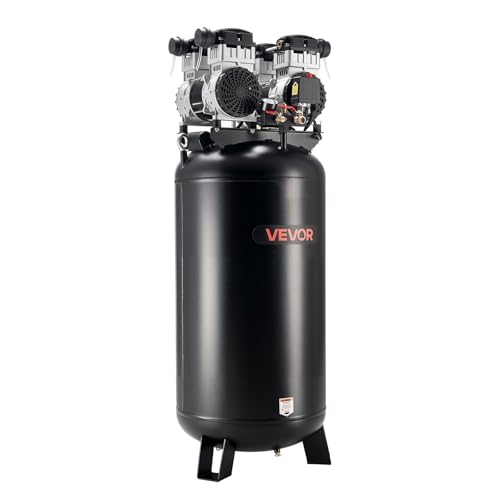
Best for large workshops needing strong air delivery with manageable maintenance. The 4 HP motor delivers 10 SCFM at 90 PSI and reaches 125 PSI max, supporting a range of pneumatic tasks with steady flow. Its oil-free design reduces routine maintenance, while the 60-gallon tank supports longer runtimes. Ideal for spray guns, grinders, and impact tools, especially in environments where downtime must be minimized.
Reference features: 4 HP motor, 10 SCFM @ 90 PSI, 125 PSI max, oil-free.
Caution: Oil-free systems can still require occasional filter cleaning and moisture management for clean air output.
VEVOR 60 Gallons Heavy-Duty Air Compressor 3.7HP

Best for users who want strong performance with a traditional oil-lubricated system. This model supplies 8 SCFM at 90 PSI and reaches up to 155 PSI, offering robust power for continuous toolkit use. The belt-driven pump enhances efficiency and can reduce pulsation for sensitive tools. A solid choice for body shops or woodworking shops that rely on consistent air pressure over long sessions.
Reference features: 3.7 HP motor, 8 SCFM @ 90 PSI, 155 PSI max, belt-driven pump, oil-lubricated.
Caution: The belt-driven system requires periodic belt tension checks and pulley alignment for best performance.
Quincy Single-Stage 60-Gallon Vertical

Best for shops prioritizing a trusted vertical tank with predictable performance. The Quincy Q13160VQ offers a 60-gallon capacity with 12.4 CFM at 100 PSI and a maximum of 145 PSI, powered by a 230-volt single-phase setup. It suits automotive bays and fabrication spaces where stable air pressure is essential for repeated use of air tools. Limitations may include higher power requirements and potential space needs for larger footprints.
Reference features: 3.5 HP, 60-gallon vertical tank, 12.4 CFM @ 100 PSI, 145 PSI max, 230V single-phase.
Buying Guide: Key Considerations For 60 Gal Compressors
- Tank size and airflow: For continuous tools like spray guns or impact wliers, prioritize higher CFM at your target PSI. A larger tank buffers brief-air drops during peak use.
- Motor type and longevity: Oil-lubricated pumps tend to last longer under heavy use, while oil-free designs reduce maintenance but may require more moisture management.
- Pressure range: Max PSI dictates how quickly tools reach full power. Consider your tools’ pressure needs to avoid overkill or undersupply.
- Noise and placement: If you operate near living spaces or noise-sensitive areas, consider models with quiet operation (e.g., 75–78 dBA range).
- Maintenance requirements: Belts, pulleys, and pump heads in belt-driven systems need periodic inspection; oil levels should be checked in oil-lubricated units.
- Power requirements: Confirm voltage and phase (230V single-phase vs. other configurations) to match your workshop electrical setup.
- Space considerations: Vertical tanks save floor space but still require ceiling clearance and access for maintenance.
Frequently Asked Questions
- What is a typical CFM requirement for 60-gallon air compressors?
Answer: The needed CFM depends on tools; spray guns and grinders typically require higher CFM at your PSI target, often ranging from 8 to 12 CFM at 90 PSI. - Why choose an oil-lubricated pump over oil-free?
Answer: Oil-lubricated pumps generally offer longer life and better lubrication under heavy use, though they require oil maintenance and filtration. - Is a 60-gallon tank necessary for a home shop?
Answer: It depends on usage; for intermittent tools, a smaller reservoir may suffice, but a 60-gallon tank provides longer run times between cycles for continuous tasks. - Can a 60-gallon compressor operate on 110V?
Answer: Most 60-gallon units require 230V single-phase or three-phase power; check the voltage requirements for compatibility with your shop’s electrical system. - What maintenance does a belt-driven unit need?
Answer: Regular belt tension checks, pulley alignment, and periodic inspection of the pump head and seals help maintain efficiency and prevent wear. - Are oil-free compressors better for beginners?
Answer: Oil-free units are low-maintenance in terms of oil changes but require moisture control and can have shorter component lifespans in heavy-duty use.
Add a Comment