The world of 5-axis robot arms blends education with hands-on STEM practice. This guide highlights five compatible options that suit Raspberry Pi, Arduino, and PC-based projects, offering varied control methods, robust hardware, and open-source resources. Each section provides a quick product snapshot, key features, and practical considerations to help builders pick the right arm for learning, prototyping, or small automation tasks.
| Product | Platform | Approx. Focus | Control Type |
|---|---|---|---|
| Adeept 5-DOF Robotic Arm Kit (Black) | Raspberry Pi / DIY | Education, Coding | Gamepad / Web UI |
| Adeept 5-DOF Robotic Arm Kit (Orange) | Raspberry Pi / DIY | Education, Coding | Gamepad / Web UI |
| Robotic Arm for Raspberry 5 4B (LewanSoul) | Raspberry Pi / Open Source | AI / Vision Ready | Python / App Control |
| FREENOVE Robot Arm Kit (Raspberry Pi Compatible) | Raspberry Pi / 4B/5 | Drawing & Clamping Modes | Python / App Control |
| Robotic Arm for Raspberry Pi: ArmPi Mini | Raspberry Pi | AI Vision & Grasping | Python / OpenCV |
Note: Each product listed supports learning-oriented experimentation with programmable motion, sensor integration, and variable control schemes. Availability and exact DOF labeling may vary by kit and revision.
Adeept 5-DOF Robotic Arm Kit — Black

The Adeept 5-DOF robotic arm kit targets teens and educators seeking hands-on coding, building, and programming experience. It is designed around a Raspberry Pi ecosystem and is compatible with Raspberry Pi 4B / 3B / 3B+ / 3A+. The kit supports multiple control methods, including a gamepad setup based on two Adeept PS2 joystick modules and a remote Web-based graphical user interface for convenient experimentation. This combination enables rapid prototyping, Python scripting, and interactive demonstrations for classroom or home learning.
Adeept 5-DOF Robotic Arm Kit — Orange
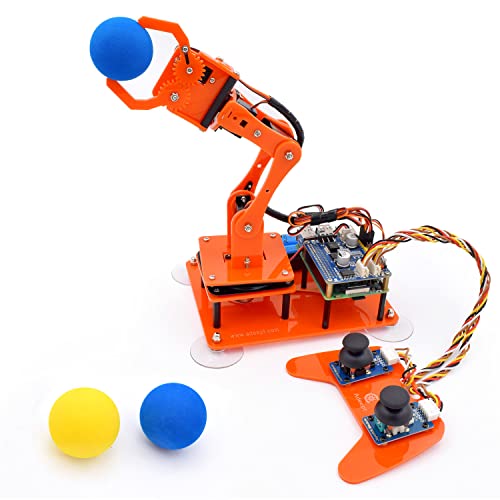
The Orange variant offers the same educational design as the black version with distinct aesthetics and identical functional goals: learning to code, assemble, and program a 5-DOF arm powered by Raspberry Pi platforms. Students and hobbyists can utilize the dual-joystick gamepad setup to control motion and leverage a web-based interface for remote command execution. The Python-based tutorials and PDF materials support structured learning paths from beginner to intermediate levels.
Robotic Arm with Arduino 5DOF — LewanSoul (Starter Kit)

This LewanSoul 5DOF Arduino-based arm emphasizes open-source learning. Built on the Atmega328 platform, it supports Arduino programming and comes with tutorials and development examples to help users design and test robotic hand projects. Additional hardware expansions, such as a Bluetooth module and various sensors, enable real-time control and experimentation with pose, sensing, and small-scale automation. The modular design supports app control and offline action editing through knob controls.
Robotic Arm with Arduino 5DOF — LewanSoul (Standard Kit)

The LewanSoul Standard Kit continues the Arduino-based approach, focusing on 5DOF control with open-source software and a rich set of expansion ports for sensors. It includes a six-channel knob controller and a Bluetooth option to extend interactive learning. With Arduino compatibility and online tutorials, users can broaden their projects from basic movements to more complex actions like sequence programming and data logging.
LewanSoul 6DOF LeArm Desktop Robotic Arm
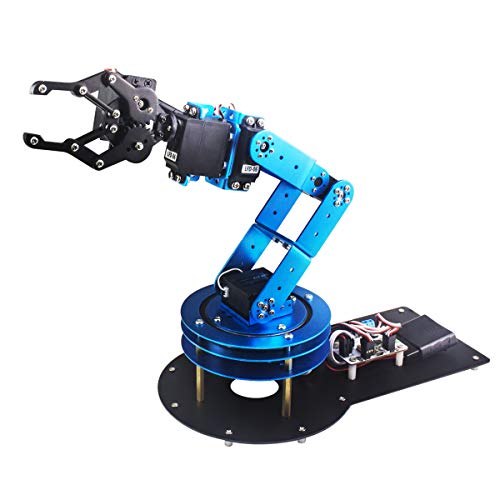
LeArm provides six high-quality digital servos for desktop robotics projects, enabling remote control, object manipulation, and graphical programming. While it advertises 6DOF, its design supports hands-on learning of multi-axis motion, servo integration, and kit-based experimentation. The metal construction and anti-stall protections help extend hardware longevity, making it a sturdy option for more advanced practice and demonstrations in classrooms or makerspaces.
Hiwonder-xArm1S 6DOF Robotic Arm
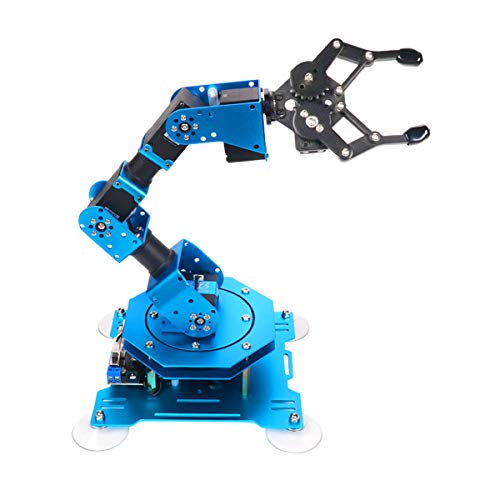
Hiwonder-xArm1S is a high-quality desktop robot arm designed for remote control, custom actions, and graphical programming. It features six high-precision intelligent servos with feedback, enabling reliable grasping tasks and more ambitious automation projects. The aluminum alloy frame contributes to durability and stability, while the included software and tutorials support recovery of action sequences and controller-based testing for researchers and students alike.
FREENOVE Robot Arm Kit for Raspberry Pi

FREENOVE’s robot arm kit targets Raspberry Pi users with clamping and drawing modes, offering Python-based coding and app control to drive motion. The kit supports Raspberry Pi 5 / 4B / 3B+ / 3B / 3A+ and notes additional compatibility with other Raspberry Pi variants with potential extra parts. It provides a structured learning path, detailed tutorials, and code samples to illuminate control logic, kinematics, and motion planning for beginners and intermediate builders.
LewanSoul ArmPi Mini — Raspberry Pi Open Source Arm

ArmPi Mini combines a smart robotic arm with a Raspberry Pi-based vision system. It features a HD camera and OpenCV compatibility for AI-enabled applications such as target recognition, color sorting, and tracking. The Raspberry Pi 5/4B-compatible hat simplifies access to sensors and processing power, supporting Python programming and AI experiments in a compact, educational package that blends vision and manipulation tasks for learners and hobbyists.
Buying Guide: Key Considerations For Choosing A 5 Axis (5DOF) Robotic Arm
- Compatibility: Confirm that the arm supports your main development platform (Raspberry Pi, Arduino, PC). Look for official tutorials and community examples for Python or Arduino sketches.
- Control Methods: Consider how you prefer to interact with the arm. Gamepad control, web GUIs, app interfaces, and autonomous scripting are common options. Some kits include off-board controllers or Bluetooth/Wi-Fi modules.
- Motor Quality and Reach: Check servo quality, torque, repeatability, and the arm’s reach. Higher torque helps with heavier payloads and steadier motion, particularly for drawing or gripping tasks.
- Open Source and Tutorials: Open-source code, tutorials, and community projects accelerate learning. Look for well-documented example projects to study kinematics, control loops, and sensor integration.
- Sensor and Expansion Ports: Sensor support (ultrasonic, accelerometers, cameras) expands capabilities. Ports for ESP32, Bluetooth, or other microcontrollers enable secondary development and experimentation.
- Build Quality and Durability: Metal frames and robust joints reduce wear and improve stability during operation. Anti-stall protections and gear durability contribute to longer lifespans during learning sessions.
- Upgrade Path: Some kits offer easier upgrade paths to higher DOF configurations or additional peripherals. Consider future expansion plans if you anticipate more complex projects.
- Software Ecosystem: Python-friendly APIs, OpenCV integration for vision tasks, and compatibility with common IDEs impact how quickly you can prototype ideas.
- Bundle Content: Look for included tutorials, sample projects, microcontroller boards, and expansion modules. A well-rounded bundle can save time when starting.
- Budget and Space: Robotic arms vary in cost and footprint. Ensure your workspace accommodates the kit, power needs, and any required peripherals.
In sum, the best 5-axis arms for learners balance accessible hardware, clear software support, and varied control options. They enable practical demonstrations of robotics concepts—from basic pick-and-place to AI-driven vision-assisted manipulation—within a beginner-friendly ecosystem.
Add a Comment