Direct answer: 3000 PSI scuba tanks are widely used for standard air fills and compact dives, offering reliable air capacity and compatibility with common regulators. This guide highlights five solid choices suited for different types of divers—from full-size aluminum tanks for saltwater adventures to compact mini-tanks for easy transport. Best for recreational divers seeking dependable capacity, better for travel-friendly options, and choose this if you need DIN/Yoke compatibility.
- Best for full-size primary dives: Cyl-Tec S80 (80 cu ft) Aluminum Scuba Tank
- Best for all environments: Catalina Cylinders 80 cf Aluminum Tank
- Best ultra-portable option: UNAROWHALS Mini Scuba Tank 1L
- Best value with easy valve conversion: Sea Elite Cyl-Tec Aluminum 80
- Best for moderate-depth dives requiring 3000 psi: TUDIVING 11.1L Scuba Tank
| Product | Capacity & Pressure | Valve | Notes |
|---|---|---|---|
| Cyl-Tec S80 | 80 cu ft @ 3000 PSI | Convertible DIN/Yoke | Durable aluminum; saltwater-ready |
| Catalina 80 cf Aluminum | 80 cf @ 3000 PSI | SSV-C-48P Valve | DOT/TC certified; ready to fill (empty) |
| UNAROWHALS Mini 1L | ~7 cf @ 3000 PSI | Standard connectors | Lightweight, high portability |
| Sea Elite Cyl-Tec Aluminum 80 | 80 cf @ 3000 PSI | Yoke/DIN conversion | DOT/TC certified; ships empty |
| TUDIVING 11.1L | 11.1 L / 80 cf @ 3000 PSI | Includes valve; M18 thread | ISO CE certified; not DOT |
Cyl-Tec S80 (80 cu ft) Aluminum Scuba Tank

Capacity and pressure: 80 cu ft at 3000 PSI (11.1 L). Valve: Convertible DIN and Yoke with removable DIN insert for broad regulator compatibility. Build: Aluminum construction offers corrosion resistance for saltwater use. This tank is ideal for divers who want a standard air capacity with flexible regulator options, especially in saltwater environments. Best for divers who need compatibility with both DIN and Yoke regulators.
Caution: Ensure proper inspection and compliance with local filling stations; the tank is shipped empty and needs filling before use. Best for: recreational divers who frequently switch regulators or dive in various locations.
Catalina Cylinders 80 cf Aluminum Tank
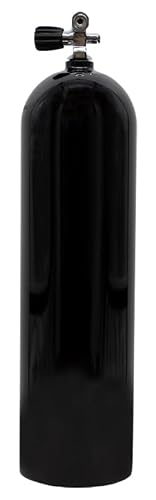
Capacity and pressure: 80 cu ft at 3000 PSI. Valve: Universal SSV-C-48P valve. Certification: DOT/TC certified; shipping is empty as required by federal law. Best for: divers who want a larger air space and a straightforward fill process in compliant stations. Limitation: installation and visual inspection steps are required by filling stations before use.
UNAROWHALS Mini Scuba Tank 1L

Capacity and pressure: 1 L tank with 3000 PSI, providing roughly 15–20 minutes of dive time depending on depth and breathing rate. Valve: Includes an extended 30-inch expandable pressure gauge for easy monitoring. Certification: DOT and CE-EN250 certified for safety. Best for: travelers and snorkelers needing ultra-portable air supplies or backup air for shortExplorations. Caution: not pre-inflated; must be inflated at a shop or with a high-pressure compressor before use.
TUDIVING-11.1L Scuba Tank

Capacity and pressure: 11.1 L (80 cu ft) at 3000 PSI. Valve: M18*1.5 thread included; cylinder is ISO CE certified (not DOT). Best for: divers who want a large-capacity aluminum tank with a standard 3000 PSI rating. Limitation: not DOT certified, which may affect fill availability at some stations.
Sea Elite Cyl-Tec Aluminum 80 Scuba Tank Brushed

Capacity and pressure: 80 cf at 3000 PSI (207 bar). Valve: Pro-style valve with easy DIN/Yoke conversion. Certification: DOT/TC certified; ships empty as required by law. Best for: divers who prioritize robust construction with simple valve conversion and legal assurance. Limitation: must be filled at a compliant station after purchasing.
Buying Guide
What matters most when choosing a 3000 PSI scuba tank?
Capacity vs. weight: Larger tanks hold more air but weigh more. Consider your dive duration, depth, and travel needs. Aluminum tanks offer corrosion resistance and lighter handling in saltwater, while steel is heavier but durable.
Valve compatibility
DIN vs Yoke: If you have regulators that use DIN or Yoke interfaces, choose a tank with a convertible valve or confirm compatibility with your regulator. A removable DIN insert increases flexibility.
Certification and legality
DOT/TC certification ensures regulatory compliance in the United States. Some tanks offer CE or ISO certifications but may not be DOT compliant, affecting where they can be filled.
Shipping, filling, and inspection
Tanks ship empty and require a visual inspection or valve installation at a cylinder filling station. Regular visual inspections are essential for safety and compliance. Always inflate at a reputable facility.
Portability and use cases
Portable mini tanks are ideal for snorkelers, travel, or as backup air that can be carried easily. Full-size 80 cu ft tanks are better for longer recreational dives or mixed-gas setups when legal and safe.
Frequently Asked Questions
- What does 3000 PSI mean for scuba tanks?
It indicates the maximum working pressure. The tank capacity (in cubic feet) determines how much air is available at that pressure.
- Are all 80 cf tanks DOT certified?
No. Some models may be DOT/TC certified, while others may be CE or ISO certified and not DOT compliant.
- Can I use a DIN regulator with a Yoke tank?
Yes, if the tank has a convertible valve or you use a removable DIN insert.
- Is a smaller 1 L tank sufficient for recreational dives?
For short or backup air needs and portability, a 1 L tank can work, but it provides far less air than an 80 cf tank and requires more frequent filling.
- Why might a tank not be DOT certified?
Some manufacturers prioritize CE/ISO standards or different market regulations, which can affect fill availability in the U.S.
- Should I choose aluminum or carbon fiber for 3000 PSI tanks?
Aluminum is common, durable, and corrosion-resistant for saltwater use. Carbon fiber is lighter and strong but typically more expensive and not always DOT certified.
Add a Comment