Answering the right questions about 30-plate heat exchangers helps buyers choose reliable, efficient models for floor heating, water heating, snow melt, and industrial cooling. This guide highlights five strong options and who they are best for, based on construction, capacity, and design features. It’s ideal for contractors, installers, or homeowners evaluating compact, high-efficiency heat exchangers. The summary table below compares key specs at a glance.
| Product | Plate Count | Approximate BTU Range | Key Benefit |
|---|---|---|---|
| 30 | 250,000 – 330,000 BTU/h | High-quality 316L with copper brazing; easy hookup | |
| 30 | 260,000 – 360,000 BTU/h | Asymmetric plate design for efficient heat transfer | |
| 30 | 363,000 BTU/h (approx.) | Fish-bone plate design reduces secondary pressure drop | |
| 30 | 200,000 – 280,000 BTU/h | Compact size with strong materials; easy installation | |
| 30 | 270,000 – 380,000 BTU/h | High capacity for larger or multiple zones |
Notes: All listed products use 316L stainless steel plates with copper brazing, designed for high temperature and pressure, and are suitable for floor heating, radiant systems, snow melting, or water heating applications. Images and manufacturer details are taken from the product listings for reference.
AB Plate Heat Exchanger, 4″x12″ (30 Plates)

Best for: Small to mid-sized hydronic systems requiring robust performance with straightforward connections. The unit uses 316L stainless steel with copper brazing at the edges for rigidity and leakage resistance. The 4″x12″ footprint makes it a solid choice for spaces with limited clearance.
- Material: 316L stainless steel plates; copper brazed at edges
- Capacity: 250,000 – 330,000 BTU/h
- Ports: 1″ MPT
Caution: Copper-brazed joints can be sensitive to extreme thermal cycling; ensure compatible pump and fluid protections to minimize thermal stress. Best for floor heating, domestic hot water, or snow-melt applications where space is a constraint.
VEVOR Brazed Plate Heat Exchanger, 5″x12″ (30 Plates)

Best for: Larger residential or light commercial heating and cooling tasks needing higher BTU output and efficient heat transfer. The 5″x12″ plate size supports higher capacity and robust flow performance.
- Material: 316L stainless steel with copper brazing
- Capacity: 260,000 – 360,000 BTU/h
- Pattern: Asymmetrical herringbone for turbulence
Limitation: Higher flow and heat transfer may require appropriately sized pumps to avoid excessive pressure drop. Generally suited for floor heating and water heating duties with moderate to high loads.
ALECOIL 4″x12″ 30 Plates Heat Exchanger

Best for: Applications requiring strong heat transfer with reduced secondary-side pressure drop. The asymmetric fish bone plate design enhances turbulence, increasing efficiency and enabling smaller pumps in some setups.
- Material: 316L stainless steel; copper brazed
- Capacity: 363,000 BTU/h
- Ports: 1″ MPT
Limitation: The higher capacity can demand careful system design to balance flow and temperature across both media circuits.
AB Plate Heat Exchanger, 5″x12″ (30 Plates)
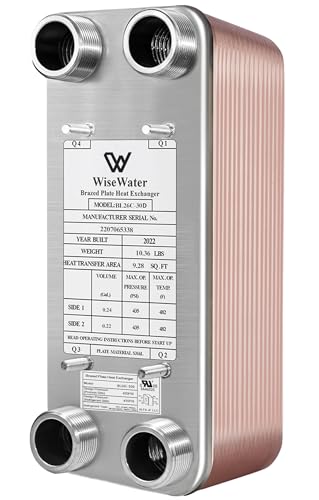
Best for: High-capacity hydronic systems that need efficient heat transfer across multiple zones or large-area radiant floor installations. The 5″x12″ plate size offers a robust balance of surface area and flow capacity.
- Material: 316L stainless steel plates; copper brazed
- Capacity: 270,000 – 380,000 BTU/h
- Ports: 1 1/4″ MPT
Limitation: The larger port size means slightly more space is required for installation; ensure mounting and piping clearance are sufficient.
Buying Guide
What should I consider when choosing a 30-plate heat exchanger?
Key factors include material quality, plate geometry, and connection size. Look for 316L stainless steel plates with copper brazing for durability and leak resistance. Consider plate patterns (such as fish-bone or herringbone) that influence turbulence and heat transfer efficiency. Ensure the port sizes (MPT) fit your existing piping and pumps.
How to match BTU capacity to my system?
Estimate the heating or cooling load of your application. Choose a unit with a BTU/h rating that comfortably exceeds the expected load to avoid underperformance and excessive pump run times. Consider room for future expansion or multi-zone heating.
What installation considerations matter?
Check space for the unit footprint, column height, and accessible connections. Ensure compatible circulator pumps and matching valve arrangements. Plan for easy maintenance, such as de-airing and cleaning, and consider a brazed unit’s serviceability limits in case of leak concerns.
Are there any safety or maintenance notes?
Maintain fluid compatibility and monitor for signs of leakage at joints. Use appropriate anti-corrosion strategies and ensure proper ventilation around heating equipment. Routine inspection of copper braze joints helps prevent long-term issues in high-temperature environments.
Which model is best for my scenario?
Choose based on system size, required flow, and space. For compact spaces, the 4″x12″ AB model provides solid performance with straightforward installation. For higher loads, the 5″x12″ VEVOR or AB units deliver greater BTU/h capacity. If minimizing pressure drop on the secondary side is critical, models with the fish-bone design (like ALECOIL) may be advantageous.
What about price and warranties?
Prices vary by capacity and size, but all listed models emphasize robust materials and brazing quality. Warranties are not specified here; review product pages for terms and ensure coverage aligns with your project expectations.
Practical checklist
- Confirm plate count and BTU/h capacity meet your load
- Verify inlet/outlet sizes match piping and pumps
- Assess space for installation and service access
- Check fluid compatibility with materials (water, glycol, etc.)
- Plan for system pressure and temperature ranges
Frequently Asked Questions
- What is a 30-plate heat exchanger used for? It transfers heat between two fluid streams in heating, cooling, or snow-melt systems with high efficiency due to large surface area.
- Why choose copper-brazed, stainless-steel plates? Copper brazing provides strong joints; stainless steel offers durability and corrosion resistance for hot, pressurized fluids.
- How many plates should I need for radiant floor heating? A 30-plate unit is common for mid-sized radiant systems, but exact needs depend on flow rate, water temperature, and loop design.
- Can I use these exchangers for beer chilling or other cooling tasks? Yes, some models support cooling duties when paired with appropriate fluids and flow management.
- Are there installation risks with high BTU models? Higher BTU units require properly sized pumps and correct piping to avoid excessive pressure drops and thermal stress.
- Do these units require electricity? The heat transfer occurs via conduction between fluids; some efficiency claims relate to reduced pump energy usage, but electrical needs depend on your system configuration.
Add a Comment