If you’re shopping for a 30-gallon air compressor tank, you need reliable storage that maintains steady pressure and fits your workspace. This guide highlights five solid options ideal for garages, workshops, and light construction. Each product is evaluated for best-use scenarios, with clear pros, limits, and who should buy. The list helps you compare tanks by capacity, durability, and compatibility with common compressors.
| Product | Brand | Capacity | Max PSI | Best For |
|---|---|---|---|---|
| Global Industrial Horizontal Air Receiver Surge Tank | Global Industrial | 30 Gallon | 175 | Heavy use in a shop with multiple tools |
| Albott 13HP Gas Air Compressor 30 Gallon | Albott | 30 Gallon | 180 | High-flow needs with portable, gas-powered unit |
| HPDMC 30 Gallon Industrial Receiver Vertical Tank | HPDMC | 30 Gallon | 200 | Compact footprint in smaller spaces |
| Campbell Hausfeld 30 Gallon Horizontal | Campbell Hausfeld | 30 Gallon | 135 | Budget-friendly, general shop use |
| VEVOR 15HP Gas Powered 30 Gallon Tank | VEVOR | 30 Gallon | 115 | Heavy-duty portable gas-powered option |
Global Industrial Horizontal Air Receiver Surge Tank

Best for: Shops needing a robust, corrosion-resistant tank with a high maximum pressure. This 30-gallon unit is designed for durable, long-term storage and supports multiple tools. The blue powder coat finish helps resist corrosion in humid workshop environments. Data shows an ASME-tested tank capable of withstanding up to 175 PSI, suitable for typical workshop air systems.
Why selected: It provides a straightforward, large-capacity solution with durable construction and standard NPT ports, simplifying integration into existing plumbing. This tank is a solid baseline for steady air supply in medium-duty settings.
Caution: Verify compatible fittings and ensure the unit’s NPT ports match your system’s connections to avoid leaks.
Albott 13HP Gas Air Compressor 30 Gallon
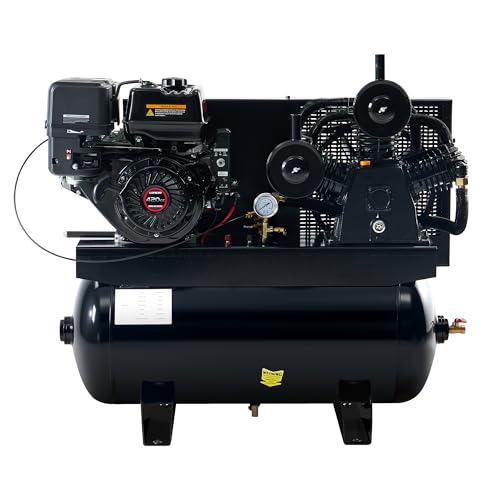
Best for: Users needing a portable, gas-powered unit with ample air storage for on-site tasks and higher CFM needs. It features a 13 HP gasoline engine and a 30-gallon ASME-certified tank, supporting air delivery up to 18 CFM at 90 PSI. The large sight glass aids pump and oil checks, offering quick monitoring during operation.
Why selected: The combination of a robust pump, durable cast-iron components, and a sizable tank makes it suitable for frequent use in semi-professional environments where mobility matters.
Caution: Gas-powered units require proper ventilation and fuel handling; check local regulations for storage and operation in enclosed spaces.
HPDMC 30 Gallon Industrial Receiver Vertical Tank

Best for: Small workshops with limited floor space that still need significant air storage. This vertical tank can fit in tighter layouts while providing up to 200 PSI maximum pressure and ASME certification. The vertical design helps minimize footprint and can be easier to access for drain and maintenance tasks.
Why selected: Its vertical form factor minimizes space requirements, making it a strong choice for organized shop layouts where floor area is a premium.
Caution: Confirm surrounding area clearance and mountings to ensure safe operation in a vertical orientation with vibration from adjacent equipment.
Campbell Hausfeld 30 Gallon Horizontal

Best for: Builders and hobbyists seeking a reliable, budget-friendly option for general air tool use. The 30-gallon horizontal tank pairs with a 3.7 HP motor to deliver steady airflow for sanding, spraying, and nailers. It uses a two-cylinder single-stage pump and is oil-lubricated for longer service life.
Why selected: It offers essential performance at a practical price point, with straightforward maintenance features that suit casual to mid-range shop tasks.
Caution: Oil-lubricated systems require regular oil checks and changes to maintain optimal performance and longevity.
VEVOR 15HP Gas Powered 30 Gallon Tank

Best for: Heavy-duty, gas-powered needs in larger shops or on construction sites where portability and high flow matter. The unit offers a 30-gallon tank and a 15 HP gas engine providing up to 33 CFM at 115 PSI. Mobility is aided by wheels, making it suitable for on-site tasks.
Why selected: It combines high air delivery with substantial storage, making it apt for continuous tool operation without frequent recharging or motor cycling.
Caution: Gas-powered units require proper ventilation and adherence to safety guidelines for fuel storage and exhaust in work areas.
Buying Guide: 30 Gallon Air Receiver Tanks
- Capacity and pressure: Look for a 30-gallon tank rated for at least 135–200 PSI to handle typical shop tools without frequent cycling.
- Tank material and finish: Steel tanks with corrosion-resistant coatings extend life in humid shops; ASME certification ensures safety under pressure.
- Orientation and footprint: Horizontal tanks save width, vertical tanks save floor space; measure your workspace to avoid clearance issues.
- Motor type and drive: Gas-powered units deliver portability, while electric motors offer cleaner operation and easier setup in indoor spaces. Consider maintenance needs and fuel availability.
- Outlets and ports: Check for NPT ports, drain valves, and tank outlets that fit your existing equipment. Ensure compatibility with your compressor’s connectors.
- Maintenance: Oil-lubricated pumps require oil checks and changes; oil-free designs reduce maintenance but may produce more heat under heavy use.
- Noise and vibration: Quieter models and those with vibration dampening improve comfort in home garages and shared spaces.
- Mobility and setup: Wheels and handles are helpful for moving units; consider whether you need a portable model for outdoor tasks.
Frequently Asked Questions
- What is the typical use for a 30-gallon air receiver?
Answer: It serves as a reserve of compressed air to smooth out demand from tools and reduce motor cycling. - Do I need ASME certification for a shop air tank?
Answer: ASME certification confirms the tank meets safety standards for pressurized vessels and is generally recommended. - Is a vertical or horizontal 30-gallon tank better for small spaces?
Answer: A vertical tank often fits tighter spaces, while a horizontal tank can be easier to integrate with existing layout. - What maintenance does a gas-powered air compressor tank require?
Answer: Regular inspection of fittings, oil checks for the engine, and ensuring proper ventilation for exhaust and fuel storage. - What should I consider when selecting max PSI?
Answer: Choose a unit with a max PSI compatible with your tools’ requirements and ensure the compressor can sustain it without overheating. - Can I mix 30-gallon tanks from different brands?
Answer: It’s possible, but ensure matching inlet/outlet sizes, valves, and safety ratings to prevent compatibility issues.
Add a Comment