Answering buyers who need reliable, compact, and energy-efficient rotary screw air compressors, this guide highlights five strong 3 HP–20 HP models suited for small to mid-size applications. These selections emphasize portability, continuous-duty performance, integrated features, and energy efficiency. Ideal buyers include hobbyists expanding to light industrial setups, auto repair shops, CNC shops, and auto-body facilities seeking clean, dry compressed air without complex retrofits. The following table summarizes key choices to weigh at a glance.
| Product | Best For | Key Benefit | Notes |
|---|---|---|---|
| MechMaxx M20AC230 | Mid-size shops | High-start torque, robust airend | 230V 3-Phase, 78 CFM, 116 PSI |
| HPDAVV DAVV 20HP | Flexible power setup | Variable speed drive for efficiency | 208-230V 1ph/3ph, 81 CFM, 115 PSI |
| HPDAVV All-In-One 15HP | Compact integrated systems | Tank and dryer integrated | 56 CFM, 125 PSI, 230V |
| HPDAVV VSD 7.5HP | Small shops with variable demand | Energy saving, flexible input | Up to 25 CFM, 150 PSI |
| MechMaxx M10AC460 | Heavy-duty 3-phase environments | High-performance motor, durable build | 460V 3-Phase, 32 CFM |
MechMaxx 20HP Rotary Screw Air Compressor – 78 CFM
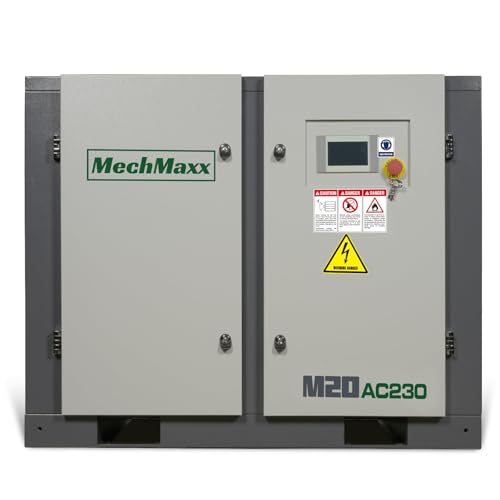
Best for: Medium-volume workshops needing robust performance and long service life. This model combines a high-performance motor with IP54 protection and a dust-proof F insulation grade, ensuring reliability in challenging environments. SKF bearings support durability under continuous use, while an advanced airend design minimizes manufacturing tolerances to micron levels, enhancing sustained performance.
Why chosen: The machine’s oil-gas separation system keeps oil content below 3 ppm in the discharge air, supporting cleaner output suitable for sensitive tooling and finishes. The combination of high starting torque and heat resistance makes it a strong all-around option for sustained operations.
Limitations: The 230V 3-Phase setup requires appropriate electrical infrastructure. Ensure adequate space for service access and ventilation to maintain optimal cooling.
DAVV Rotary Screw Air Compressor, 20HP – 81 CFM
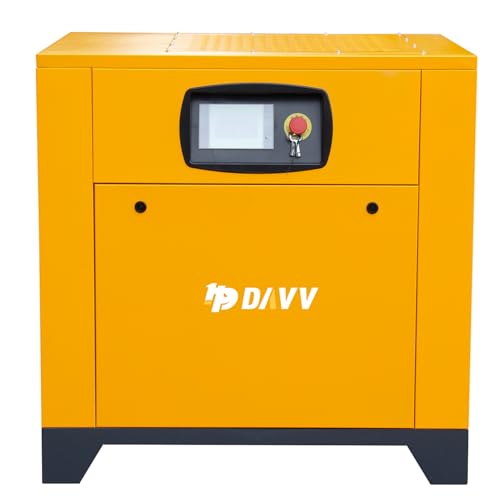
Best for: Shops needing flexible power options and intelligent control. The DAVV 20HP unit offers a variable speed drive with a PLC for scheduling and operation, adapting to variable demand without sacrificing pressure stability.
Why chosen: The compressor supports 208-230V input in both single and three-phase configurations, delivering 81 CFM at up to 115 PSI. It is designed for long service life in industrial environments and suits operations with fluctuating air demand.
Limitations: Variable speed systems can be more complex to troubleshoot than fixed-speed units; ensure operator familiarity or available technical support for fine-tuning performance.
HPDAVV All-In-One Rotary Screw, 15 HP

Best for: Auto body shops, manufacturing lines, or spaces that benefit from an integrated dryer and receiver tank. This model consolidates essential components into a single footprint, reducing installation complexity and pipework.
Why chosen: The integrated air dryer and ASME receiver deliver clean, dry air at 56 CFM and 125 PSI. Its belt-driven design minimizes vibration and wear, supporting continuous operation in demanding environments.
Limitations: Higher initial footprint than a bare pump; ensure the site has enough room for service and condenser cooling components integrated in one unit.
HPDAVV VSD Rotary Screw, 7.5 HP
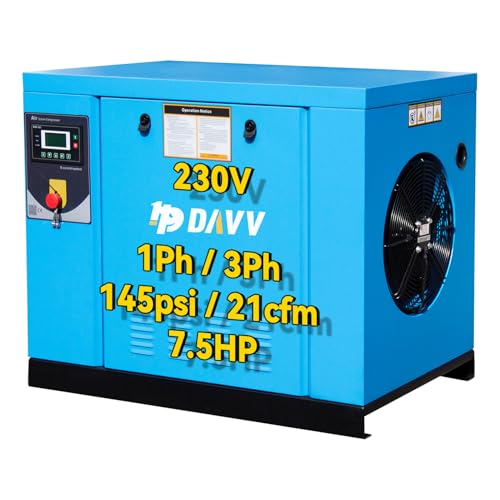
Best for: Small workshops and spaces with irregular demand needing energy savings. The VSD technology automatically adjusts motor speed to match air demand, delivering substantial energy savings while maintaining stable pressure up to 150 PSI.
Why chosen: Flexible power input (1-phase or 3-phase) makes it accessible where three-phase service is not available, while keeping industrial performance. It is quiet and reduces inrush currents for indoor use.
Limitations: While efficient for fluctuating demand, it may be less cost-effective in consistently high-demand environments compared to fixed-speed models.
MechMaxx 10HP Rotary Screw Air Compressor

Best for: Heavier workloads in smaller industrial settings requiring robust 3-phase performance. The 10HP unit balances power and reliability with a compact footprint.
Why chosen: Features mirror MechMaxx’s focus on durable components—a high-performance motor with IP54 protection, dust-proof insulation, SKF bearings, and a precision airend design that keeps oil content in discharge air under 3 ppm.
Limitations: Higher horsepower units demand adequate electrical supply and cooling; verify service clearance and ventilation at installation.
MechMaxx 20HP Rotary Screw Air Compressor – 78 CFM (460V)

Best for: Facilities with high-demand, continuous-duty air needs at higher voltage and three-phase power. An ideal fit for production lines or heavy tooling environments.
Why chosen: The same reliability features as the 230V variant—high-torque motor, advanced airend, and low oil carryover—are maintained, with emphasis on a 460V three-phase configuration for heavy workloads.
Limitations: 460V power is not common in smaller shops; plan electrical expansion and safety clearances accordingly.
Buying Guide
What to consider when choosing a 3 HP to 20 HP rotary screw air compressor
- Air demand and duty cycle: Estimate CFM needs at your typical operating PSI. Choose a model with a buffer above peak demand to avoid short cycling.
- Voltage and phase availability: Check if your facility provides 208-230V three-phase, 230V single-phase, or needs a unit with a flexible input (1P/3P).
- Integrated components: If space or piping is limited, an all-in-one unit with a dryer and receiver can reduce installation time and moisture-related issues.
- Oil separation quality: Look for systems that maintain oil content under a few ppm to ensure cleaner air for tooling and finishes.
- Noise and vibration: Consider belt-driven designs and vibration isolation if the unit will operate near work areas.
- Maintenance and accessibility: Favor models with easily reachable service points and clear documentation for routine maintenance.
- Future scalability: If you anticipate growth, select a compressor that can comfortably exceed current air demand without excessive energy use.
FAQs
- What PSI do most small shops need? Most operations fall within 90–125 PSI, but verify tool requirements to avoid undersupply or wasteful over-pressurization.
- Is a dryer necessary for most workshops? If your processes are moisture-sensitive (paint, CNC, or precision metalwork), a built-in or external dryer helps prevent rust and finish defects.
- Which energy-saving feature matters most? Variable Speed Drive (VSD) reduces energy use by matching motor speed to demand, which is beneficial for fluctuating workloads.
- Do I need 460V power for some units? Some high-capacity models use 460V 3-phase. Confirm electrical infrastructure before purchase.
- What is oil carryover and why care? Low oil carryover (under 3 ppm) means cleaner compressed air, reducing contamination of tools and products.
- How do I size the unit correctly? Start with peak CFM, then choose a unit with 20–50% more capacity to handle peak loads and startup surges.
Add a Comment