Answering the question: a 3-axis CNC mill is ideal for beginners and intermediate makers who want precise, versatile carving on wood, plastics, and softer metals. The top picks here emphasize compact desktop models with solid rigidity, easy software compatibility, and practical features for hobbyists and small workshops. The best buyers are DIYers seeking reliability, upgrade paths, and straightforward operation. Below are five standout machines with clear reasons to choose each, plus a buyer’s guide and practical FAQs.
| Product | Best For | Key Benefit |
|---|---|---|
| Genmitsu CNC 3018-PRO Router Kit | Entry-level hobbyists | GRBL control, broad software support |
| FoxAlien Masuter Pro 3-Axis | Intermediate projects | All-metal, flexible spindle options |
| LUNYEE 3018 Pro Max | Rugged build & long Z travel | All-metal frame, 500W spindle |
| Twotrees TTC450 Pro | Large-format desktop carving | High-precision Z-axis, expansion ports |
| Carvera Air Desktop CNC | Enclosed safety & quick tool changes | Enclosed design, fast tool changer |
Genmitsu CNC 3018-PRO Router Kit

The Genmitsu 3018-PRO is a popular 3-axis kit designed for beginners and educational settings. It runs on GRBL control software, widely supported by design tools like Easel and Fusion 360, with an upgraded base height for stability. The kit is suitable for plastics, soft metals like aluminum, woods, acrylics, and PCBs. It’s a strong all-around starter due to its plug-and-play assembly, accessible software ecosystem, and out-of-the-box capabilities for basic milling and engraving projects. Best for learners who want a well-supported platform and quick results.
Why this was selected: its balance of ease, community support, and broad material compatibility makes it a reliable entry point. Caution: assembly complexity can vary with user experience; follow the included guides to avoid misalignment during setup.
FoxAlien Masuter Pro 3-Axis

The FoxAlien Masuter Pro offers a rugged all-metal frame with a stable Z-axis, tuned for precision in engraving and cutting on wood, acrylic, MDF, nylon, and similar materials. It includes a robust control surface with safety-minded features like an emergency stop and accessible home buttons. The machine supports various spindle options and is adaptable for upgrades, including higher-wow spindles for deeper cuts. Best for makers who want a durable, upgradeable platform with clear expansion potential. Caution: upgrading spindles changes load and cooling needs; plan power and mounting compatibility ahead.
LUNYEE 3018 Pro Max All-Metal CNC Router

The LUNYEE 3018 Pro Max is a robust all-metal CNC router with a 500W spindle and a notably long Z-axis travel of 80 mm, designed to tackle deeper milling jobs. Its reinforced aluminum frame and 12 mm optical axis contribute to precise movement and durable performance under heavier loads. Best for users needing higher spindle power and greater Z-axis clearance to handle thicker materials. Limitation: a fully all-metal build can add weight and may require a sturdier benchtop or stand to avoid vibration during heavy cuts.
Twotrees TTC450 Pro All-Metal CNC Router

The TTC450 Pro is a larger, all-metal desktop router with a 3.5″ touch screen and expanded ports for future upgrades, including a 4th axis and laser modules. Its 18.1″ square work area (460 x 460 x 80 mm) gives room for bigger panels and components. It uses an open-source GRBL control system compatible with Fusion 360, Easel, and more. Best for makers planning more ambitious runs and multi-tool setups. Caution: the larger footprint means more work surface and bench space is needed, and setup can be more involved than entry-level models.
Carvera Air Desktop CNC Machine
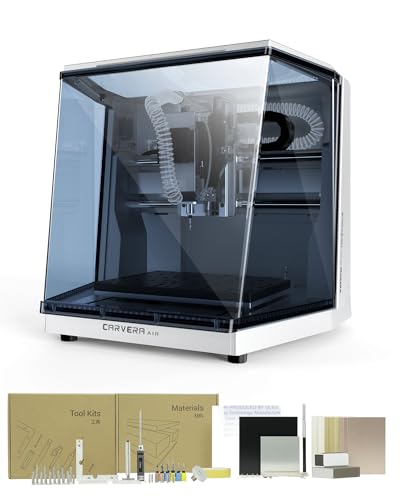
The Carvera Air is a compact, enclosed desktop CNC that emphasizes safety and ease of use. It includes Makera CAM software for straightforward workflow and a quick tool-changing system to speed up multi-step projects. Best for beginners and small studios that value a contained workspace and safer operation in a home or shared space. Caution: the enclosure design helps with safety but may limit cleanup access compared to open-frame designs.
Buying Guide: Key Considerations For A 3-Axis CNC Mill
What material will you mostly machine? If you plan to work with soft woods, plastics, and light aluminum, most 3-axis desktop mills are adequate. For engraving, look for a stable Z-axis with good repeatability. Consider spindle power: 500W or higher is beneficial for deeper or tougher cuts, but it adds weight and requires robust mounting. Do you need an enclosed workspace? Enclosures reduce dust and noise, improving safety in home workshops.
Software And Compatibility
Choose machines with widely supported control software (GRBL is common) and compatibility with popular CAD/CAM programs like Fusion 360, Carveco, and Easel. Clear upgrade paths (additional axes, spindles, laser modules) are a plus for growing projects.
Work Area And Clearance
Assess your typical workpieces. If you routinely carve large panels, opt for a larger bed and a longer Z travel. For tiny parts, a compact model with precise control is ideal.
Rigidity And Build Quality
All-metal frames typically deliver better rigidity than plastic-framed variants. Look for linear rails or robust ball-bearing guides, and verify that the frame resists deflection under load for consistent accuracy.
Safety And Practical Use
Enclosures, emergency-stop features, and dust containment are practical benefits for home users. Consider chip management and noise levels, especially if you operate in a shared or apartment environment.
Upgrade Potential
Some machines offer 4th-axis expansion, higher-power spindles, or additional ports for lasers. If you anticipate expanding capabilities, choose a model with clear upgrade paths and a supportive ecosystem.
Frequently Asked Questions
What is a 3-axis CNC mill?
A 3-axis CNC mill moves along three perpendicular axes (X, Y, Z) to carve, cut, or engrave materials with a rotating spindle. It is commonly used for wood, plastics, soft metals, and PCB work.
Is enclosure important for a desktop CNC?
Enclosures can improve safety by containing chips and dust and reducing noise, making them desirable for home workshops and shared spaces.
Which spindle power is typical for hobby CNC mills?
Most hobby-level machines use spindles in the 200–500W range, with 500W offering a balance of speed and material capability for many projects.
What software should I learn for a 3-axis CNC?
Grbl-based controllers pair well with Easy-to-use CAM tools like Easel and open-source options such as Carbide Create, as well as Fusion 360 for more complex workflows.
Can these machines mill metal?
While many can mill non-ferrous or soft metals, significantly harder metals require higher torque spindles, rigid frames, and advanced cooling that are typically beyond entry-level units.
Add a Comment