< article>
When selecting a vacuum pump for HVAC or refrigeration work, aim for models that deliver strong, reliable vacuum levels and durable construction. This guide highlights options closest to 20 CFM, prioritizing two-stage designs for faster evacuations, low oil mist, and quiet operation. It’s ideal for technicians servicing R134a, R22, R410A, and A2L refrigerants. The top picks are well-suited for professional shops and serious DIYers who need efficient, cleaner evacuations and longer service intervals.
| Product | Best For | Key Benefit | Approx. Flow (CFM) |
|---|---|---|---|
| Orion Motor Tech 14.4 CFM Vacuum Pump | Shop technicians needing deep evacuations | Two-stage design with 1.5 hp motor | 14.4 |
| VIVOHOME 3/4 HP 7.2 CFM 2-Stage | Budget projects with flammable refrigerants | Sparkless operation for A2L systems | 7.2 |
| Orion Motor Tech 9 CFM 2-Stage | Medium-size HVAC service | Good balance of flow and depth | 9 |
| VEVOR 12 CFM 1 HP Double Stage | Durable, heavy-duty daily use | Viewable oil window and anti-backflow | 12 |
| VIVOHOME 14.4 CFM 2-Stage Kit | All-in-one package with gauges | Gas ballast and leak detector integration | 14.4 |
Orion Motor Tech 14.4 CFM Vacuum Pump
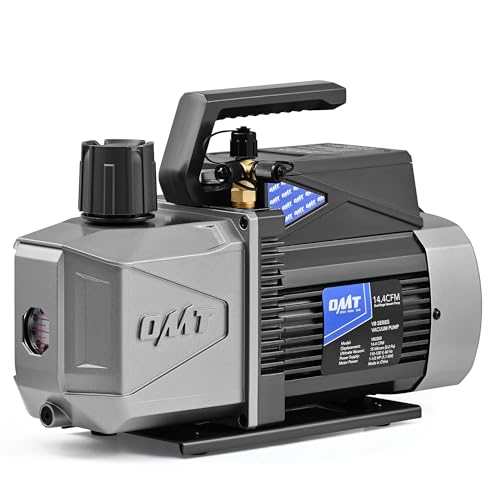
This two-stage pump provides 14.4 CFM with a 1.5 hp motor, targeting deep evacuations to about 1.5 microns. Best for technicians servicing R134a, R22, R410A, and other common refrigerants. It’s well-suited for faster evacuations in mid-to-large HVAC systems and light commercial applications. Use this when you need quick, thorough vacuuming and deeper micron-level results.
- Best for professional shops requiring deep vacuuming
- Better for high-efficiency evacuations in R134a/R410A systems
- Limitations: Oil consumption and heat buildup can occur under continuous duty; ensure adequate cooling
VIVOHOME 3/4 HP 7.2 CFM 2-Stage

This sparkless dual-stage pump is designed for A2L refrigerants like R32, R1234yf, and R454B, while still handling R410A, R134a, R22, and more. It achieves 0.2 Pa (1.5 microns) vacuum quickly in about three minutes. Best for environments with flammable refrigerants where ignition risk must be minimized. Choose this for safer operation on modern refrigerants.
- Best for flammable refrigerant systems (A2L)
- Better for quick evacuations with strong micron performance
- Limitation: Lower CFM than larger units, so may take longer on very large systems
Orion Motor Tech 2 Stage Vacuum Pump, 9 CFM

This 9 CFM two-stage pump offers a balanced solution for mid-sized HVAC tasks. It reaches near 1.5 microns and features a 3/4 hp copper motor for efficient performance. Best for technicians handling a mix of residential and light commercial AC units. Consider this when you need solid depth without stepping up to the biggest units.
- Best for mid-size service work
- Better for mixed residential/commercial tasks
- Limitation: Not as fast as 14–15 CFM units on large systems
VEVOR Vacuum Pump 12 CFM 1 HP

VEVOR’s 12 CFM, 1 HP double-stage design emphasizes durability and usability. It includes a viewable oil window and an oil drain valve for easier maintenance, reducing downtime. Best for daily shop use where reliable vacuum depth and straightforward oil management are important. Limitations can include heavier weight and a slightly higher noise profile in some setups.
- Best for heavy daily use
- Better for easy oil monitoring and draining
- Limitation: Heavier than smaller models; transport may require care
VIVOHOME 14.4 CFM 2-Stage Kit

This all-in-one kit features a 1.5 HP dual-stage pump with a gauge set and leak detector. It reaches 0.2 Pa and includes hoses and the tools needed for quick, thorough evacuations. Best for technicians who want an integrated package with monitoring capabilities. Choose this for a complete workflow from evacuation to leak testing.
- Best for comprehensive kits with gauges
- Better for integrated workflow and leak testing
- Limitation: More components mean more setup time upfront
Buying Guide: Key Considerations For A 20 CFM Class Vacuum Pump
What matters most when choosing a high-CFM vacuum pump?
- Two-Stage Design: Two-stage pumps achieve deeper vacuums more quickly than single-stage models. Look for micron-level specifications (ideally 1.5 microns or better) for reliable evacuations.
- CFM Rating: Higher CFM accelerates evacuation on larger systems. For typical mid-to-large residential or light commercial work, 9–14.4 CFM is common; the higher end reduces job time.
- Micron Vacuum Level: A micron-level vacuum (e.g., 0.2 Pa / 1.5 microns) indicates deep evacuation. Consider whether your applications require this depth for leak testing and proper refrigerant recovery.
- Oil Management: Oil mist reduction, oil viewing windows, and anti-backflow features minimize contamination and mess. An accessible drain and filter improve maintenance.
- Noise and Duty Cycle: Quieter operation (below 70 dB) and longer duty cycles reduce fatigue in busy shops. If you’ll run pumps for extended periods, check duty cycle specs and cooling features.
- Refrigerant Compatibility: Ensure compatibility with your refrigerants, including R134a, R410A, R22, R1234yf, and A2L blends like R32. Sparkless designs are advantageous for flammable refrigerants.
- Power Source and Portability: AC-powered pumps work well in shops; cordless or portable units are beneficial for on-site work. Battery-powered options offer mobility but may limit run-time.
- Durability and Construction: Aluminum housings and copper motors provide longevity and better heat dissipation. A stable base reduces vibration during operation.
Frequently Asked Questions
- What is a two-stage vacuum pump? A two-stage pump evacuates air and condensable gases through two pumping stages, achieving deeper vacuums faster than single-stage models.
- Why is micron-level vacuum important? Micron-level vacuum ensures thorough air removal and aids accurate leak detection, which helps in refrigerant charging and system reliability.
- Can I use a 14.4 CFM pump for small modern cars? Yes, but ensure the unit depth matches the system. Some small vehicles may not require the full capacity, but the extra speed helps in busy shops.
- Are cordless pumps practical for on-site work? Cordless models provide mobility, but check run-time per charge and compatible battery ecosystems for your workflow.
- What should I monitor during operation? Oil level and mist management, intake cleanliness, noise level, and duty cycle are important for consistent performance and longevity.
- Is an integrated gauge set necessary? Gauge sets improve monitoring during evacuation and leak testing, especially for complex systems with multiple refrigerants.
Add a Comment