If you need precise delivery pressures for inert gas operations, a nitrogen regulator that can handle high input pressures and deliver stable output is essential. This guide highlights five reliable nitrogen regulators, explaining who each is best for and why it’s a good fit. Ideal buyers include HVAC professionals for purging, metalworkers doing brazing or soldering, and technicians performing leakage tests or inertization. The following summary table helps you compare key specs at a glance.
| Product | Inlet | Delivery | ||
|---|---|---|---|---|
| RX WELD Nitrogen Regulator with 0-1000 PSI | CGA580 | 0-800 PSI (adjustable) | Input up to 4000 PSI; output up to 800 PSI | HVAC purging, inertization, leakage tests |
| Flame Tech High-Pressure Piston Regulator | Inlet up to 3000 PSI | 0-3000 PSI (typical) | 0-3000 PSI | Precise control for inert gases like nitrogen/argon |
| Toolshouse Nitrogen Regulator | CGA-580 | 0-1400 PSI | Inlet up to 4000 PSI; outlet up to 1400 PSI | Single-stage simplicity for inert gases |
| Uniweld RHP800 Nitrogen Regulator | CGA580 | 0-800 PSI | Inlet up to 4000 PSI; outlet up to 800 PSI | Reliable 0-800 PSI delivery with rugged brass design |
| RX WELD Nitrogen Regulator with 0-800 PSI | CGA580 | 0-650 PSI (adjustable) | Input up to 4000 PSI; output up to 650 PSI | HVAC purging, inertization, pressure tests |
Below are five products chosen for their balance of durability, readability, and pressure control range. Each entry includes who it’s best for and a practical caveat to consider before purchasing.
RX WELD Nitrogen Regulator With 0-1000 PSI

This regulator features a CGA580 inlet, 1/4″ SAE male flare outlet, and easy-to-read 2-inch gauges with protective boots. It supports an input range up to 4000 PSI and a configurable output up to 800 PSI, with a 60-inch refrigeration hose. Best for HVAC purging, inertization, and leakage tests where a longer hose improves accessibility. A caution: ensure the 800 PSI maximum output aligns with downstream equipment to avoid over-pressurizing tubing.
Flame Tech High-Pressure Piston Regulator

The Flame Tech HPPR-IN-700-580 uses a piston design for precise stabilization of inert gases like nitrogen and argon. It features a forged brass body, a dual-scale dial, and supports up to a 0-3000 PSI inlet. Best for shops needing tight control at higher pressures. Caution: heavier, bulkier regulator may be less convenient for portable field use.
Toolshouse Nitrogen Regulator
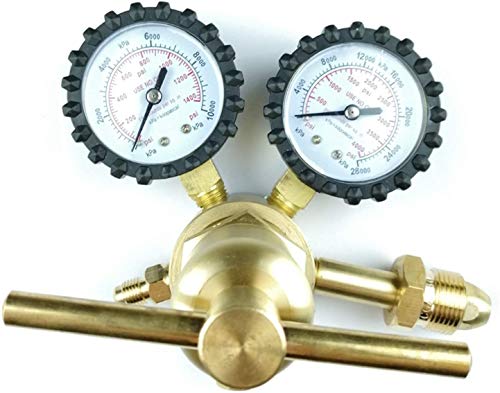
Toolshouse offers a forged brass regulator with a single-stage design and a built-in pressure overload auto-degassing device. It includes a sintered inlet filter and a rubber bumper for protection. With a 0-4000 PSI inlet and 0-1400 PSI outlet, it’s suited for inert gas applications requiring broader range. Best for technicians who value visible higher-pressure readings. Limitation: the larger range may require careful adjustment to avoid overshoot.
Uniweld RHP800 Nitrogen Regulator

The Uniweld RHP800 delivers 0-800 PSI with a CGA580 inlet and 1/4″ flare outlet. It uses a durable brass piston-diaphragm design and includes a self-re-seating relief valve. Best for steady, moderate-pressure needs and long-term reliability in inert gas tasks. Caution: it does not include downstream protection beyond the self-seating relief feature, so monitor system integrity carefully.
RX WELD Nitrogen Regulator 0-600 PSI

This regulator uses a CGA580 inlet with a 1/4″ flare outlet and protective gauges boots. It supports up to 4000 PSI input while delivering up to 450 PSI (often read as 600 PSI on display but rated for 450 PSI output). It’s suitable for HVAC purging and leak tests where moderate delivery is sufficient. Caution: display can appear to indicate higher output than the actual safe operating limit—verify downstream compatibility.
Buying Guide
What to consider when choosing a nitrogen regulator for 1000 PSI tasks:
- Inlet and outlet connections: Ensure CGA580 inlet and 1/4″ flare outlet are compatible with your gas cylinders and hoses.
- Pressure range: Match the regulator’s delivery range to your expected operations (0-800 PSI, 0-1400 PSI, or higher). Consider future use at higher pressures.
- Regulator design: Single-stage vs. piston-regulated designs affect stability and response time. Piston regulators tend to offer steadier control for inert gases at higher pressures.
- Readability and durability: Large dual gauges with protective boots improve readability and longevity in workshop conditions.
- Protection features: Look for self-sealing relief valves and degassing features to prevent overpressure events and to safeguard downstream equipment.
- Hose length and accessibility: Longer hoses support harder-to-reach purging or inertization points, but ensure they do not introduce excessive pressure loss or sag.
Frequently Asked Questions
- What is the typical maximum safe delivery pressure for most nitrogen regulators?
Many regulators are rated for up to 800 PSI to 1400 PSI on the outlet, with higher inlet pressures up to 4000 PSI. Always verify the downstream system’s rating. - Do I need a high-precision regulator for HVAC purging?
Yes, a regulator with stable, readable gauges and a safe, consistent output (often 0-800 PSI or 0-600 PSI) is ideal for purging and inertization tasks. - Is a two-inch gauge easier to read than a larger gauge?
Two-inch gauges offer good visibility at a glance in typical workshop lighting, but larger gauges (e.g., 2.5 inches) can improve precision checks at higher pressures. - What safety features should I look for in a nitrogen regulator?
Protective gauge boots, degassing devices, and self-reseating relief valves help prevent overpressure and protect equipment. - Can I use a single regulator for nitrogen and argon?
Some regulators are designed for multiple inert gases with compatible connections; check the regulator’s documentation and required adapters for different gases. - Should I avoid a regulator with a longer hose?
Long hoses improve reach but may cause greater pressure drop; balance length with required pressure stability for your applications.
Add a Comment